A Spin That Never Dies express
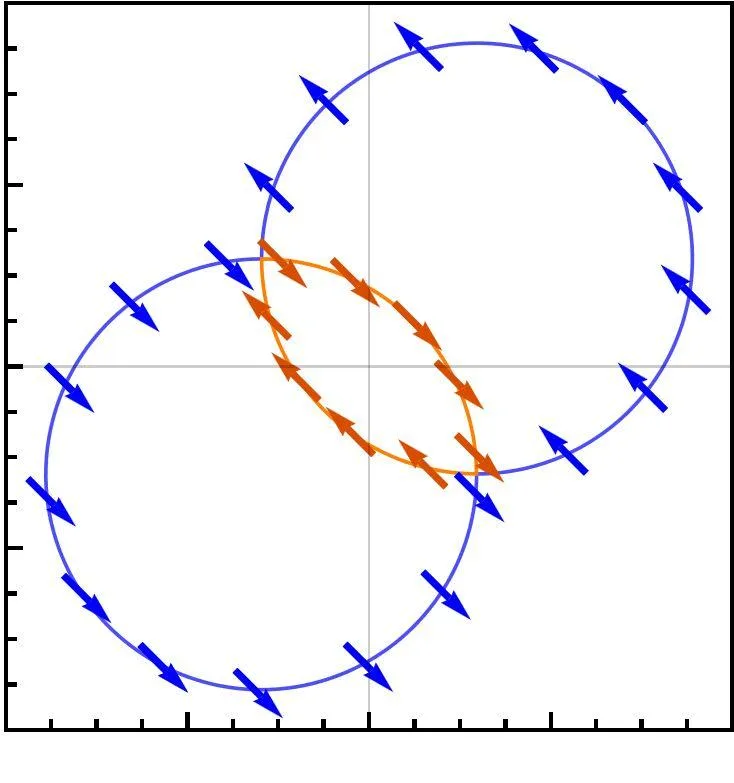
An electron is not just a tiny ball; it also spins around its own axis like a top. Under normal conditions, these tops point in random directions and quickly get knocked out of alignment. But in some materials, where spin is coupled to electron motion, an astonishing order emerges: all tops point the same way, and their direction does not depend on velocity. This state is called persistent spin texture (PST). It lives unusually long, and researchers dream of using it in future electronics.
The trouble is that directly observing this order is very difficult. Standard methods based on quantum geometry — how the electron's wave function bends in parameter space — barely work here. But the authors of the new study found a workaround. They showed that in systems with PST, only one kind of quantum geometry remains: the one tied to spin rotation. And it manifests in an unusual response to current and magnetic field.
The physicists tested their idea on two models: a two-dimensional electron gas with finely tuned Rashba and Dresselhaus interactions, and a cubic material where spin-orbit coupling imposes symmetry. In both cases, the response remained the same in direction as the chemical potential varied — a hallmark of PST. Moreover, even when adding a perturbation that breaks the exact symmetry, the qualitative picture holds.
Such nonlinear magnetotransport can be measured in the lab. This means physicists now have a long-awaited tool to find materials with long-lived spin and to assess how well they suit spintronics — electronics where information is carried not by charge but by electron spin.
Original abstract
as written by the authors arXiv:2603.04023
Persistent spin textures (PST) are special spin configurations in spin-orbit-coupled systems in which the spin polarization acquires a symmetry-enforced momentum-independent orientation, leading to exceptionally long spin lifetimes and persistent spin helices. Identifying direct experimental probes of PST, however, remains challenging because conventional quantum-geometric responses are strongly suppressed in this regime. Here, we show that PST systems isolate spin-rotation quantum geometry, which manifests through distinctive nonlinear magnetotransport responses. Using both a fine-tuned Rashba-Dresselhaus two-dimensional electron gas and a symmetry-enforced cubic spin-splitting model realizing PST, we demonstrate that PST suppresses conventional and Zeeman quantum-geometric contributions, leaving the spin-rotation quantum geometric tensor as the sole source of nonlinear magnetic-current and spin-magnetization responses. Remarkably, the nonvanishing response components exhibit identical direction-independent behavior as a function of chemical potential, providing a distinctive signature of PST. We further show that, in the Rashba-Dresselhaus two-dimensional electron gas at the PST point, these qualitative signatures remain robust even in the presence of a cubic Dresselhaus term that breaks the exact SU(2) symmetry. Our results establish nonlinear magnetotransport as an experimentally accessible probe of PST and their underlying spin-rotation quantum geometry.
Electron spin cannot be taken literally as the rotation of a ball: an electron has no size, and its 'top' is a purely quantum property that nevertheless behaves like a real angular momentum.
The idea of controlling electron spin and storing information in it sounds like a plot from 'Star Trek', where future computers run on quantum states of particles.