Magnetic texture refers to the spatial arrangement of magnetization directions within a magnetic material. In a simple ferromagnet, all magnetic moments point the same way, but in many materials — especially thin films, nanostructures, or chiral magnets — the magnetization can twist, curl, or form complex patterns. These textures are not just static curiosities; they determine how a material responds to external fields, how it stores information, and how it interacts with electrical currents.
History
The concept of magnetic domains was proposed by Pierre Weiss in 1907 to explain why ferromagnets can have zero net magnetization. The detailed study of textures, including skyrmions, gained momentum in the 1990s with advances in imaging techniques and the discovery of chiral magnets.
How it works
The texture emerges from a balance of competing energy terms: exchange interaction (which aligns neighboring moments), anisotropy (which prefers certain crystallographic directions), demagnetizing fields (which favor flux closure), and the Dzyaloshinskii–Moriya interaction (which twists moments in non-centrosymmetric crystals). The result can be smooth domain walls, swirling vortices called skyrmions, or periodic stripe patterns. These textures can be moved, created, or erased by applying magnetic fields, electric currents, or heat.
In practice
Magnetic textures are the basis of spintronics: skyrmions are being explored as bits for ultra-dense, energy-efficient data storage, and domain walls are used in racetrack memory devices.
Fun fact
Skyrmions — tiny swirling magnetic textures — can be as small as a few nanometers and are so stable that they can be moved with electric currents of only about 10⁶ A/m², far less than needed for conventional magnetic switching.
A sheet of paper left on a wet table warps and lifts its edges. No one controls that motion, but it follows the same laws as plant growth: some areas of the sheet shrink more than others, and the flat form becomes three-dimensional. Engineers have long dreamed of taming this process so that a flat blank folds itself into a desired sculpture. In the new work, that trick succeeded with accuracy down to one percent.
A magnetic vortex is like a tiny whirlpool in the sea, except that instead of water, it's magnetization that swirls. Such vortices could become memory cells in future computers, but to write and read information, you need to be able to move each vortex individually. So far, this is done crudely — shifting a whole bunch at once.
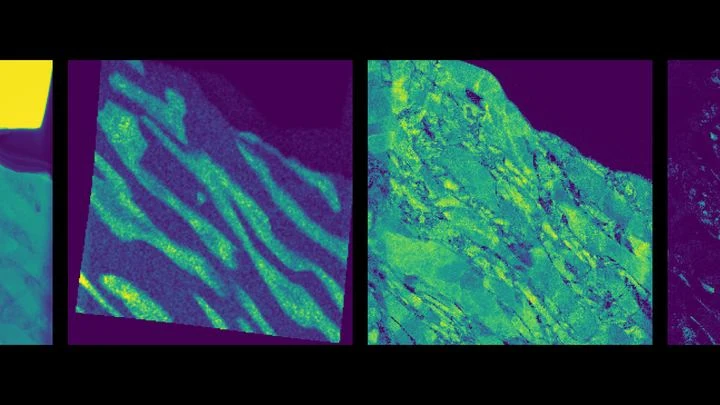
A piece of metal smaller than a millimeter, when cooled to minus 256 degrees Celsius, behaves like a kaleidoscope: in one corner, magnetic arrows align in neat rows, while in a neighboring corner, they twist into a screw. This was observed by directing a narrow X-ray beam at the sample and slowly sweeping it across the surface, like a flashlight along a dark wall.
A star's radius drops by a thousand kilometers. Not because its mass increased, but because its own magnetic field squeezed the crust like an invisible corset.
Magnetic vortices just tens of nanometers across are like tiny tornadoes frozen in metal. Called skyrmions, they are remarkably stable: hard to destroy but easy to move. That's why engineers see them as ideal 'bits' for future memory — fast, energy-efficient, and resilient.
But until now, no one knew how such a vortex is structured within the material's depth.
A thin magnetic film is like a row of toy soldiers with tiny magnetic arrows. In the flat world, thermal jostling quickly disrupts this formation — even the slightest heating destroys the order. This is the Mermin–Wagner prohibition: in two dimensions, continuous symmetry cannot survive at finite temperature.
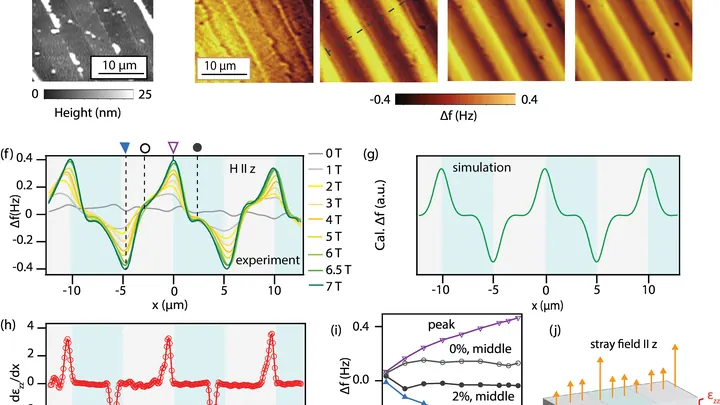
On the surface of a thin film of bismuth iron oxide, you can see neat stripes, like furrows in a plowed field. What lies beneath them has remained a mystery until now.
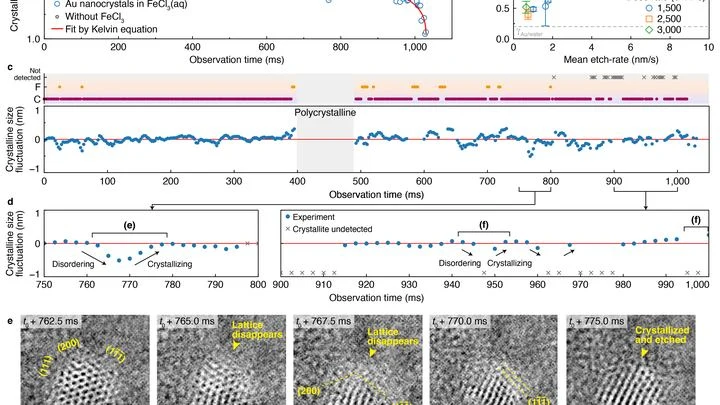
Gold nanoparticles in liquid are like tiny living creatures: they constantly change their internal structure, as if breathing. Scientists managed to peek into this process using an electron microscope that takes snapshots every millisecond, and a neural network that cleans the images from noise.
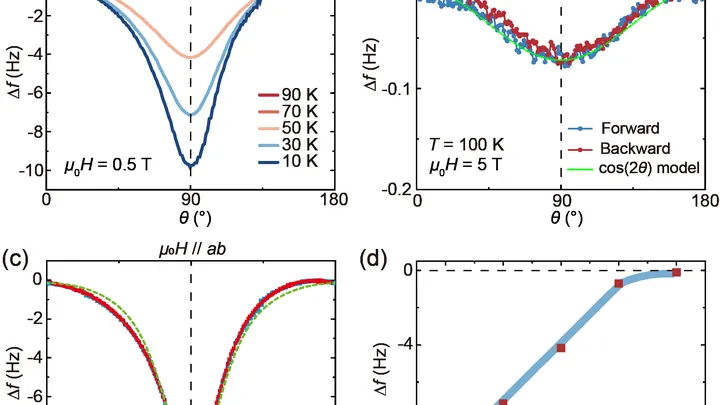
A magnet, like a compass needle, likes to point in a certain direction. But what if the material is layered, like a stack of pancakes? Scientists took just such a magnet made from a compound of chromium, germanium, and tellurium and set out to find out how stubbornly it resists having its magnetization turned.
An electron is not just a tiny ball; it also spins around its own axis like a top. Under normal conditions, these tops point in random directions and quickly get knocked out of alignment. But in some materials, where spin is coupled to electron motion, an astonishing order emerges: all tops point the same way, and their direction does not depend on velocity.
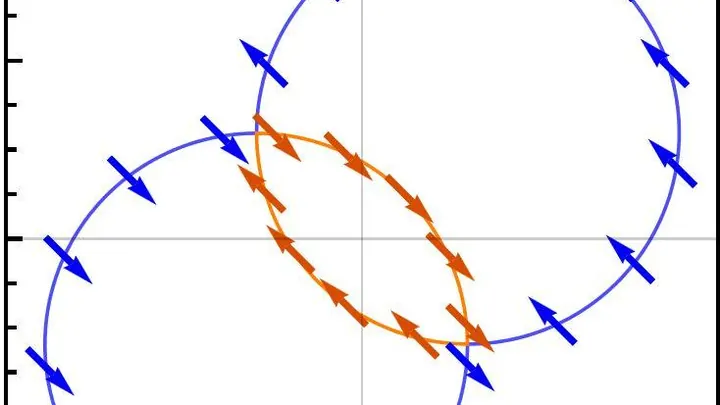
Altermagnets resemble a ballroom where couples spin in opposite directions: the hall itself is still, but inside, ordered motion seethes. Similarly, electron spins (the direction of their rotation) in these materials form intricate patterns without creating an overall magnetism.
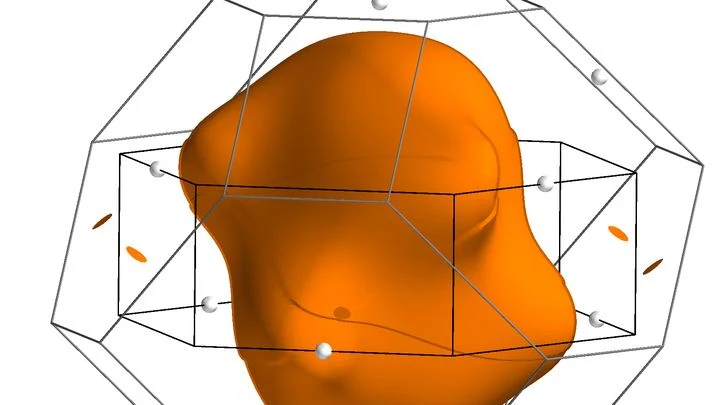
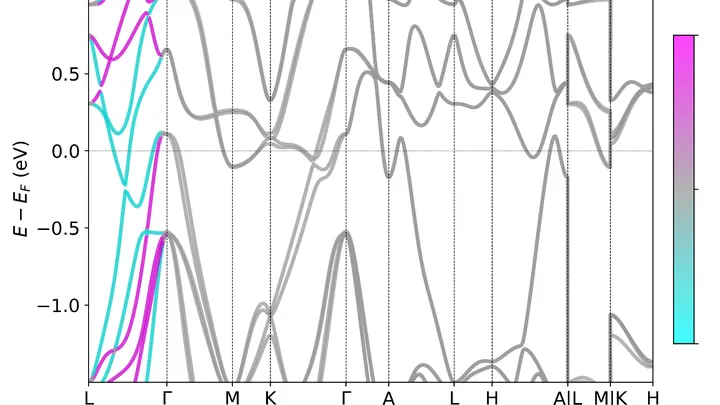
Electrons in a CrSb crystal behave like a school of fish: inside the material, they dart along their "corridors," and at the boundary with vacuum, they arrange themselves into intricate patterns. These patterns are the Fermi surface — a map of all allowed electron velocities. You can't reach out and touch it, but you can "feel" it with a magnetic field.
A piece of gold doesn't attract paperclips. But if you take a thin film of a gadolinium-gold-germanium alloy and start bending it, magnetic regions can appear. Scientists did this not with their hands, but with a beam of helium ions that penetrated the material through a patterned mask.
A nanowire is like a tiny cable: inside is a magnetic core, outside is an aluminum shell that can conduct current without resistance. But they don't get along easily: a strong magnetic field destroys superconductivity, like noise drowns out a quiet melody.
Steel is not just a piece of iron. Inside it, like in a layered pie, different structures, phases, coexist. In ultra-strong steel for cars, there are three such phases: soft ferrite, strong martensite, and ductile austenite. Medium-manganese steel owes its strength precisely to this trio.
Imagine a city map where streets are replaced by car speeds and buildings by the metal content of stars. Such a map can tell you where the center is and where the outskirts are, even without knowing exact distances. This is precisely the approach astronomers took with our Galaxy, using longitude–velocity (ℓ–v) diagrams.
The EuAuBi crystal is like a layered cake of europium, gold, and bismuth atoms. When cooled to near absolute zero, three different magnetic patterns appear in sequence, like a kaleidoscope pattern shifting with a slight turn. First, the magnetic atoms align strictly in antiphase, then they tilt slightly, and at even lower temperatures, a third order emerges.
The crystal was cooled to minus 228 degrees Celsius, and a pattern emerged on its surface, like frost on a window. But it's not moisture that draws it; it's the magnetic field: tiny iron particles suspended in a liquid settle on magnetized regions, revealing their location. That's the method the researchers used.
The pattern turned out to be two-tiered.