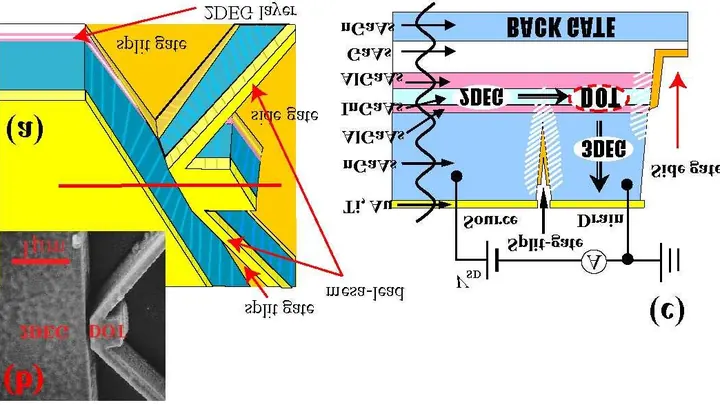
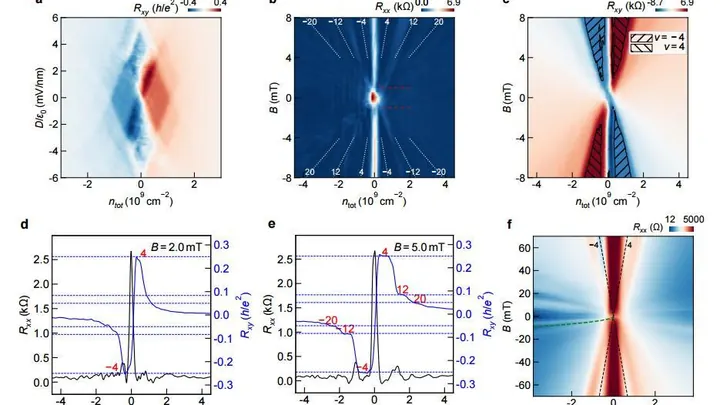
A two-dimensional electron gas (2DEG) is a system in which electrons are confined to move in a single plane, typically at the interface between two different semiconductor materials. At low temperatures and in high magnetic fields, this confinement leads to striking quantum phenomena, such as the quantum Hall effect, where the electrical conductivity becomes quantized in exact integer or fractional multiples of fundamental constants. The 2DEG is a cornerstone of condensed matter physics, providing a clean experimental platform to study quantum mechanics on a macroscopic scale.
History
The concept emerged in the 1960s–1970s with the development of semiconductor heterostructures, and the integer quantum Hall effect was discovered by Klaus von Klitzing in 1980, followed by the fractional quantum Hall effect by Daniel Tsui, Horst Störmer, and Robert Laughlin in 1982.
How it works
The confinement is achieved by sandwiching a thin layer of a semiconductor (like gallium arsenide) between layers of a wider-bandgap material (like aluminum gallium arsenide). Electrons fall into a potential well at the interface, and their motion perpendicular to the plane is quantized into discrete energy levels. At low temperatures, only the lowest of these levels is occupied, so the electrons behave as a truly two-dimensional quantum system. In a strong magnetic field, the in-plane motion also becomes quantized, forming Landau levels, which give rise to the quantum Hall effects.
In practice
2DEGs are used in high-electron-mobility transistors (HEMTs), which are key components in high-frequency amplifiers for satellite communications and radar systems, as well as in quantum Hall resistance standards for metrology.
Fun fact
In a 2DEG, electrons can form a 'Wigner crystal'—a regular lattice of electrons—when the density is low enough and the temperature is near absolute zero, a state predicted by Eugene Wigner in 1934 and observed decades later.
A layered cake of molybdenum disulfide MoS2 sits on the lab bench. It is prepared in the usual way: adhesive tape peels off the top layers to obtain a thin sample. But beneath the tape remains an invisible cavity where the atomic floors are no longer pressed together. It is there that electrons begin to behave differently than in the crystal bulk.
A thin film of zirconium nitride lies on a magnesium oxide substrate. Its thickness is two-tenths of a micron, like a spider's web, but inside it quantum life is boiling. When cooled to half a kelvin, superconductivity does not disappear all at once: it breaks up into rare islands that still hold on amid the disorder.
In an ultracold cloud of atoms cooled to near absolute zero, regions with different spin orientations emerge, like patches with different magnetization. The boundaries between them are called domain walls. Usually they are stationary, but in this experiment the walls started moving on their own.
Take two thin sheets of a semiconductor. One is saturated with free electrons, like a packed café where every table is taken. The other, by contrast, is full of empty spots—'holes' eager to be filled. When these sheets are brought close together, a spark of attraction jumps between them: electrons and holes begin to feel each other across the thin gap.
In a pot of boiling water, steam bubbles appear and disappear — a similar struggle takes place in two-dimensional materials. Here, electrons both create magnetism and try to extinguish it.
A pale green crystal was placed in a magnetic field and cooled below one kelvin — almost to absolute zero. Inside it hide chains of copper atoms that behave like tiny magnetic needles. Usually their orientation is chaotic, but the strong field and cold make the needles align in a unified impulse, like soldiers on a parade ground.
Imagine a skyscraper assembled not from individual bricks but from entire studio apartments. That's exactly how the Au₆Te₁₂Se₈ crystal is built: its nodes are not atoms but superatomic clusters of gold and chalcogens that behave as single quantum objects.
A thin film of soap on your hand conforms to the shape of your palm, but clench your fingers and the tension changes unevenly. A monolayer of molybdenum disulfide on a graphite substrate behaves in a similar way.
A piece of metal heated at one end produces a weak electric current: this has been known for nearly two hundred years. But what if, instead of a simple metal, you take a layered "sandwich": a superconductor, a thin insulator, and a flat layer of electrons?
A rug lies flat, but if you push it from the edge, wrinkles run across it. In a thin film of tantalum sulfide (1T-TaS2), wrinkles made of electrons, charge waves, freeze as if the rug were stuck to the floor. To move them, you need to apply force. Scientists have found a way to control this force using an electric field and a magnet.
A quantum dot is like a tiny island where one or a few electrons can settle. In this new work, such an island was connected to two 'seas' of electrons: one flat like a pancake, the other bulky like an ocean. Electrons can hop from the island to the seas and back, and this hop depends on the shape of the electron's wave on the island.
The quantum Hall effect has long been suspected of superfluidity — the ability to flow without friction. Imagine a cook following a recipe: for each unit of magnetic flux, he must add exactly a certain number of electrons.
A layer of electrons trapped between two semiconductor plates lines up into a neat lattice at low temperatures, like beads on a string stretched between your fingers. As the temperature rises, order collapses: the crystal melts. But exactly how it melts has long been a puzzle.
Graphene is a carbon sheet just one atom thick, a fantastic conductor. But its surface is crinkly, like a wrinkled tablecloth that hasn't been ironed. Scientists built a 'sandwich': two of these sheets pressed together with a non-conductive spacer in between. They iron out each other's folds, like two halves of a sandwich making the surface perfectly even.
Imagine a superhighway where cars zoom along with barely a slowdown: that's what a layer of ultraclean semiconductor looks like, where electrons travel vast distances without a single collision. Scientists have built a transistor in which electrons run twice as fast as in any similar device before.
A sheet of germanane just one atom thick sits on a piece of germanium, and current races across it like a highway with no traffic lights. Germanane is a flat lattice of germanium atoms covered with hydrogen, a cousin of graphene.
Ice cubes in a glass melt, and the water mixes on its own. Many quantum systems behave this way: particles exchange energy, and after a while, order disappears. But if you add a spoonful of honey to the glass, mixing slows down, and in intense cold, the water freezes into glass — without a crystal lattice, but also without flow.
A drop of ink in a glass of water quickly spreads, tinting the whole liquid. Similarly, electrons in a metal move freely, like molecules in a gas. But when a magnetic impurity, an atom with its own magnetic moment, enters this medium, something strange happens.