The Sun Disagrees with Itself express
For eight consecutive years, two different methods of measuring the temperature of the solar corona have given different answers. One instrument, a radio telescope in Nancay, sees 600 thousand degrees. The other approach, calculating from how the gas is distributed with height, requires 1.5 million. Both look at the same electrons, but they differ by a factor of 2.4.
The discrepancy cannot be dismissed as noise. It has been checked with two different radio telescopes, Nancay and LOFAR, and over eight years, including both quiet and active phases of the solar cycle. The gap remains stable. Turbulent scattering of radio waves, which could weaken the signal, explains only part of the gap, but not all of it.
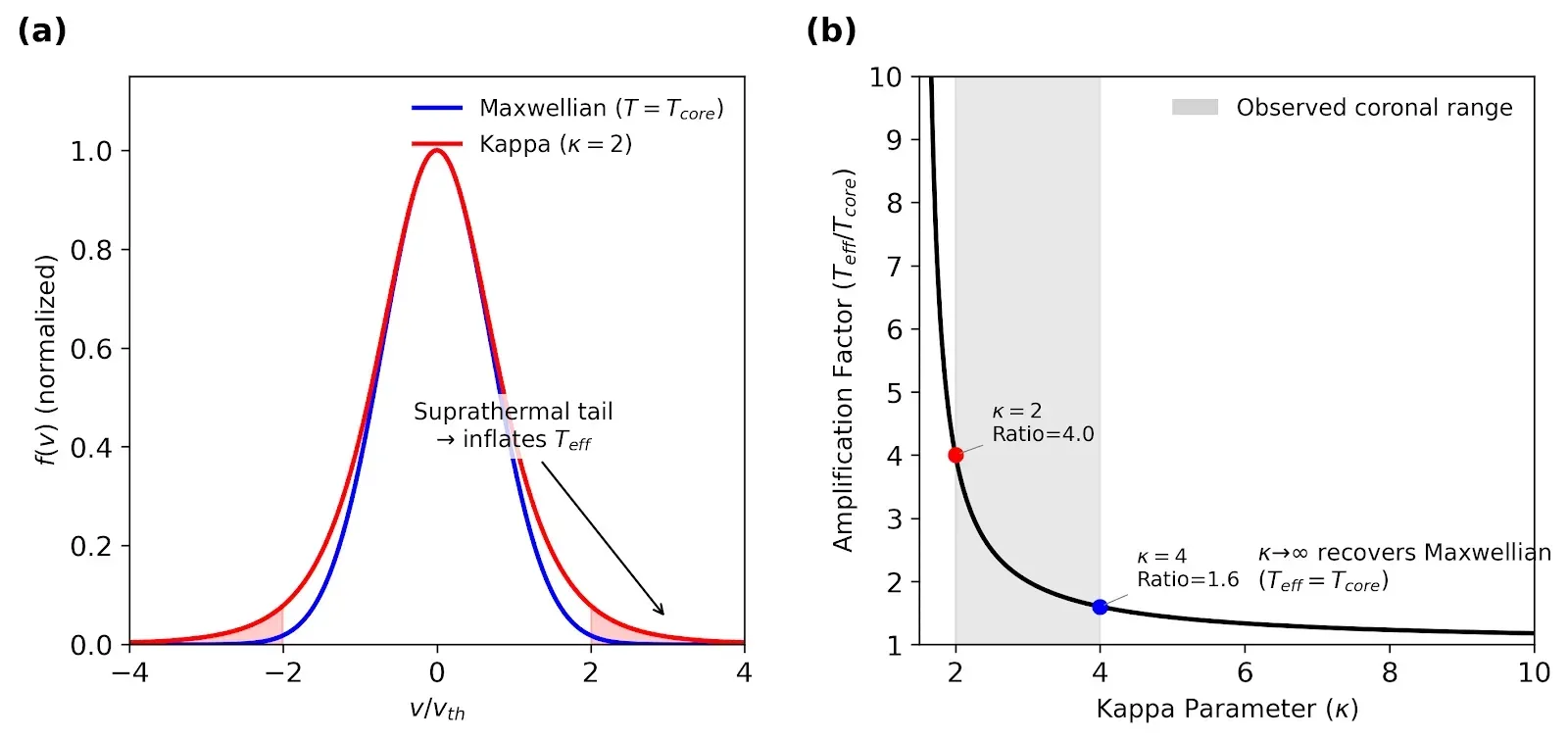
What remains is the suggestion: electrons in the corona do not obey the usual law of velocity distribution. Radio waves are mainly produced by slow electrons, while the height of the gas layer depends on fast ones. If there are more fast electrons than the standard model predicts, the puzzle fits. Calculations show that the velocity distribution needs to have a shape with a 'heavy tail'—then the temperature ratio comes out to exactly 2.4.
This is like an orchestra where the violins and double basses play different notes. The radio telescope hears only the violins, while the altimeter hears only the double basses. Until they play in unison, the temperature of the corona will depend on which instrument you listen to.
Original abstract
as written by the authors arXiv:2603.10040
Two independent electron temperature diagnostics applied to the quiet solar corona yield systematically different results. Radio brightness temperatures from the Nancay Radioheliograph indicate T_e ~ 0.6 MK, while hydrostatic scale-height modeling requires T_e ~ 1.5 MK. Both probe electrons; they disagree by a factor of R = 2.4 +/- 0.3. This discrepancy persists across eight years spanning solar minimum and is confirmed by LOFAR at lower frequencies. We consider turbulent scattering, which suppresses brightness temperature, but comparison with the FORWARD/PSIMAS Maxwellian model shows the standard thermal structure predicts ~1.6 MK; scattering accounts for the reduction toward observed MWA values but not the gap to 620 kK. The ratio R is also cycle-invariant despite measured variations in turbulence. We propose the residual discrepancy reflects non-Maxwellian electron velocity distributions. Radio bremsstrahlung samples the distribution core; ionization and scale heights are dominated by the suprathermal tail. For kappa distributions, the predicted ratio kappa/(kappa - 3/2) matches R = 2.4 at kappa ~ 2-3, consistent with spectroscopic measurements in active regions but in tension with perturbative predictions of kappa ~ 10-25. We predict Active Region cores should show a collapsed ratio (R <= 1.5) as collisionality restores thermal equilibrium.
The solar corona is hotter than the Sun's surface: the visible disk has a temperature of about 5500 degrees, while the corona is heated to millions. Why this is so is one of the main mysteries of solar physics.