Solar corona observation involves techniques to study the Sun's outer atmosphere, which is millions of degrees hot but faint compared to the solar disk. Methods include using natural eclipses, coronagraphs that block the solar disk, and radio occultation where spacecraft signals pass through the corona. The corona's density, temperature, and magnetic field structure are critical for understanding solar wind and space weather. Recent techniques also use radio signals from spacecraft like Akatsuki to probe the corona's density profile.
History
The corona has been observed during eclipses since ancient times, but systematic study began in the 19th century. The invention of the coronagraph by Bernard Lyot in 1930 allowed observation without eclipses. Radio occultation techniques were developed in the 1960s with the first interplanetary spacecraft.
How it works
During a total solar eclipse, the Moon blocks the solar disk, revealing the corona. Coronagraphs achieve the same effect artificially with an occulting disk. Radio occultation works by transmitting a signal from a spacecraft through the corona to Earth; the signal's frequency shift and bending reveal the electron density along the path. This provides density profiles at various solar distances, complementing optical observations.
In practice
Used for space weather forecasting, understanding solar wind acceleration, and calibrating radio communications affected by the corona.
Fun fact
The corona is so hot (millions of degrees) that it defies the solar surface temperature of about 5,500°C, a mystery known as the coronal heating problem.
Picture a guitar string stretched between two frets. When you pluck it, a standing wave forms: some points on the string oscillate strongly, while others, the nodes, remain almost still. The chromosphere, a layer of the solar atmosphere sandwiched between the photosphere and the corona, behaves in much the same way.
Night on La Palma. The 4.2-meter William Herschel Telescope is aimed at Venus. At the focus is the experimental polarimeter ExPo, designed to catch the ghostly light of exoplanets.
In the first seconds after the Big Bang, the Universe left us not only light but also something far more elusive — the relic neutrino background. This echo of creation permeates every cubic centimeter, yet we barely notice it.
Every star is a living archive, and its spectrum a multilayered manuscript. Over billions of years, the history of the galaxy is written into it: the galactic chemical evolution of the Milky Way leaves a smooth trace in elemental abundances.
A planet glides across a star's disk, and for a moment becomes a flashlight. It blocks a tiny patch of surface, revealing details that otherwise escape our view. That's exactly how astronomers peered into the dark spots on V1298 Tauri, a young twin of our Sun. They were aided by the James Webb Space Telescope JWST and three giant planets in orbit.
When a planet slips behind the edge of its star, the star backlights the planet's atmosphere, just as a setting sun illuminates clouds on the horizon. This brief moment, lasting only minutes, carries the imprint of the gases through which the starlight has passed.
A lantern shines through thick fog. Light scatters off water droplets, and the lantern appears blurred. Something similar happens around a black hole: hot gas, like fog, envelops it, while X-rays from the inner parts of the disk struggle through this cloud. Only here, the "droplets" are electrons, and the "fog" itself is called the corona.
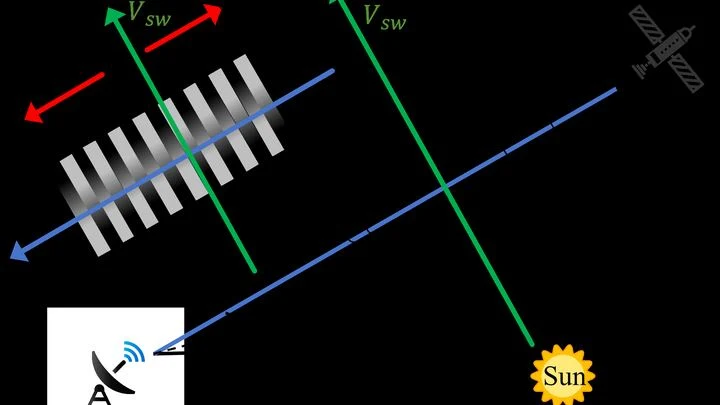
A radio signal travels from Mars to Earth, but on the way it has to push through the invisible "wind" of charged particles blowing from the Sun. This wind, like ripples on water, slightly distorts radio waves.
By day in Chile's Atacama Desert, the air shimmers with heat like the haze above a hot skillet. Sunlight passing through this shimmer begins to dance and flicker. Astronomers call this airy trembling "seeing" — and it keeps telescopes from getting a sharp view of the stars.
To fight this nuisance, engineers have built a special instrument — a solar seeing monitor.
Radio waves passing through the solar corona, the outer atmosphere of the Sun, are distorted just like the air shimmers over scorching asphalt. This haze is caused by seething streams of charged particles — the solar wind.
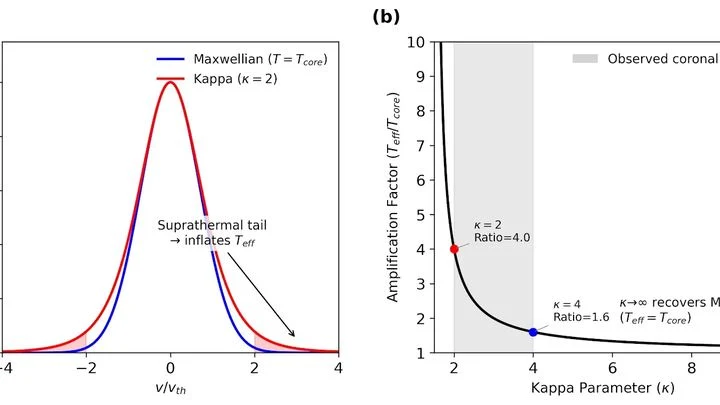
For eight consecutive years, two different methods of measuring the temperature of the solar corona have given different answers. One instrument, a radio telescope in Nancay, sees 600 thousand degrees. The other approach, calculating from how the gas is distributed with height, requires 1.5 million.
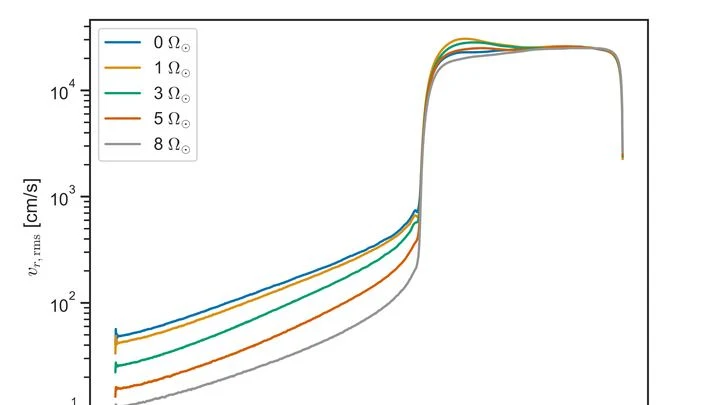
A star like the Sun hums like a bell: sound waves inside make its surface tremble ever so slightly. From this trembling, astronomers, like doctors reading a pulse, infer the star's temperature, density, and age. But the Kepler telescope spotted an oddity: many stars that spin fast and are covered in spots show no trembling at all. It's as if they've lost their voice.
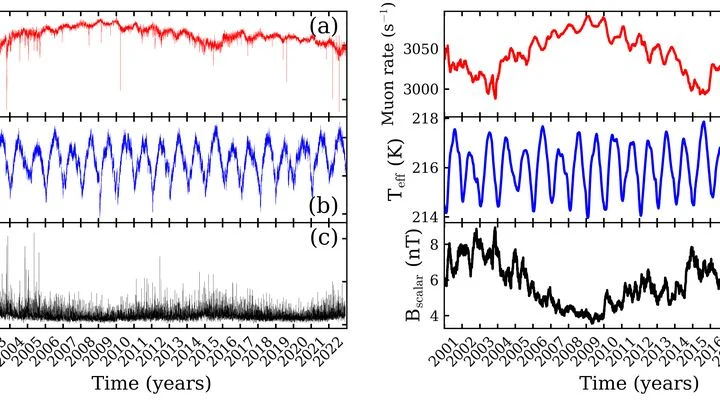
Every second, invisible particles from space, cosmic rays, strike Earth's atmosphere. Colliding with air molecules, they produce showers of secondary particles, among which muons are especially abundant. A muon is a heavy cousin of the electron that lives only a couple of microseconds but still manages to reach the ground.
The solar corona, the Sun's outer atmosphere, stretches millions of kilometers, yet it's visible only during a total eclipse or with specialized instruments. Typically, we gauge the corona's density by how it scatters white light, but that method relies on simplifications that can skew the results.
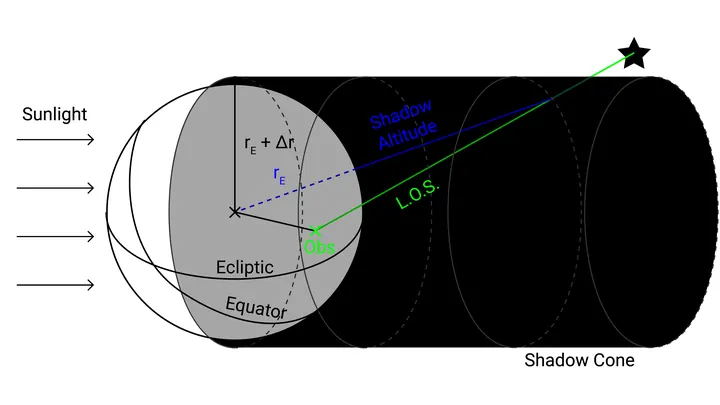
At night, the sky is never completely black. Even far from cities, the upper atmosphere glows faintly: sunlight makes hydrogen atoms emit a reddish glow that astronomers call geocoronal emission. For a telescope, it's like a fogged-up window: it adds extra light and hinders seeing distant galaxies.
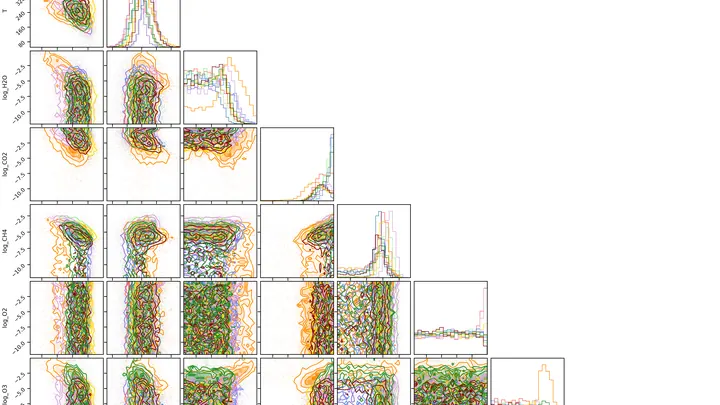
Eavesdropping on a distant planet's atmosphere is hampered by the star's noise. In the TRAPPIST-1 system, astronomers used a planet-"bug": TRAPPIST-1 b — an airless neighbor that records only the interference.
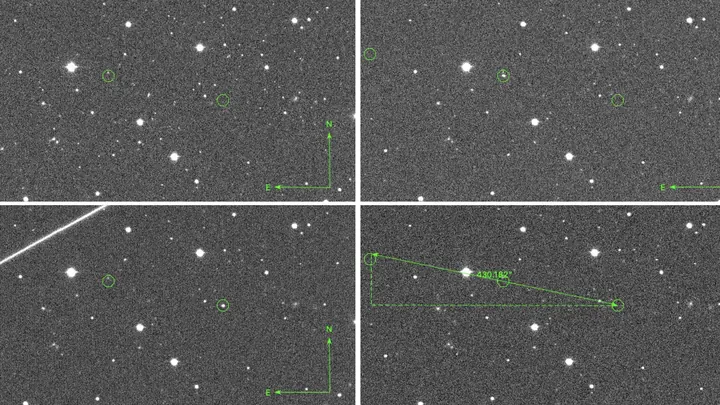
Back in the 18th century, William Herschel was searching for life on Mars. Today, astronomers are targeting not planets but artifacts — for example, alien probes lurking in the Solar System. The problem is that spotting a tiny object next to the blinding Sun is nearly impossible.
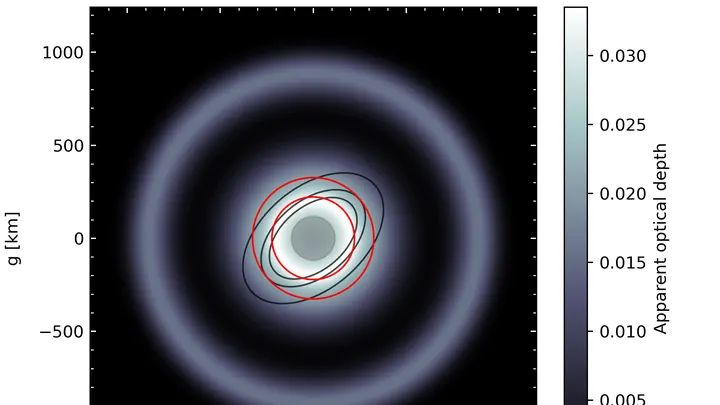
Only by passing in front of a star did Chiron reveal its secret. Three icy hoops encircle the 200-kilometer body — a hybrid of comet and asteroid. Previously, they were only hinted at by spectra of reflected light and brightness fluctuations.