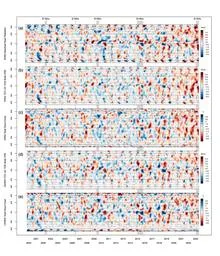
The average temperature anomaly of the top 300 metres of the equatorial Pacific. The same stored heat as the warm water volume, expressed as a temperature instead of a volume.
The upper 300 m temperature is a way of expressing the same heat content as the warm water volume, but in units of temperature rather than volume. Instead of asking how much water is warmer than 20 °C, it asks what the average temperature anomaly is across the top 300 meters of the equatorial Pacific. A positive anomaly means the entire layer is warmer than its long-term average; a negative anomaly means it is cooler. This metric is useful because temperature anomalies are easier to compare across different regions and depths than raw volumes.
History
This metric was developed alongside the warm water volume index as part of the same monitoring effort, with NOAA PMEL providing regular updates. It reflects a broader practice in oceanography of converting heat content into temperature anomalies for easier analysis.
How it works
The calculation takes temperature measurements from the same moored buoys and floats, averages them over the top 300 meters, and then subtracts the climatological average for that time of year. The result is a single number that tracks the buildup or release of ocean heat. Because the warm water volume and this temperature anomaly both depend on the same underlying data, they move together, but the temperature form is often more intuitive for interpreting the state of the ocean.
In practice
Researchers use it to study the evolution of ENSO and to validate climate models that simulate ocean–atmosphere interactions.
Fun fact
The top 300 meters of the equatorial Pacific hold more heat than the entire atmosphere above it, making this layer a critical buffer for global climate.
Swimming season opens when the water feels tolerable. But everyone has their own threshold: one person shivers at twenty degrees, another swims comfortably at fifteen. Scientists decided to figure out where this difference comes from.
They compared a swimmer's body to a house trying to keep heat in while a cold wind blows outside.
Jupiter's atmosphere resembles a layered cake, where each layer plays its role. Scientists took data from four instruments at once (VLT/MUSE, Cassini/VIMS, IRTF/SpeX, and Juno/JIRAM) and built a model of clouds and ammonia in the planet's equatorial zone, from 0.1 to 10 bar (pressure equivalent to hundreds of kilometers below Earth's…
Imagine water as a ballroom, where each molecule is a dancer, constantly forming fleeting partnerships. These hydrogen bonds give rise to local patterns: some resemble a stiff waltz — an ordered network with cavities (low-density structure), others a wild jitterbug, where partners crowd into chaotic dense clusters.
Water is the only common liquid that doesn't immediately contract when cooled. Ice melts, and water becomes denser, but only up to 4 degrees Celsius. Beyond that, with further cooling, it expands again. This quirk explains why fish survive in freezing ponds: the densest water sinks to the bottom, while a lighter cold layer stays on top and turns into ice.
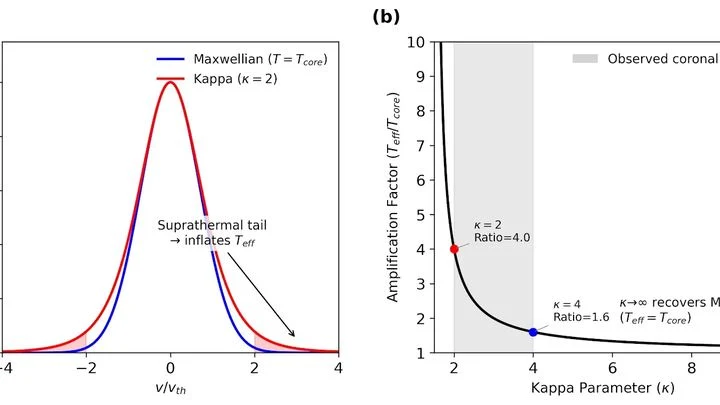
For eight consecutive years, two different methods of measuring the temperature of the solar corona have given different answers. One instrument, a radio telescope in Nancay, sees 600 thousand degrees. The other approach, calculating from how the gas is distributed with height, requires 1.5 million.
Beneath a thin layer of red dust on Mars lies water ice. Its presence was confirmed by the Phoenix lander and orbital instruments, but the mystery remained: why is the ice always just a few centimeters below the surface?
The answer lies in the wobbles of Mars' axial tilt.
Hot Jupiters, exoplanets giants snuggled up to their stars, are mysteriously puffed up. Their radii often exceed standard models by 50–100%. New models, based on transiting data (transit method), flip our understanding: heat doesn't come from the interior but from the upper atmosphere.
In the summer of 2023, thermometers around the world registered numbers that even the boldest forecasts had not anticipated. The planet's average temperature rose to 1.48°C above pre-industrial levels, a jump of 0.17°C that broke the previous record as if the climate had suddenly shifted gears.