Room temperature is the range of ambient air temperatures that most people find comfortable when wearing typical indoor clothing. While it is often cited as a single value around 20–25°C (68–77°F), it is more accurately a range that depends on humidity, air movement, and individual acclimatization. In physics and engineering, room temperature is a convenient reference point for experiments and material properties, as many physical constants and behaviors are measured or specified at this condition.
History
The notion of a comfortable indoor temperature has been recognized for centuries, but standardized definitions emerged with the development of thermodynamics and climate control in the 19th–20th centuries. No single inventor is credited; it evolved from practical observations and the needs of industry and science.
How it works
The concept is rooted in human thermoregulation: the body continuously generates heat and must dissipate it to maintain a core temperature near 37°C. At room temperature, the rate of heat loss through convection, radiation, and evaporation balances metabolic heat production without requiring active sweating or shivering. In technical contexts, room temperature is often standardized as 20°C or 25°C for measurements, ensuring reproducibility across laboratories.
In practice
Room temperature is a baseline for calibrating instruments, characterizing materials (e.g., superconductors, semiconductors), and designing heating, ventilation, and air conditioning systems.
Fun fact
The standard room temperature used in many physics experiments is 25°C, but the ISO definition for thermal comfort in buildings is 20–24°C, reflecting different purposes.
Units by system: SI: kelvin · CGS: kelvin · Planck: planck temperature · natural: kelvin
A magnet weighing just a few grains of sand hovers in midair with no support. It doesn't touch the walls, doesn't rub against bearings — it just hangs in a magnetic trap like a speck of dust in a sunbeam. Researchers have turned this tiny object into an ultra-sensitive compass: the device detects changes in the magnetic field of 23 femtotesla.
In an oven, as temperature rises, molecules move faster and disorder increases. With language models like ChatGPT, it's the opposite. When developers increase the 'temperature' parameter, the model gets access to a wider choice of words, but its long texts suddenly start looping.
A team of researchers tested 11 different AIs by generating 12,000 text continuations.
In a room, air touches the skin, and we feel its temperature. But if your body suddenly accelerated at a colossal rate, heat would come even from absolute emptiness. This is not fiction but a strict consequence of quantum field theory: for an accelerating observer, the vacuum becomes a warm bath.
Heat is all around us: from a car's exhaust pipe to the casing of a running laptop. Thermoelectric materials could turn that waste heat into electricity.
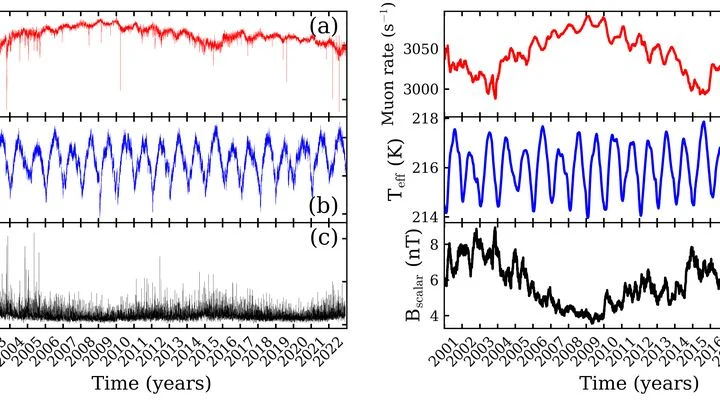
Deep underground, in the thickness of granite, detectors catch rare visitors from space — muons. These particles are born high in the atmosphere when cosmic rays slam into air nuclei. They make it to the underground lab thanks to their enormous speed, close to the speed of light.
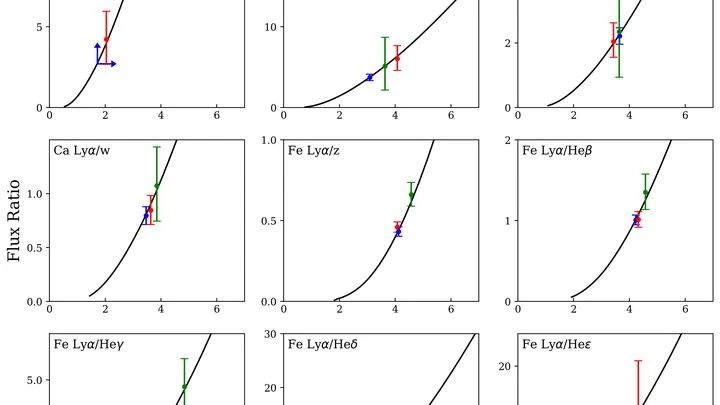
In astrophysics, some numbers seem random yet recur with the persistence of a spell. One such number is the ratio of X-ray brightness to H-alpha hydrogen emission in turbulent gas tails. From galactic winds to ‘jellyfish’ slicing through clusters, this ratio steadily holds at around three.
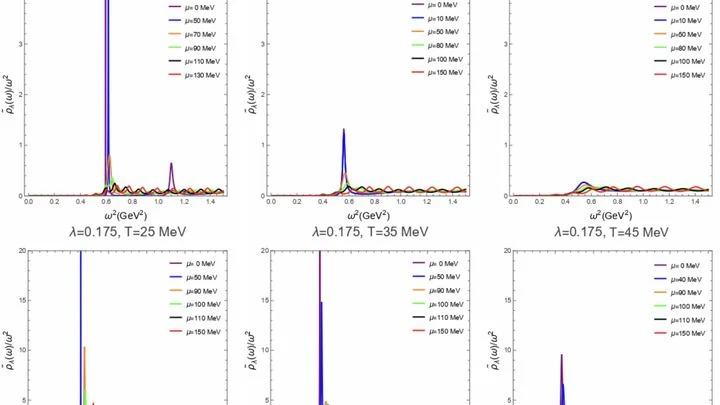
An ice cube in hot tea melts strictly at zero degrees. But what if the ice is made of subatomic particles and the tea is scorching nuclear matter? The authors studied the rho meson, a particle made of a quark and an antiquark that lives for just 4×10⁻²⁴ seconds, and searched for its 'melting temperature'.
Quantum laws reign supreme in the microworld, but macroscopic objects usually behave classically: the thermal motion of atoms drowns out quantum effects.
A giant cauldron of simmering soup stretches across millions of light-years. This is the atmosphere of the Perseus galaxy cluster — a cloud of scorching gas held together by gravity. Until recently, astronomers thought that in the center of this cauldron, the gas was calmly cooling, ready to condense into new stars.
Bismuth is a metal used to make low-melting alloys and additives to steel. But when you sputter it onto a substrate in a very thin layer, its behavior depends on how cold the substrate is. Physicists compared two methods: one at ordinary room temperature, the other at liquid nitrogen temperature, about −196 °C.
Water is the only common liquid that doesn't immediately contract when cooled. Ice melts, and water becomes denser, but only up to 4 degrees Celsius. Beyond that, with further cooling, it expands again. This quirk explains why fish survive in freezing ponds: the densest water sinks to the bottom, while a lighter cold layer stays on top and turns into ice.
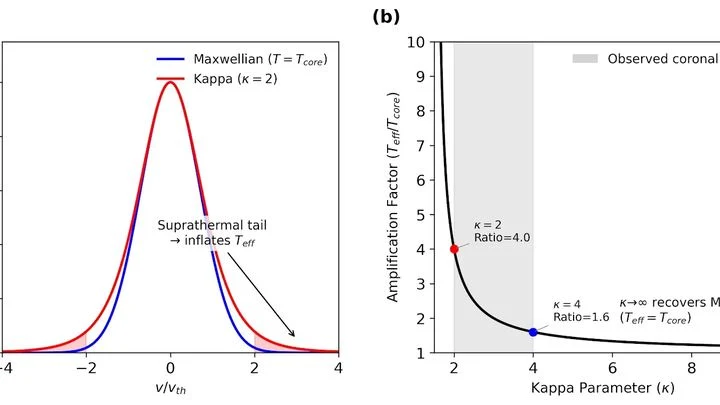
For eight consecutive years, two different methods of measuring the temperature of the solar corona have given different answers. One instrument, a radio telescope in Nancay, sees 600 thousand degrees. The other approach, calculating from how the gas is distributed with height, requires 1.5 million.
A radiation sensor in the city is like a street musician: it has to hit the right notes even when fingers go numb from cold or the instrument is baked by the sun. Usually, such devices are kept in greenhouse conditions, with heating or cooling, otherwise the energy scale (which distinguishes harmless potassium in concrete from dangerous cesium) starts to lie.
A seismometer is the planet's ear. It picks up the faintest tremors in the ground and turns them into an electrical signal. But this ear isn't perfect: its sensitivity depends on temperature. In the cold and in the heat, the instrument hears slightly differently, and that introduces error into measurements.
Every second, invisible particles from space, cosmic rays, strike Earth's atmosphere. Colliding with air molecules, they produce showers of secondary particles, among which muons are especially abundant. A muon is a heavy cousin of the electron that lives only a couple of microseconds but still manages to reach the ground.
A distant red object usually means one thing: we're seeing a dust veil over a scorching disk falling into a black hole. But when the James Webb split its light into shades, a shadow appeared inside — just like steam from boiling water intercepts rays.
A thin film of silicon nitride is stretched over a frame like the skin of a drum. The slightest nudge from gas molecules makes it tremble. A laser beam delivered through a glass fiber picks up that trembling and turns it into a pressure reading. The whole setup fits in a pocket, not on an optical table.
Two qubits, quantum bits, two-level systems, glide through hot and cold thermal baths. One moves at 0.8 times the speed of light. At that moment, familiar thermodynamics cracks: a moving qubit senses temperature differently than a stationary one. For it, the cold bath can feel hotter, and the hot bath colder.
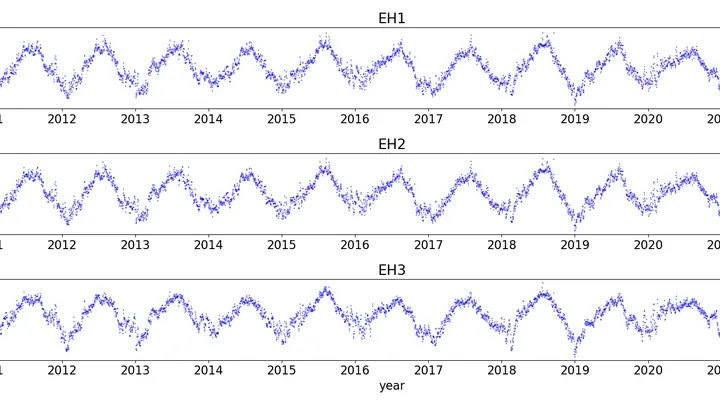
Seventy-five years of weather observations in India, when plotted on a graph, resemble the cardiogram of a vast organism. Instead of a single steady pulse, there are fifteen different lines, each with its own rhythm. Somewhere the heartbeat is as steady as a sleeping person's, while elsewhere it falters, as if after a quick run.
The thermometer at a weather station in Delhi doesn't know it's part of a giant ear. Every day it records the temperature, and after forty years of such records, you can hear the breathing of an entire subcontinent. The India Meteorological Department divided the country's land into one-degree squares and took readings from 1970 to 2009.
On April 16, 2012, Washington experienced heat no one expected. The thermometer climbed 18 degrees above normal. Sixty days earlier, Bucharest and Kyiv had weather unusual for them. The link between these events was found by an algorithm that scans pairs of cities worldwide, looking for recurring coincidences.
Twice a day, at eleven in the morning and eleven at night, a white balloon with an instrument rises into the sky from a tiny station in San Pietro Capofiume, just eleven meters above sea level. Over twenty-two years, more than sixteen thousand such launches have recorded how air temperature changes with altitude: from the warm ground to the thin cold at twenty kilometers.