Wien's displacement constant is the proportionality factor in Wien's displacement law, which states that the wavelength at which a black body emits the most intense radiation is inversely proportional to its absolute temperature. In other words, hotter objects glow with peak emission at shorter wavelengths — a red-hot object is cooler than a white-hot one, which is cooler than a blue-white one. The constant has a value of approximately 2.898 × 10⁻³ meter·kelvin, and it links the macroscopic property of temperature to the microscopic distribution of thermal radiation.
History
Wilhelm Wien derived the displacement law in 1893, before Planck's full quantum theory of black-body radiation. It was a key step toward quantum mechanics, and Wien received the Nobel Prize in Physics in 1911 for his work on thermal radiation.
How it works
The law emerges from the Planck radiation formula, which describes the spectrum of electromagnetic radiation emitted by an ideal black body. By taking the derivative of the spectral radiance with respect to wavelength and setting it to zero, one finds the wavelength of maximum emission. That wavelength, λ_max, equals the constant divided by the temperature T: λ_max = b / T. The constant b encapsulates fundamental physical constants — Planck's constant, the speed of light, and Boltzmann's constant — in a single numerical value.
In practice
It is used in astronomy to estimate the surface temperature of stars from their color, and in infrared thermography to calibrate thermal imaging cameras.
Fun fact
The constant means that a star like the Sun, with a surface temperature of about 5,800 K, peaks in the visible spectrum, while the cosmic microwave background at 2.7 K peaks in the microwave region.
In a room, air touches the skin, and we feel its temperature. But if your body suddenly accelerated at a colossal rate, heat would come even from absolute emptiness. This is not fiction but a strict consequence of quantum field theory: for an accelerating observer, the vacuum becomes a warm bath.
Every quantum system (whether an atom, a crystal, or the entire Universe) has its own set of allowed energies, like the steps of a ladder. The hotter the system, the more readily particles climb to higher rungs.
In a thin semiconductor channel, electrons behave not like lone runners but like a crowd at rush hour. They constantly bump into each other, and these collisions determine how easily heat and electric current pass through the material.
The heart doesn't push blood in a steady stream but in pulses. Each beat sends a wave racing through the arteries, like ripples along a taut garden hose. For a long time, it was thought that an animal's metabolic rate depended only on how vessels branch, like pipes in a house. But new work flips that view: what matters isn't the shape of the pipes but the pulse itself.
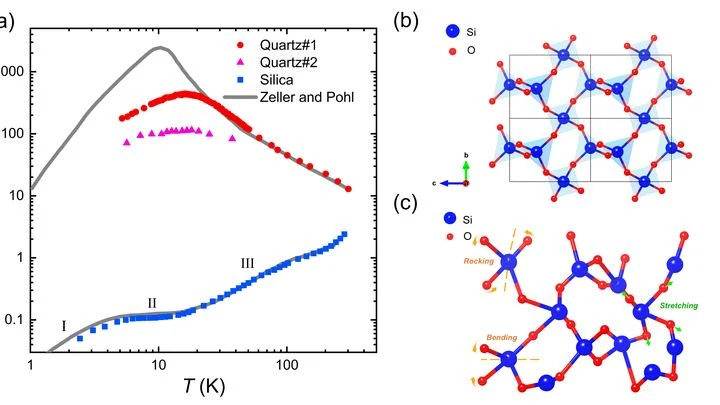
If you push heat through a piece of quartz, it usually goes straight, like water through a pipe. But switch on a magnetic field, and the flow veers slightly sideways, as if the pipe suddenly grew a side branch.
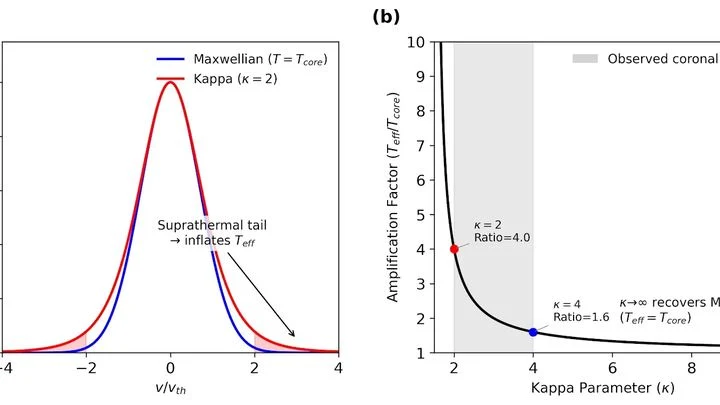
For eight consecutive years, two different methods of measuring the temperature of the solar corona have given different answers. One instrument, a radio telescope in Nancay, sees 600 thousand degrees. The other approach, calculating from how the gas is distributed with height, requires 1.5 million.
A flashlight shines through fog, and its light changes color slightly. From that change, you can tell what the fog is made of. That's how astronomers study cold gas around X-ray sources: iron atoms in the gas absorb and re-emit X-rays at a very specific energy, like a fingerprint. But there's a catch: if you strip a few electrons from the atom, the line shifts.
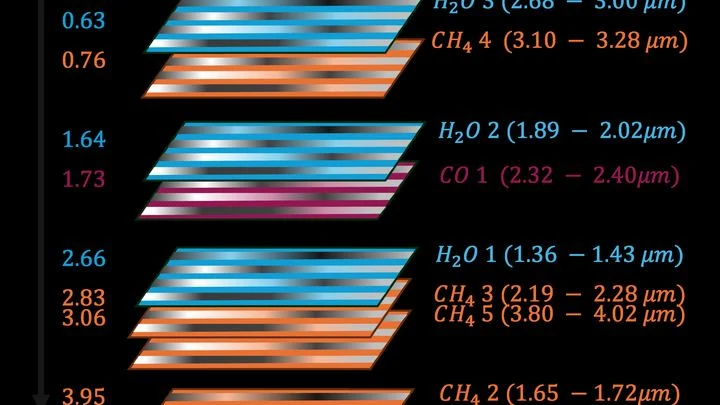
Brown dwarfs are heavier than planets but lighter than stars. Their atmospheres resemble a bubbling pot: clouds of scorching sand and iron droplets rise and fall.