Ultraviolet Light Combs express
Ordinary white light is a jumble of all colors at once, like the noise of a crowd where everyone speaks at their own frequency. But scientists need light where frequencies are aligned with ruler-like precision, like piano keys, where each note sounds distinct and exact. Such "frequency combs" have long been achievable in the infrared range, but in the ultraviolet it's trickier: light is easily lost and hard to amplify.
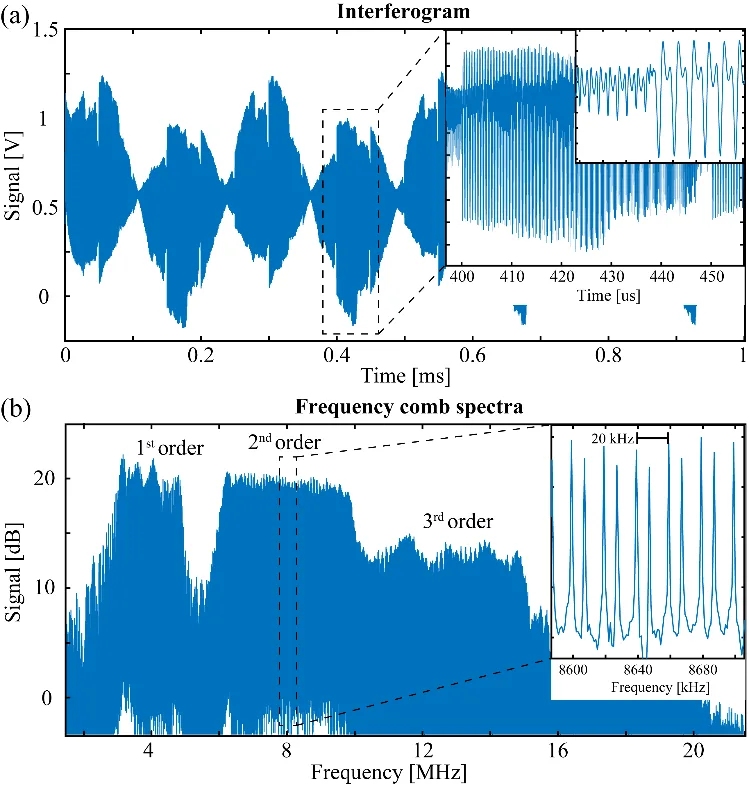
In the new work, physicists took an infrared comb, passed it through a crystal, and mixed it with a green laser. The result was ultraviolet light with the same precise frequency grid, but at a wavelength of 323 nanometers — a range nearly invisible to the eye, used for studying atoms. The trick is that the mixing happened inside an optical resonator — a pair of mirrors that makes light pass through the crystal many times. This boosted the ultraviolet power a hundredfold compared to a single pass, making it easy to detect with a standard photodiode.
Using this system, the scientists measured the spectrum of rubidium atoms — absorption lines that reveal the atom's internal structure. Such measurements are needed for atomic clocks, quantum memory, and tests of fundamental physics. Importantly, the method isn't tied to one wavelength: by changing the infrared source, you can produce combs anywhere in the ultraviolet range from 300 to 400 nanometers. This opens the door to new experiments requiring precise control over ultraviolet light.
Rubidium, used in the experiment, is a soft, silvery metal that melts at just 39 degrees Celsius — slightly warmer than the human body.