Fundamental physics is the branch of science that seeks the deepest, most general laws governing nature — the rules from which all other phenomena can, in principle, be derived. It covers the smallest scales (elementary particles), the largest (cosmology), and the most basic interactions (gravity, electromagnetism, and the nuclear forces). The goal is a unified, consistent description of reality, often expressed in mathematical form.
History
The field crystallized in the early 20th century with quantum mechanics and relativity, and continues today in efforts like the Standard Model of particle physics and attempts at quantum gravity.
How it works
Fundamental physics works by proposing minimal, elegant principles — such as symmetry, conservation laws, and locality — and testing their consequences through experiment and observation. Theories like quantum mechanics and general relativity are its current pillars; they are validated by precise measurements and, where they conflict, drive the search for deeper frameworks.
In practice
Fundamental physics underpins technologies like GPS (relativity corrections), semiconductors (quantum mechanics), and medical imaging (particle physics), even when the research itself is driven by curiosity.
Fun fact
The Standard Model of particle physics, a cornerstone of fundamental physics, fits on a single page of equations yet accurately predicts the behavior of all known particles to extraordinary precision.
The first three minutes after the birth of the world are a cosmic kitchen where nature cooked the lightest atomic nuclei. The recipe is set by gravity: it controls the cooling rate of the hot 'broth' of particles. If gravity worked differently than we are used to, the dish would have turned out different — with different amounts of helium and deuterium.
An old mechanical alarm clock ticks on the shelf. You hear the steady sound, see the hands moving, and you're certain time is passing. But if you take the clock apart, you won't find a single part labeled "time." Only springs and gears.
In the orchestra of atoms, each instrument has its own score. But sometimes two musicians start playing in unison, and the sound amplifies many times over. In the quantum world, this 'harmony' is called a Feshbach resonance. It allows you to control atomic interactions with jeweler-like precision.
A lightning strike splits the sky in a fraction of a second, leaving a branched trail. At the same moment, in a tiny superconducting crystal cooled to near absolute zero, an avalanche of magnetic field rushes through — thin fingers of magnetization piercing the material.
A magnetic field in plasma resembles a stretched soap film: pressure from inside pushes it out, while surface tension pulls it in, giving it shape. Here too, magnetic pressure and tension forces balance each other.
An ice cube in a glass of water doesn't just float: it gets pushed. Water molecules bombard it from all sides, and this bombardment gives rise to a force you can measure. In physics, there's a similar force, but it acts not on ice but on anything with mass, and it arises not from molecular jostling but from information. It's called entropic force.
Two great theories describe reality: one — how massive bodies cause curvature of space, the other — the Standard Model — governs elementary particles. Reconciling them remains elusive, like trying to describe an ocean storm in the language of a diamond lattice.
A tiny tungsten tip with a radius of less than a hundred nanometers is the perfect stage for watching a quantum performance. Apply an electric field of a few volts per nanometer, and electrons start flying out of the metal: that’s field emission.
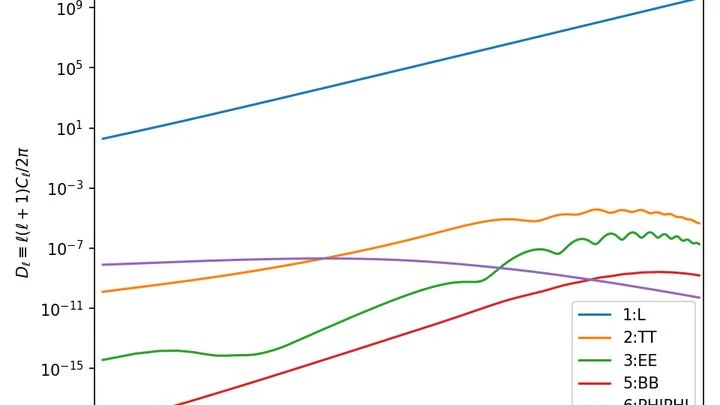
At night, an astronomer points a telescope at the edge of the visible universe and sees not stars but ripples — the imprint of the first moments. He knows these ripples should obey statistics, like the heights of people in a crowd. But he has only one crowd, and nothing to compare it with.
This is cosmic variance.