Chaos in a Falling Film express
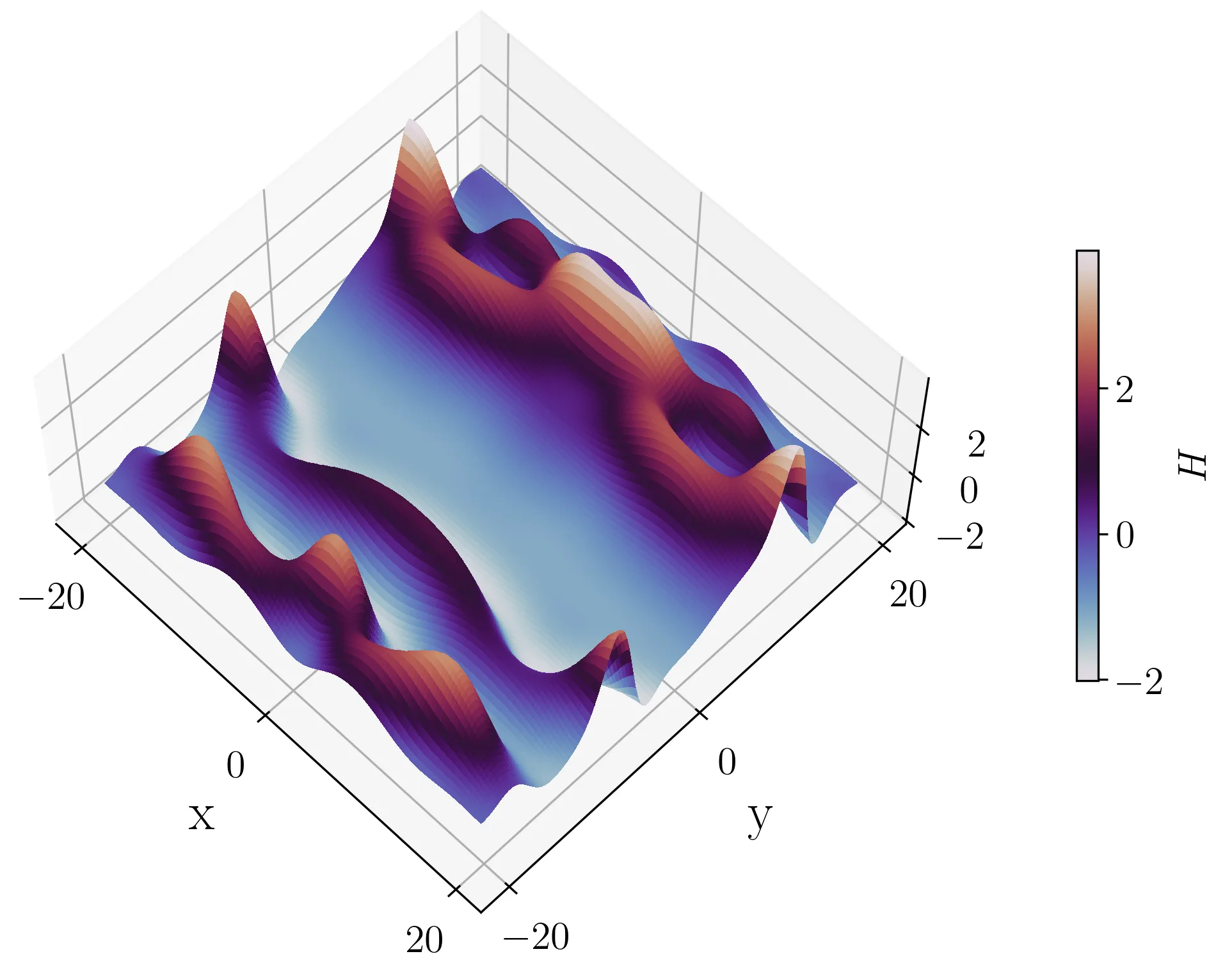
A thin stream of water on a shower glass gathers into winding rivulets that quiver and shift before your eyes. Such a liquid film flowing down a vertical surface is a classic example of chaos in nature: it all flows downward, sure, but the surface lives its own unpredictable life.
Physicists took the equations describing this flow and ran them for a wide range of scenarios — varying the flow width and fluid properties. The result was a map: in some regions, smooth waves run across the surface like folds in a curtain; in others, waves periodically 'burst' into splashes; and in still others, complete disorder reigns. In the chaotic zone, the flow resembles boiling porridge: patterns appear and vanish with no rhythm at all.
It turns out that even in the most turbulent zone, recurring motifs can be discerned. The researchers computed these hidden 'skeletons': standing patterns, traveling waves, and cycles that return to themselves. The chaotic flow repeatedly approaches them, as if remembering a familiar dance, only to break into improvisation again.
This is the first time such precise structures have been identified in the chaos of a falling film. The practical payoff is in understanding how to control flow in industry — from coating applications to surface cooling.
Original abstract
as written by the authors arXiv:2603.07297
Dynamical-systems approaches to spatiotemporal chaos have been developed primarily for single-phase flows, where the system state is defined by bulk velocity fields. Extending these ideas to two-phase flows remains challenging because the dynamics are intrinsically coupled to the evolution of a deforming interface. Here, we address this challenge for a two-dimensional vertical falling film by formulating the dynamics in terms of the interface evolution. Starting from the Navier--Stokes equations, we recover a classical long-wave interface evolution equation, originally derived by Topper & Kawahara (1978). Using this formulation, we perform an extensive parametric study to construct a regime map in the space of domain size and dispersion parameter. The resulting map reveals a rich range of interfacial behaviors, including travelling waves, bursting travelling waves, and fully chaotic regimes. In the chaotic falling film regime, we exploit the dissipative nature of the governing equation, which suggests that the long-time dynamics evolve onto an inertial manifold. Using a data-driven approach, we parameterize this inertial manifold and estimate its intrinsic dimension, suggesting approximately linear growth with domain size. We then construct low-dimensional models in manifold coordinates to facilitate the search for exact coherent states of the full system. Using this approach, we identify travelling waves, relative periodic orbits and equilibria embedded within the chaotic attractor. Chaotic trajectories repeatedly approach the neighbourhoods of these invariant solutions, indicating that the recurrent interfacial patterns observed in the dynamics correspond to visits to these coherent states. To the best of our knowledge, this constitutes the first identification of exact coherent structures embedded in chaotic falling-film dynamics.
Falling liquid films aren't just for the shower: some types of chemical reactors work this way, with liquid flowing in a thin layer down a wall to improve mixing and heat exchange.