Chaotic Dynamics nlin.CD

55 articles

Dynamical systems, chaos, quantum chaos, topological dynamics, cycle expansions, turbulence, propagation.

articles

The Swing That Ignores the Push: Why the Annual Rhythm Produces a Three-Year Cycle
A swing builds up when you push it in time. But sometimes the person on the swing responds not to every push but to every third one, and the amplitude grows slowly yet inexorably.
Noise as Glue for a Broken Climate Vase
For thirty years, climatologists have been gathering the shards of a broken vase. Each climate model is its own shard, and they all promise different warming by 2100, from 1.5 to nearly 6 degrees. The spread does not shrink no matter how much the models are improved.
Climate as a Road Map: Bifurcations and Resonances of El Niño
The Pacific Ocean does not breathe evenly but in bursts. Every few years, its warm waters stir, and then Australia suffocates from drought while Peru is flooded with rain. This phenomenon is called El Niño, and it resembles a traveler wandering along an invisible road map.
One-Third Resonance: Why Climate and the Sun Swing in Sync
A swing pushed once per second usually oscillates once per second. But if you push it harder and at the right rhythm, it can swing three times slower: one full swing for every three pushes. Physicists call this subharmonic resonance, and it seems to govern the most prominent climate and solar oscillations.
The Pacific Ocean Pendulum: Why Strong El Niños Are Unpredictable
In 2014, forecasters around the world were expecting a powerful El Niño. The ocean had warmed, the trade winds had weakened, all the signs were there. But the event only came a year later. The Pacific seemed to change its mind.
Two Ocean Pendulums Sing in Unison
Two pendulums hang from the same wall, with a spring stretched between them. Each on its own can swing or stay still, but connect them and a shared dance begins: one nudges the other, and oscillations spread through the whole setup. That's how the Pacific Ocean works, where two neighboring regions exchange heat through waves.
The Planet's Pulse with an Irregular Rhythm
Every few years, the Pacific Ocean takes a deep breath. Warm water that usually piles up near the coasts of Indonesia spreads eastward toward South America, and the trade winds that had been pushing it west temporarily ease. This inhale and exhale is called El Niño–Southern Oscillation, or ENSO.
The Pendulum That Forgets How to Swing
In 2014, forecasters expected a strong El Niño, but it arrived only a year later. The ocean seemed to change its mind. Researchers studied a simple model of the tropical Pacific and found that the system has two distinct "personalities": one regularly generates powerful El Niños, while the other oscillates chaotically without them. This model resembles a pendulum that sometimes jumps to a different swing.
Relay of Chaos: How Warm Pacific Waters Make Weather Unpredictable
In the 1960s, meteorologist Edward Lorenz discovered that the air above our planet behaves like a crowd at a sale: the slightest nudge can change everything. His famous question about a butterfly in Brazil causing a tornado in Texas became a symbol of chaos in the atmosphere. But Lorenz only looked at the air. He left the ocean, which covers seven-tenths of the globe, out of the picture.
The Breath of Monsoons: How Random Gusts Settle into a Predictable Rhythm
Every summer, the same performance unfolds over the Indian Ocean: moist air rushes from the sea onto the scorched land, bringing rains that billions of people depend on.
Ocean Memory Quenches El Niño Chaos
A warm current off the coast of South America shifts weather across the planet every few years. This is El Niño, and its behavior resembles a pendulum that sometimes swings too far. In 1986, meteorologist John Vallis described the process with three equations in which the ocean and atmosphere exchange heat and momentum.
Chaos That Vanishes: How to Tell a Storm from a Mirage
A traveler in the desert sees a lake. It shimmers, beckons with coolness, but as you approach, the water recedes. So it is in mathematics: the computer draws chaos, lines dart across the screen, and it seems we are witnessing a real storm. But if you wait long enough, the storm subsides, and the trajectory settles into a simple equilibrium.
Noise Smooths the Devil's Staircase
The devil's staircase is what mathematicians call a graph that looks like steps leading upward, but the steps are infinitely thin and packed without gaps.
A Probability Map for El Niño
Imagine a map where each patch of ocean is colored with its own shade: in some places the color is saturated, meaning the future of the system is predetermined; in others it is pale, meaning the outcome depends on a random gust of wind.
The Noise That Conducts the Ocean
Every few years, the Pacific Ocean rearranges itself: warm water from the east flows toward the coasts of South America, and weather goes haywire for six months. This is El Niño, and its arrivals cannot be predicted precisely, even though there is a rhythm to them. A model with 930 variables shows that noise is to blame—random gusts of wind acting like an invisible conductor.
The Climate Pendulum: How Extreme El Niño Events Are Born
Every few years, the Pacific Ocean off the coast of Peru warms up, and then fields dry out in Australia while deserts in Chile get drenched. This phenomenon is called El Niño.
stat.ME2020-10-053 minarXiv:2010.02247
A Causal Map Without Intervention
An orchestra without a conductor plays in harmony, and you want to understand who influences whom. The violinist hears the cello, the cellist catches the rhythm of the percussion, and the flute adapts to everyone at once.
A Translator Who Hears the Call-and-Response: Finding Causality in Nonlinear Noise
A translator in a meeting room hears not only individual voices but also how they bounce off each other: one speaker trails off, another picks up the thought, a third clarifies. Remove that interplay, and you are left with a set of monologues, and the meaning of the conversation slips away.
Two Orchestras, One Score: How El Niño Splits the Midlatitude Climate
Two orchestras play from the same score, but in different keys. The score is the warm El Niño current, which every few years heats the tropical Pacific. The key is the regime in which the midlatitude atmosphere responds to that heating. One orchestra plays steadily and predictably; the other keeps stumbling, yet its playing carries deep bass notes that the first lacks.
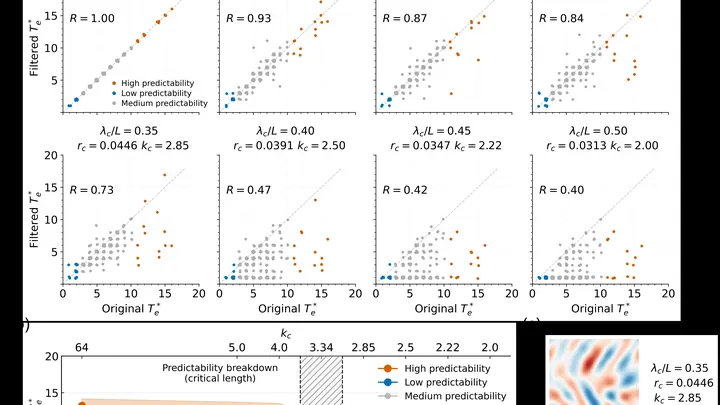
The Committor as a Compass: Where Climate Predictability Ends
In the Pacific Ocean, every few years the water off the coast of Peru warms up, and fishermen call it El Niño. Sometimes the warming is mild, sometimes so strong that it changes weather across the entire planet. Forecasting a strong El Niño six months to a year ahead is a task at the edge of possibility: weather is forgotten within two weeks, while climate remembers for decades.
stat.ME2021-12-093 minarXiv:2112.04843
The Uneven Pulse of Time: How Irregular Measurement Rhythms Skew Conclusions and What to Do About It
Imagine an interpreter who gets distracted by every rustle in the hall. The more rustles, the more errors in the translation, even though the meaning of the speech hasn't changed. The same happens with data: if measurements are unevenly spaced, standard analytical tools start "hearing" changes that never occurred in the underlying process.
math.ST2022-06-272 minarXiv:2206.13659
A Translator That Never Loses the Meaning
A meteorologist stares at a pressure map, trying to figure out where the cyclone will go. They have a model, but it is flawed, and fresh measurements, but they are incomplete. Merging the two so that the forecast remains physically meaningful is harder than it seems: classical methods sometimes produce negative temperatures or impossible probabilities.
Reservoir with a Correction: How to Predict Noisy Chaos
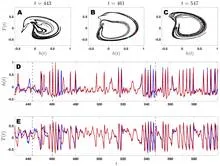
A translator who learns to correct their own slips works more accurately. In the world of forecasting noisy processes, a new method takes on this role: a reservoir computer that adds a random correction to its prediction at each step.
A Network That Rings Before the Lurch
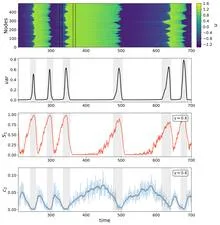
A fisherman pulls on his net and listens to it ring. Each strand quivers in its own way, but before a strong tug, all the strands begin to vibrate in unison. So it is with complex systems: before a sharp state jump, the individual parts suddenly start to oscillate in concert, and that synchrony betrays the coming jump.
Blind Search for El Niño Precursors
A blindfolded sapper searches for a mine by tossing pebbles at random. He cannot see the map or calculate where the charge is buried. But if he throws enough pebbles and listens for which one lands with a duller thud, he can pinpoint the danger. That is roughly how a new method for predicting El Niño works: the warm current that every few years alters weather across the entire planet.
India's Climate: A Pattern of Chaos and Order
Seventy-five years of weather observations in India, when plotted on a graph, resemble the cardiogram of a vast organism. Instead of a single steady pulse, there are fifteen different lines, each with its own rhythm. Somewhere the heartbeat is as steady as a sleeping person's, while elsewhere it falters, as if after a quick run.
Trees Predict Chaos Without Tuning
An orchestra without a conductor: the musicians take their seats, tune their instruments, and begin to play in harmony because each one hears the common rhythm. That is how TreeDOX works, a method that predicts chaotic time series without requiring the user to choose parameters or fine-tune anything.
A Translator That Learned the Language of the Ocean
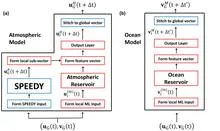
A translator at an important negotiation starts by simply repeating words, but gradually begins to anticipate what the counterpart will say. The new weather model works similarly: physics provides the framework, and machine learning learns from errors and fills in the gaps.
The Climate Symphony: How Random Jolts Produce a Predictable Response
The orchestra plays the symphony of climate. Each violin, each wind instrument carries its own part: these are the Kolmogorov modes, the system's natural rhythms. Suddenly, a thunderclap bursts into the hall: a sharp jump, like a gust of wind or a downpour. Previously, we could only listen to the smooth sound, but we couldn't decipher such chords. In the new work, mathematicians have completed the score.
Noise as the Conductor of Chaos: Quantum Chaos in an Open System
Five superconducting qubits on a chip: the stage for a performance of quantum chaos. Four qubits form the system, and the fifth acts as the environment, introducing dissipation. After a short evolution, the environment is discarded, leaving the system with an open quantum map, an operator that transforms the system's state.
Ten Thousand New Three-Dimensional Orbits in the Three-Body Problem
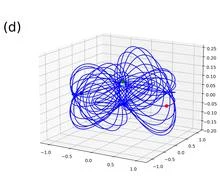
Three bodies attracting each other by universal gravitation: a problem that has stumped mathematics for three centuries. After Poincaré, it became clear that no general solution exists and trajectories are chaotic. But within this chaos there are islands of order: periodic orbits where motion repeats.
The Noise That Rocks the Pacific Swing
The Pacific Ocean is like a giant swing: warm water piles up in the west, then slides toward the east, and the temperature off the coast of South America jumps. Such warm years are called El Niño, and cold ones La Niña. But the swing doesn't move on its own: it's pushed by the wind.
El Niño Can Be Predicted a Year and a Half in Advance
The Pacific Ocean breathes slowly and deeply. Every few years, its warm surface waters shift eastward toward the coast of South America, and then Peru gets drenched while Australia goes up in flames. A year or two later, the water retreats, and the picture flips. This breathing is called El Niño, and until now its rhythm could only be guessed a couple of steps ahead.
Chaotic Dynamics2026-02-072 minarXiv:2602.07660express
How to Tell Chaos from Order by a Particle's Trail
Drop a stone into a calm pond — the ripples spread evenly. Drop it into a churning stream — the water swirls unpredictably. Scientists have long wrestled with a similar question: how can you tell from a single particle's path whether its motion is chaotic? Previously, this meant comparing the particle's path with neighboring ones, which is complicated and time-consuming.
A Gyroscope for Climate: Teaching Neural Networks Not to Make Up Energy
Every few years, the warm current off the coast of Peru shifts, and fishermen come home empty-handed. This is El Niño, the breath of the tropical Pacific, which affects weather from Indonesia to California. Predicting its arrival is as hard as predicting where a stone thrown into a raging river will roll.
Fluid Dynamics2026-02-162 minarXiv:2602.15234express
How lizards and snakes plan their falls
A lizard falling from a branch doesn't just tumble: it catches the air with its body and turns the fall into a glide. Engineers have long borrowed tricks from such feats, but until now there was no common language to compare the gliding of a snake, a lizard, and a man-made wing. The new study introduces such a language: a three-dimensional map of velocities that shows where any motion inevitably ends up.
Machine Learning2026-02-212 minarXiv:2602.18679express
How a Neural Network Predicts the Unseen
Turbulent water flowing through a pipe and the swing of a pendulum may seem worlds apart. But they share something fundamental: both follow their own laws of motion, which can be described by numbers. A neural network trained on just one such 'dance of numbers' suddenly starts to understand another — without a single extra example.
Fluid Dynamics2026-03-071 minarXiv:2603.07297express
Chaos in a Falling Film
A thin stream of water on a shower glass gathers into winding rivulets that quiver and shift before your eyes. Such a liquid film flowing down a vertical surface is a classic example of chaos in nature: it all flows downward, sure, but the surface lives its own unpredictable life.
Hidden Pathways Across an Ocean Desert
Thousands of kilometers of open ocean separate the reefs of the central Pacific from the sparse coral outposts to the east. This stretch of water, known as the Eastern Pacific Barrier, has long been considered nearly impassable for tiny coral larvae. The currents here mostly carry water westward, away from the eastern islands.
Chaotic Dynamics2026-03-142 minarXiv:2603.13789express
Why Some Vortices Are Predictable and Others Aren't
In a turbulent flow, like a raging river, energy constantly cascades from large whirlpools to small ones. Occasionally, particularly powerful bursts occur, resembling sudden waves crashing against the shore. Scientists asked: can we know in advance when such a "wave" will strike? It turns out the answer depends on which vortices are present in the flow at that moment.