In physics, a state space is the abstract collection of every possible configuration a system can take. For a simple pendulum, it's all combinations of angle and angular velocity; for a gas, it's all positions and momenta of every molecule. The concept turns dynamics into geometry: instead of tracking a system's evolution as a sequence of numbers, you trace a single point moving through this high-dimensional landscape.
History
The formalization is often credited to Henri Poincaré in the late 19th century, who used geometric methods to study the three-body problem, though the underlying idea of representing states as points in a space has roots in earlier work by Hamilton and others.
How it works
The state space is defined by the variables needed to fully describe the system at one instant. The laws of physics then become a rule for how the point moves: given the current state, the equations tell you the direction and speed of motion. This transforms problems into geometry — equilibrium points become fixed locations, periodic motion becomes closed loops, and chaos becomes trajectories that stretch and fold.
In practice
State space methods are essential in control theory (designing autopilots and robots), in analyzing complex systems like weather prediction, and in quantum mechanics where the state space is a Hilbert space.
Fun fact
The state space of a single gas molecule with 10^23 particles is so vast that if each possible state were a grain of sand, the total would exceed the number of atoms in the observableuniverse.
In the conventional Heisenberg picture, spins at low temperatures are supposed to line up in a strict pattern. But there are crystals — like pyrochlore — where geometry has its own way. Each ion sits at a vertex of a tetrahedron, and the main interaction enforces a rule: two spins point inward, two outward.
A crowd at a metro station during rush hour. Some hurry toward the escalator, others slow down at the departure board, still others weave around a column. Each step is not merely a reaction to what's right in front of your nose. A person estimates in advance where a neighbor will be a second from now and adjusts their route accordingly. Physicists call this forward-looking behavior anticipatory.
A thrown stone follows a smooth arc: its path is easy to predict. But if the stone skips across water, the trajectory becomes jagged and far more interesting. Quantum particles behave much the same way when their state is not a calm wave with fixed energy but a turbulent mix of several waves at once.
A flashlight beam in a dark room can hold a dust mote almost still: that's how optical tweezers work. But light doesn't just push the particle; it also jostles it with random kicks. Each absorbed photon strikes it like an invisible hammer. The authors of the new study have devised a light trap of a special shape.
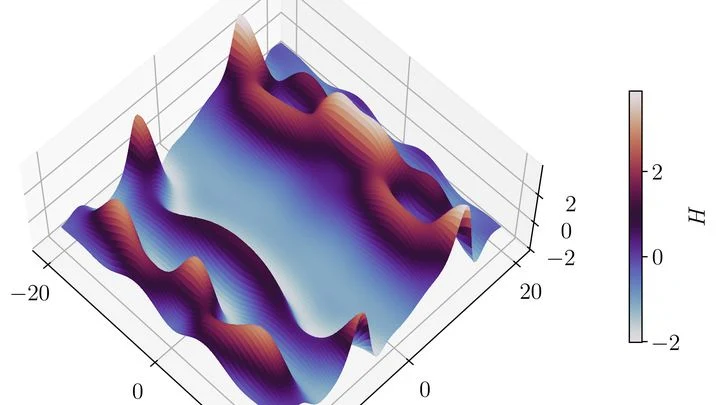
A thin stream of water on a shower glass gathers into winding rivulets that quiver and shift before your eyes. Such a liquid film flowing down a vertical surface is a classic example of chaos in nature: it all flows downward, sure, but the surface lives its own unpredictable life.
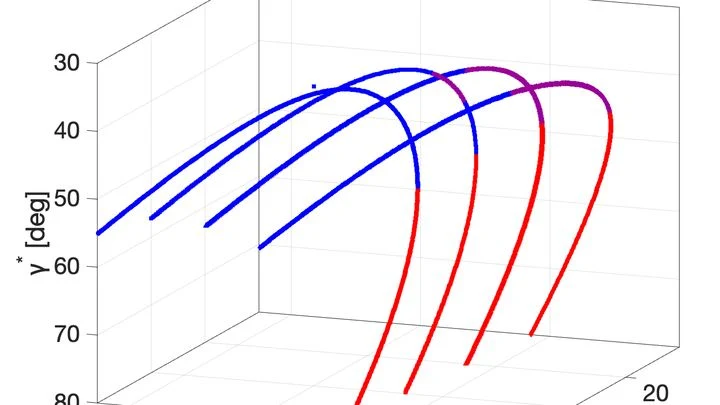
A lizard falling from a branch doesn't just tumble: it catches the air with its body and turns the fall into a glide. Engineers have long borrowed tricks from such feats, but until now there was no common language to compare the gliding of a snake, a lizard, and a man-made wing. The new study introduces such a language: a three-dimensional map of velocities that shows where any motion inevitably ends up.
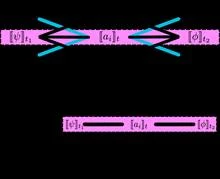
Time in quantum mechanics is like a shadow on a wall: we see its motion, but we cannot grasp the shadow itself. The Schrödinger equation describes how a system's state changes, but time enters it as an external parameter that nothing measures.