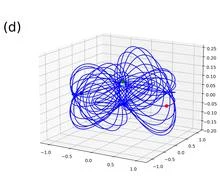
A periodic orbit is a path in a dynamical system that repeats itself exactly after a fixed amount of time, forming a closed loop in the state space. Think of a planet orbiting a star: after one year, it returns to the same position and velocity, so its trajectory is a periodic orbit. In contrast, a chaotic system may have trajectories that never quite repeat, even if they stay bounded. Periodic orbits are the simplest nontrivial solutions to dynamical equations, and they serve as the skeleton around which more complex behavior is organized.
History
The concept dates back to the early studies of celestial mechanics, with Henri Poincaré's work in the late 19th century laying the foundation for understanding periodic orbits in nonlinear systems. He introduced the Poincaré map as a tool to study them.
How it works
In a system described by differential equations, a periodic orbit corresponds to a solution where the state variables return to their initial values after a period T. The orbit is stable if small perturbationsdecay over time, pulling the trajectory back onto the loop; it is unstable if perturbations grow. Stability is determined by how the system's linearized dynamics behave around the orbit, often analyzed using Floquet theory or Poincaré maps, which reduce the continuous flow to a discrete map on a cross-section.
In practice
Periodic orbits are used to design spacecraft trajectories, such as halo orbits around Lagrange points, and to analyze the stability of mechanical systems, electrical circuits, and biological rhythms.
Fun fact
In chaotic systems, periodic orbits are dense—meaning that arbitrarily close to any chaotic trajectory, there exists a periodic orbit that is unstable, a fact that underpins the theory of chaotic saddles and symbolic dynamics.
A forest does not live in a static world. Between winter and summer, day and night, conditions shift, and each fluctuation is like a rhythm that all its inhabitants must keep pace with. Yet until now, ecologists have mostly studied how communities of living beings persist in an unchanging environment, like testing a bridge's strength only in calm weather.
A lighthouse that blinks not every second but once every few minutes or even hours. That is exactly how long-period radio transients behave — cosmic sources discovered only recently.
A quantum particle moves in a circle, passing through several stations. At each station, something happens to it — for example, its properties change slightly. After completing a full circle, the particle returns, but its state is no longer exactly what it was at the start.
The spiral of water draining into a sink spins faster and faster toward the center. In an ordinary black hole, that funnel ends in an infinitely sharp point — a singularity where the laws of physics break down. But this new work considers a different picture: the funnel doesn't taper to a needle but ends in a smooth, swelling bubble.
In the world of atoms and particles, everything tends toward rest: particles lose energy, just as a swing slows down due to energy loss (friction). But many devices — from hydrogen masers to atomic clocks — live by repetitive cycles.
A flock of birds or a school of fish sometimes swirls into a vortex, even though no individual commands 'spin.' Such collective rotation helps the group stay together and mix better. It is usually explained by the individuals being asymmetric, like a screw, or pushing each other with a twist. But a new study finds another route.
A black hole can torment a star for years, rather than rip it apart immediately. Tidal forces are when the hole's gravity stretches the star: the near side is pulled harder than the far side. Usually, getting too close rips the star apart instantly — that's a tidal disruption event.
An icy rock is flying through the Solar System on an open trajectory — coming in from interstellar space, swinging around the Sun, and heading back into the dark.
A comet hurtling through space is a mountain of ice and dust that carries itself across the Solar System. If you mount small engines on such a mountain, it becomes a ship with its own fuel: gas from the interior can be vented through nozzles to change course.
A thin stream of water on a shower glass gathers into winding rivulets that quiver and shift before your eyes. Such a liquid film flowing down a vertical surface is a classic example of chaos in nature: it all flows downward, sure, but the surface lives its own unpredictable life.
Ordinary tiles form a repeating pattern. But atoms can do more: under certain conditions, they themselves lay out a complex mosaic where the pattern never repeats, like on antique tile panels.
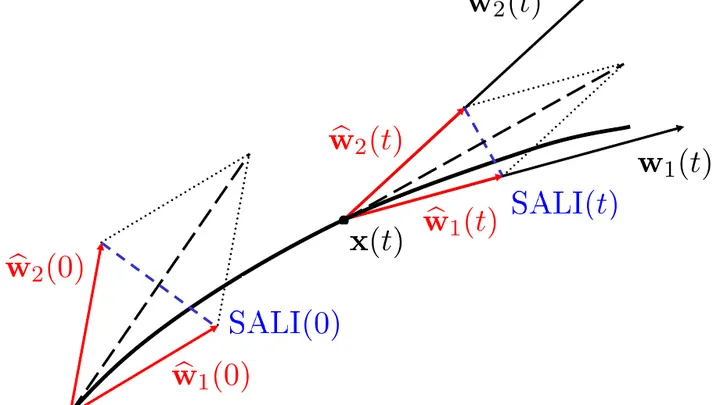
Drop a stone into a calm pond — the ripples spread evenly. Drop it into a churning stream — the water swirls unpredictably. Scientists have long wrestled with a similar question: how can you tell from a single particle's path whether its motion is chaotic? Previously, this meant comparing the particle's path with neighboring ones, which is complicated and time-consuming.
Interstellar wanderers are rocks and icy chunks that have broken free from their home planetary systems and now drift through the Galaxy. The first such visitor, 'Oumuamua, zipped past the Sun in 2017, followed by Comet Borisov and the ATLAS object. Where do they come from?
Two stars, drawing together in a cosmic dance, experience an extra wobble — a consequence of spacetime curvature (an effect predicted by Einstein). A planet orbiting them also wobbles. Sometimes the rhythms align: the gravitational tugs from the stars fall in step with the planet’s orbit, like hands pushing a swing.
Imagine a pendulum that is pushed in time with the seasons: harder in winter, softer in summer. But this pendulum has a quirk: a switch that operates with a delay. When the pendulum passes through zero, the switch clicks and changes the direction of the push. That is exactly how the simplified El Niño model built by mathematicians works.
Three bodies attracting each other by universal gravitation: a problem that has stumped mathematics for three centuries. After Poincaré, it became clear that no general solution exists and trajectories are chaotic. But within this chaos there are islands of order: periodic orbits where motion repeats.
The ocean off Peru is not just warm: it pulses. Every few years, the winds die down, warm water creeps eastward, and fishermen are left empty-handed. This is El Niño, and its arrivals do not follow a simple schedule. Some researchers blamed random weather gusts, others sought chaos in the climate system itself.
A traveler in the desert sees a lake. It shimmers, beckons with coolness, but as you approach, the water recedes. So it is in mathematics: the computer draws chaos, lines dart across the screen, and it seems we are witnessing a real storm. But if you wait long enough, the storm subsides, and the trajectory settles into a simple equilibrium.