A chaotic attractor is a geometric shape that describes the long-term behavior of a dynamical system that is both deterministic and unpredictable in detail. In such a system, the state evolves over time, and no matter where it starts, it eventually settles onto this attractor—a set of states it keeps visiting. However, the path it takes on the attractor is exquisitely sensitive to tiny differences in starting conditions, so two nearly identical initial states quickly diverge and follow completely different trajectories.
History
The concept emerged from Edward Lorenz's work in the 1960s on simplified atmospheric convection, where he discovered that a three-variable model produced a butterfly-shaped attractor with chaotic behavior. The term 'strange attractor' was coined by David Ruelle and Floris Takens in 1971.
How it works
The attractor is formed by the system's equations, which pull the state toward certain regions of its state space while also stretching and folding the trajectories like a baker kneading dough. This stretching amplifies small uncertainties, while the folding keeps the motion bounded, so the system never escapes but also never repeats exactly. The result is a fractal structure that is neither a simple point, a closed loop, nor a smooth surface, but a strange, infinitely detailed object.
In practice
Chaotic attractors are used to analyze turbulence, design secure communication systems that exploit chaos, and understand the limits of predictability in weather and climate.
Fun fact
The Lorenz attractor, the first chaotic attractor studied, is shaped like a butterfly's wings, giving rise to the famous 'butterfly effect' metaphor.
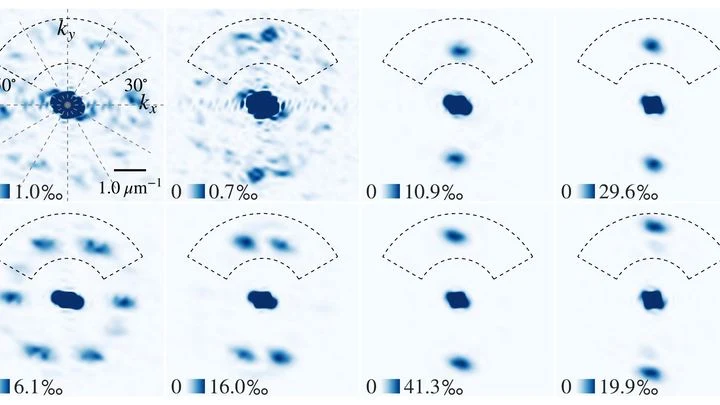
Two dancers on one stage: the triangle and the stripe. In a quantum gas of dysprosium atoms cooled to 62 nanokelvin, these two spatial structures have met for the first time in a single experiment. The gas is held in a trap shaped like a surfboard, and its atoms are among the most magnetic in the periodic table.
Moiré patterns are familiar to everyone. Two combs with different spacing, placed on top of each other, show dark fringes. Something similar has emerged in time. Physicists took a cloud of Rydberg atoms, particles with unusually large electron orbits, and illuminated it with two lasers.
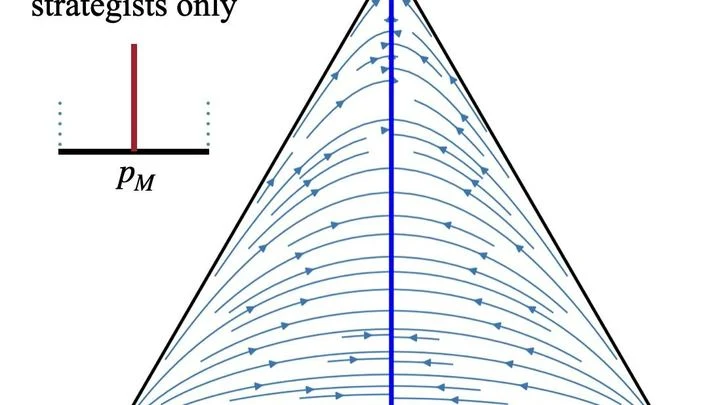
For a long time, biologists argued: if a herd of animals stably maintains a mix of aggressive and peaceful individuals, does each one alternately change behavior, or do some always fight while others always yield? In classical equations, these options are indistinguishable.
An orchestra of billions of cesium atoms struck a single note, and it sounded for 17 hours without fading. That’s no exaggeration: Chinese physicists created a continuous time crystal with a record-breaking lifespan. A time crystal is a system that breaks time symmetry, spontaneously pulsating in an unchanging rhythm.
An ionic conductor resembles a crowded bus where passengers (ions) try to squeeze toward the exit. Previously, it was thought that fast exit could be achieved either by a gently swaying bus (soft lattice) or by passengers standing in chaotic order (geometric disorder). The new work shows these are not two different tricks but the same one.
A string sounds perfectly pure until a draft touches it. That's roughly how a superradiant laser works: a beam of atoms, pre-charged with energy, flies through a room made of two mirrors — an optical resonator (a trap where light bounces back and forth).
A crowd at a metro station during rush hour. Some hurry toward the escalator, others slow down at the departure board, still others weave around a column. Each step is not merely a reaction to what's right in front of your nose. A person estimates in advance where a neighbor will be a second from now and adjusts their route accordingly. Physicists call this forward-looking behavior anticipatory.
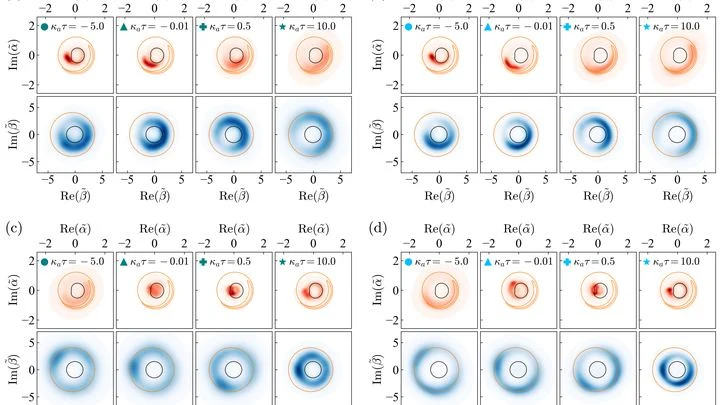
A swing can rock strongly or barely move. Usually, if left alone, it stays in its chosen mode. But in the microworld, things are different: a tiny membrane, oscillating under the action of a laser beam, can spontaneously jump from one amplitude to another.
A crystal is like a row of soldiers on a parade ground: every atom is in its place, and electrons march through it in neat waves. An amorphous material is like a crowd at a train station, where there is no order, just a jostling throng. In such a crowd, an electron usually gets stuck quickly, like a person trying to push through a dense mass of people.
A pendulum chooses how to swing on its own. If you give it a strong push, it quickly returns to a smooth rhythm. If you hold it at its extreme position, it will stay there, but as soon as you let go, it resumes its usual motion.
A figure skater glides across the ice, gradually approaching the center of the rink. A slight twist of the torso, and the smooth spiral breaks, the trajectory becomes unpredictable. Something similar happens when a small black hole with its own rotation (spin) falls toward a giant black hole.
According to the Standard Model, the vacuum is not emptiness but an ocean of virtual ghost particles. An ultra-strong electromagnetic field, like a storm, yanks electron-positron pairs into reality.
The quantum world loves order, but reality often brings disorder. In this work, physicists study one-dimensional chains of spins — tiny magnetic arrows that can point up or down. Usually, topological phases (stable states protected by symmetry) are defined for pure states, where each arrow is precisely known.
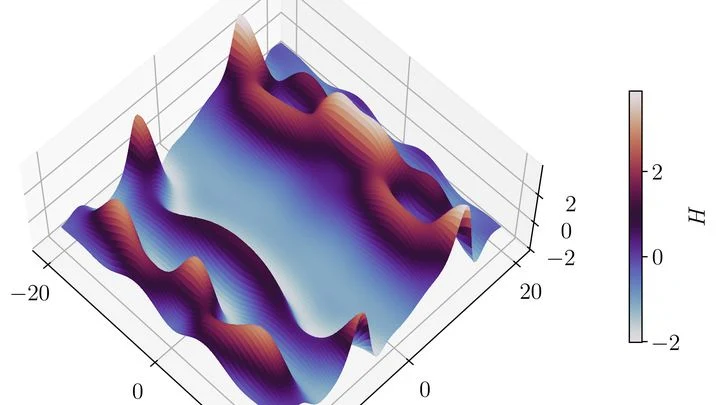
A thin stream of water on a shower glass gathers into winding rivulets that quiver and shift before your eyes. Such a liquid film flowing down a vertical surface is a classic example of chaos in nature: it all flows downward, sure, but the surface lives its own unpredictable life.
Polymers are long threads of carbon and hydrogen atoms. In living cells, they encounter streams of chemical signals that pulse like the surf. Long chains and closed rings behave like skilled surfers: they catch the wave and glide with it. Short fragments and tight coils, counterintuitively, move strictly against it.
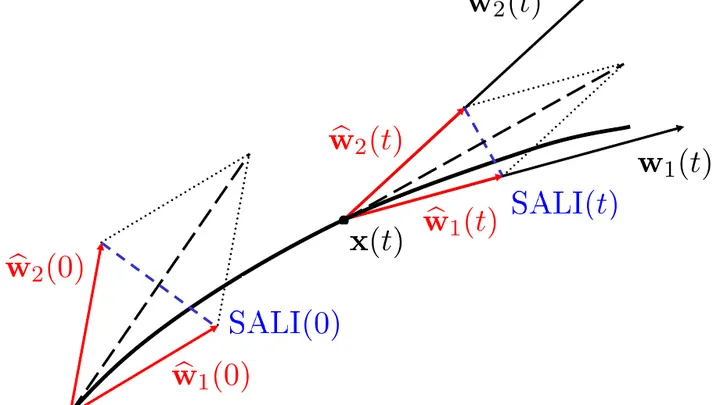
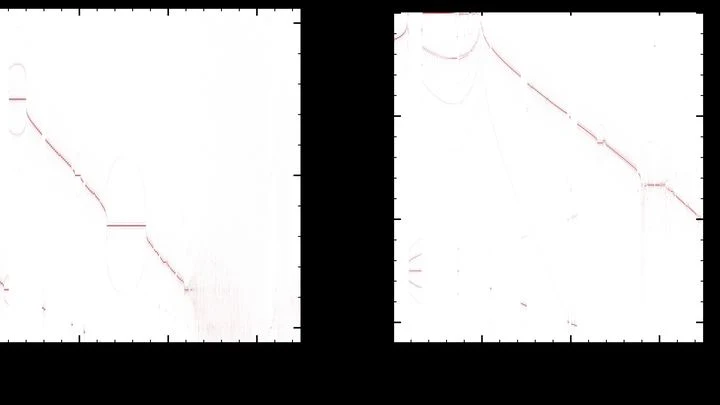
Drop a stone into a calm pond — the ripples spread evenly. Drop it into a churning stream — the water swirls unpredictably. Scientists have long wrestled with a similar question: how can you tell from a single particle's path whether its motion is chaotic? Previously, this meant comparing the particle's path with neighboring ones, which is complicated and time-consuming.
Time crystals are an exotic phase of matter that exhibits periodic motion not in space but in time, even while in its ground, unexcited state. This idea, reminiscent of a perpetual clock that never needs winding, was first proposed by Frank Wilczek.
Paraglider, hang glider, and glider — three different wings, but in the sky they behave the same. Pilots catch invisible warm air currents, rise on them, then glide to the next. Such flight is like a game of hopscotch: a jump upward, then a glide forward, and again a search for a place to jump.
Scientists analyzed thousands of real routes and found a common law.
A thin thread in a water flow is like a hair in a shower stream. If you jerk the water back and forth, the hair either stretches out with the flow or crumples up. The researchers took real protein threads (actin, which makes up muscles) and placed them in a microscopic channel where the fluid oscillated at different frequencies.
In 2019, the Event Horizon Telescope gave humanity the first image of a black hole's shadow. Since then, astrophysicists have dreamed of more: seeing how matter moves in the very funnel of spacetime. One of the mysteries is chaos.
A traveler in the desert sees a lake. It shimmers, beckons with coolness, but as you approach, the water recedes. So it is in mathematics: the computer draws chaos, lines dart across the screen, and it seems we are witnessing a real storm. But if you wait long enough, the storm subsides, and the trajectory settles into a simple equilibrium.