Invisible Rubidium in a Cesium Cloud express
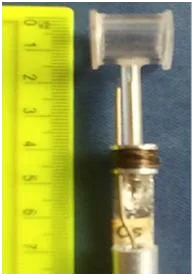
In a sealed glass bulb the size of a finger, metallic vapor boils. The main component is cesium, but one percent rubidium hides within. A laser beam at 795 nanometers finds this impurity and makes it glow.
Rubidium alone would give a weak signal: atoms quickly fly through the beam. But cesium acts like a dense crowd, in which rubidium atoms jostle and slow down. A slow atom stays in the beam longer, and the response becomes brighter.
It's like spotting a familiar face in a crowd: alone, a person runs past, but in a crowd they're forced to walk slowly, and easier to notice.
The cell is made entirely of sapphire. Ordinary glass at 500°C blackens from metal vapor, but sapphire withstands heating without clouding. This allows studying mixtures at high temperatures.
The measured spectra provide an estimate of collisions between cesium and rubidium atoms. Such data are needed for precise atomic clocks and quantum sensors.
Original abstract
as written by the authors arXiv:2603.09284
In the sealed-off cesium vapor cell studied in this work, a residual rubidium fraction of approximately $$\sim$$1\% was observed. We investigate the optical response of these trace Rb atoms in a sealed 1~cm long Cs-filled vapor cell. Despite the low concentration, laser excitation at 795~nm allows the observation of saturated absorption and electromagnetically induced transparency (EIT) resonances. The surrounding Cs vapor effectively acts as a buffer medium, reducing the Rb atomic velocity and increasing the interaction time with the laser field, which improves the EIT signal. The experiments are performed in an all-sapphire cell that can be heated up to 500$$^{\circ}$$C without window blackening, unlike conventional glass cells. From the measured spectra, Cs--Rb collisional cross sections are estimated. These results show that residual atomic species in high-temperature vapor cells can be exploited for spectroscopic and nonlinear-optical studies.
Rubidium and cesium are neighbors in the periodic table, but cesium evaporates at 28°C, while rubidium does so at 39°C. In the cell, both metals are in vapor form.