A barium ion (Ba⁺) is a barium atom that has lost one electron, giving it a positive charge. In quantum physics, barium ions are prized as trapped particles for experiments in quantum computing, precision measurement, and fundamental physics. They have a relatively simple electronic structure with strong, accessible optical transitions, making them easy to laser-cool and manipulate. Barium ions can be held in electromagnetic traps (Paul traps) and their internal quantum states can be read out with high fidelity.
History
Barium ions were first trapped and laser-cooled in the late 1970s and early 1980s, following the development of ion trapping techniques by Wolfgang Paul and Hans Dehmelt (Nobel Prize 1989).
How it works
In a typical experiment, barium ions are produced by heating a barium sample and ionizing the atoms with an electron beam or laser. The ions are then confined in a radio-frequency Paul trap, where oscillating electric fields create a potential well. Lasers cool the ions to near their motional ground state, and additional laser pulses manipulate their electronic and hyperfine states to perform quantum operations. The ion's fluorescence (scattered laser light) reveals its quantum state, enabling measurement.
In practice
Barium ions are used in trapped-ion quantum computers, optical atomic clocks, and tests of fundamental symmetries, such as searches for electric dipole moments.
Fun fact
Barium ions can be 'sympathetically cooled' by a neighboring ion of a different species, allowing quantum experiments with ions that lack convenient laser transitions.
Miners took canaries underground not for their songs. The bird would fall off its perch before the miner noticed carbon monoxide. In ultrahigh vacuum, the canary's role is played by a cloud of one hundred thousand lithium or rubidium atoms.
To probe deeper into the workings of the universe, physicists accelerate electrons and smash them together. An ordinary electron is like a spinning top that wobbles randomly. For delicate experiments, you need particles whose spins all point in the same direction: this is called polarization.
An extra electron in a molecule is like a passenger barely hanging onto the step of a departing train. Such a 'passenger' turns the particle into an anion — a negative ion. Studying it is tough: the bond is weak, the electron cloud is diffuse, and any jolt can knock the electron off.
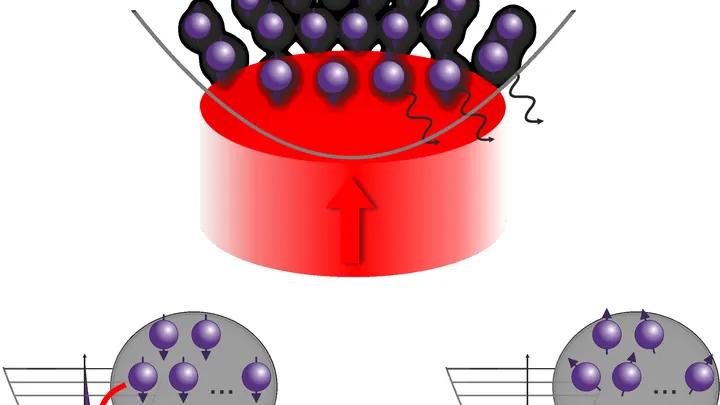
A tiny crystal of charged atoms, trapped in a trap, trembles with heat. Each ion oscillates like a ball on a spring, and these vibrations hinder using the crystal for precise quantum operations. Usually, excess energy is removed with a laser — the beam hits the ions and slows their motion, like a stream of air damping a pendulum.
Energy transfer in photosynthesis is like a children's slide: it bends under the weight of one, reshaping the path for the next. That's what happens in a leaf: an excited molecule instantly reshapes the 'landscape' of its neighbors.
Physicists reproduce this effect using ions suspended in a vacuum trap.
A long string of beads settles into a tiny box — some beads press together, others spread apart. That's the puzzle a protein solves when it folds into a working molecule. Except the beads, amino acids, can number in the hundreds, and every contact between them reshapes the whole structure.
A typical atom trap works like a funnel: laser light and a magnetic field slow atoms down and gather them at the center. But the funnel has a limit: it only catches atoms moving within a certain speed range.
A stone falls into a pond, and ripples spread in all directions. In much the same way, a massive body creates ripples in spacetime. Only it's not water that oscillates, but the very fabric of reality, and instead of circles, there are gravitational waves.
When heavy nuclei collide in accelerators, a multitude of particles is produced, and physicists want to understand how electric charge moves through this chaos. Two trains crash into each other: the passengers (quarks) scatter, but their luggage (charge) may end up far from the crash site.
A solid electrolyte is like a sponge for lithium ions. In a regular lithium battery, ions float in a liquid, like fish in an aquarium. In a solid-state battery, they have to squeeze through the crystal lattice, like through narrow corridors.
A beam of carbon ions strikes the tumor precisely, like a surgeon who can only see the skin. Inside the body, the beam stops, and exactly where used to be a mystery. Now, helium is mixed into the same beam: it passes through the body like an X-ray, and its trail shows where the carbon went.
In a sealed glass bulb the size of a finger, metallic vapor boils. The main component is cesium, but one percent rubidium hides within. A laser beam at 795 nanometers finds this impurity and makes it glow.
Rubidium alone would give a weak signal: atoms quickly fly through the beam.
In a giant particle accelerator, where protons traveling at nearly the speed of light smash into a neon target, charmed baryons are born — particles that live for less than a billionth of a second.
An ordinary magnet makes a compass needle turn, but it doesn't stop the needle from moving forward. But if you twist a magnetic field into a knot, it can trap a particle in place, like a snare. This phenomenon is called an 'Aharonov–Bohm cage': the particle's waves cancel each other out at some points and reinforce at others, leaving only tiny 'islands' where it can exist.
A magnetic material can be compared to a crowd of tiny compasses. In an ordinary magnet, all the needles point in the same direction, and turning them all at once is no easy feat. Physicists have found a way to do this with an electric current.
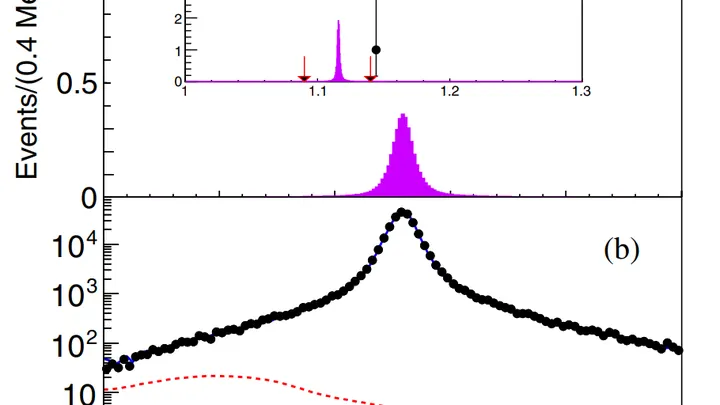
In a particle accelerator, the anti-lambda particle is a rare guest. It is born on the fly, lives for a tiny fraction of a second, and usually decays on its own. But sometimes it manages to collide with an ordinary proton, and then a whole shower of light particles is born: kaons, pions.
A football kicked with spin doesn't fly straight: it bends to the side. A tightly focused beam of light does something similar: it starts pushing an atom not just forward but also sideways. Physicists measured this shift on a single calcium ion trapped in a light trap.
The beam was aimed at the atom like a spotlight on a grain of sand.
In the first minutes after the Big Bang, the Universe was like a blazing hot stove. On it, according to the 'recipe' of the standard theory, hydrogen, helium, and a bit of lithium were supposed to cook. But telescopes see only a third of the lithium that this recipe calls for.
In the BESIII detector, particles put on a show: they collide, are born, and decay, leaving flashes of light. But sometimes an actor can leave the stage unnoticed — through a hidden door that cameras don't see. Physicists were looking for exactly such 'quiet' decays, when a particle turns into something invisible to the instruments.
A lone ion in a trap jitters like a swing, and each oscillation introduces an error into quantum calculations. Traditionally, jitter is suppressed by cooling almost to absolute zero: this is bulky and expensive.