Crystal Detector Based on Rubidium-87: Hunting for Traces of Sterile Neutrinos
Ordinary table salt on the kitchen counter seems inert, but inside its crystal lattice, events invisible to the eye can take place.
A chemical element with atomic number 37, often used in ultracold atom experiments due to its favorable properties.Rubidium is a soft, silvery-white alkali metal with atomic number 37. In physics, its popularity stems from two properties: its two stable isotopes (85Rb and 87Rb) have convenient transitions for laser cooling, and its relatively simple electronic structure makes it ideal for trapping and manipulating atoms with light. Rubidium atoms are the workhorses of ultracold atom experiments, where clouds of atoms are cooled to microkelvin temperatures and used to study quantum phenomena like Bose-Einstein condensation and quantum simulation.
Rubidium was discovered in 1861 by Robert Bunsen and Gustav Kirchhoff via spectroscopy. Its use in ultracold experiments began in the 1980s, and the first Bose-Einstein condensate was created with rubidium-87 in 1995 by Eric Cornell, Carl Wieman, and Wolfgang Ketterle.
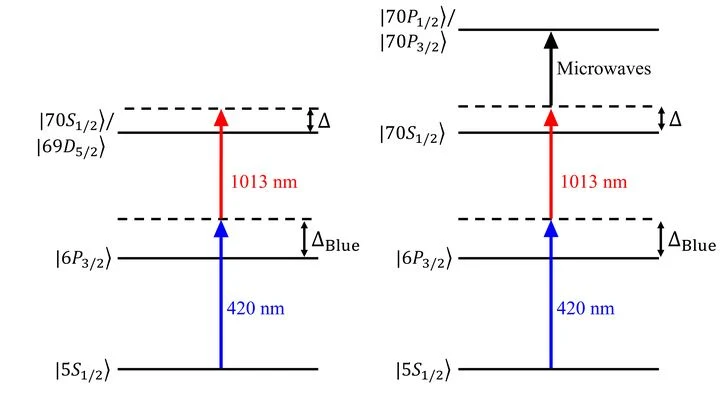
Rubidium atoms are cooled using laser light tuned slightly below an electronic transition. Photons scatter off the atoms, each scattering event reducing the atom's momentum, effectively creating a friction force that slows them down. Further cooling via evaporative techniques brings the cloud to quantum degeneracy. The atoms' internal states can be precisely controlled with magnetic fields and radiofrequency pulses, making them excellent qubits or simulators of condensed-matter systems.
Rubidium atomic clocks are used in GPS satellites and telecommunications; ultracold rubidium clouds are used in quantum sensors and quantum computing research.
Rubidium-87's ground-state hyperfine transition is so stable that it defines the second in some atomic clock standards, though cesium-133 is the official SI definition.