The Helium-7 Mystery: Three Neutrons Set Free express
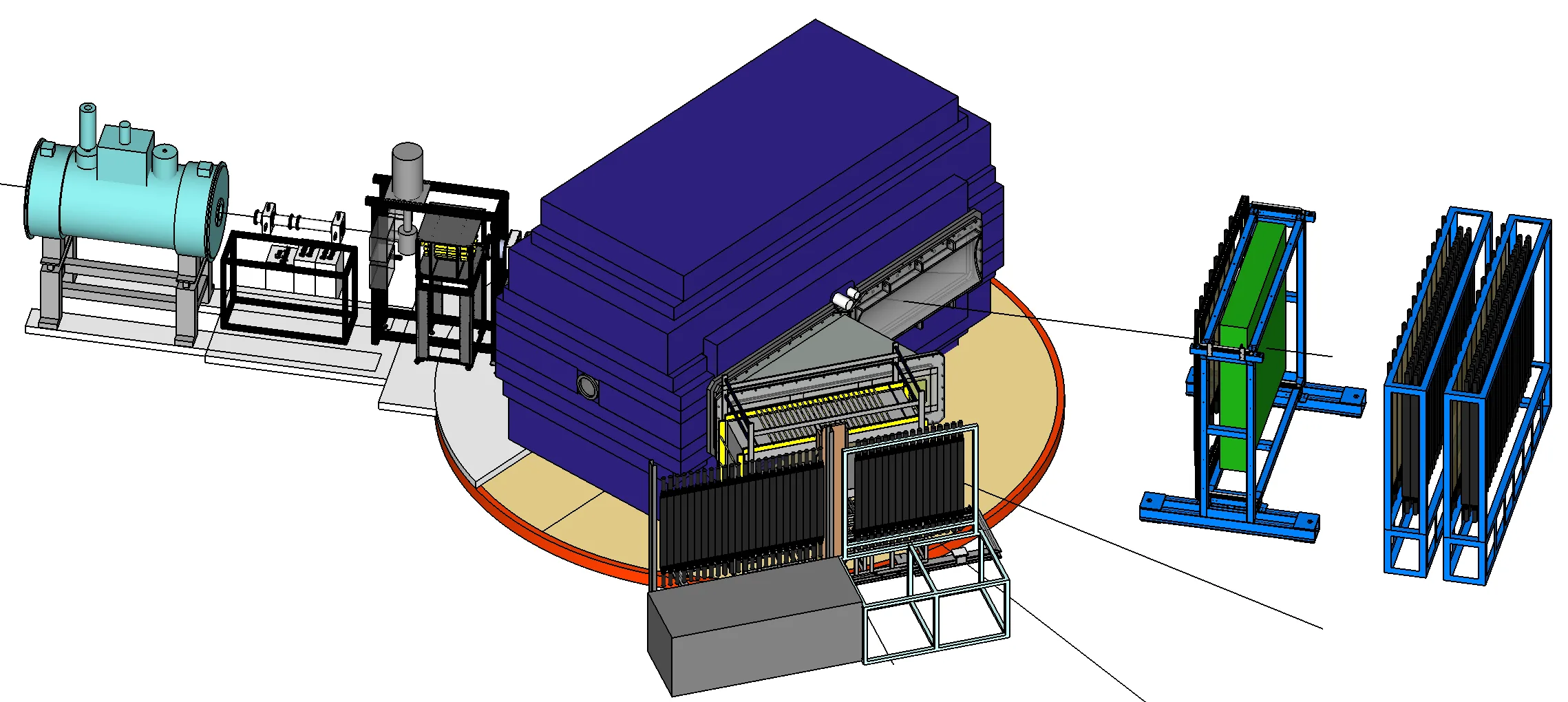
A high-speed collision knocked a neutron out of a helium-8 nucleus, and for an instant a helium-7 nucleus appeared, like an overloaded shelf shedding three books at once. This fleeting 'sound' of decay was captured for the first time: three neutrons flew apart, leaving behind an ordinary helium-4 nucleus.
It turned out that the neutrons don't leave all at once but one by one: first, two form an excited helium-6 nucleus, and only then does the third fly out. The experiment found no special 'triple embrace' of neutrons, including the hypothetical trineutron — everything is explained by known pairwise interactions.
This work is like a precise recording of three drops falling from a leaf: physicists can now test their models of nuclear forces against reality at the very edge of stability.
Original abstract
as written by the authors arXiv:2603.10859
Three-neutron emission from $$^7$$He has been directly measured for the first time, following neutron knockout from a $$^8$$He beam at 156 MeV/nucleon. A resonance-like structure at $$2.08(4)$$ MeV above the $$^4$$He+$$3n$$ threshold [$$E_x=2.68(4)$$ MeV] with a width of $$3.9(2)$$ MeV was observed and deduced to arise predominately from the predicted $$J^{\pi}=3/2^{-}_2$$ level. The three-neutron invariant-mass spectrum was reconstructed and found to peak at around 1 MeV and could, through complete simulations incorporating neutron-neutron correlations, be very well described by the sequential decay of $$^7$$He$$^*$$ via the $$2_1^+$$ excited state of $$^6$$He. No evidence was found for any significant three-neutron correlations beyond those expected from well-established two-body interactions, including a trineutron resonance.
The helium-7 nucleus is so unstable that its lifetime is comparable to the time it takes light to travel a few centimeters.