The teraelectronvolt (TeV) is a unit of energy equal to one trillion electronvolts (10^12 eV). In particle physics, it is the standard scale for describing the energies of elementary particles, both in cosmic rays arriving from space and in the collisions produced by the world's most powerful accelerators. Because mass and energy are equivalent (E=mc²), particle masses are also commonly quoted in electronvolts (or multiples like GeV and TeV), so the TeV marks the threshold where particles become 'heavy' in the modern sense — for example, the top quark, the heaviest known elementary particle, has a mass of about 0.173 TeV.
History
The electronvolt was introduced in the early 20th century, and the prefix 'tera' (meaning trillion) was adopted as accelerator energies grew in the 1970s. The TeV became a household term in particle physics with the construction of the Tevatron at Fermilab (completed 1983) and later the Large Hadron Collider.
How it works
An electronvolt is defined as the kinetic energy gained by a single electron when accelerated through an electric potential difference of one volt. One TeV is simply a billion times larger. In practice, physicists use the TeV to compare the energy of cosmic rays (which can reach millions of TeV) with the energy of particles produced in colliders like the LHC, which collides protons at 13 TeV. When a particle's rest mass is expressed in TeV, it directly tells you how much energy is locked in that mass, and therefore how much collision energy is needed to create it.
In practice
The TeV scale is used to calibrate and describe the energies of cosmic-ray observatories (like the Pierre Auger Observatory) and high-energy particle colliders, as well as to set the energy thresholds for detecting astrophysical neutrinos and gamma rays.
Fun fact
A single proton in the Large Hadron Collider carries about 6.5 TeV of energy — roughly the kinetic energy of a flying mosquito, but squeezed into a volume a trillion times smaller than a grain of sand.
Systems:natural1 TeV = 10^12 eV = 1.602176634 × 10^-7 joules
A proton beam aimed at a tumor cuts through soft tissue like a knife through butter, but its range depends on the subtle properties of water, the stuff we're mostly made of. Water is the body's main component, and how quickly protons slow down in it determines exactly where they deposit their energy.
The universe sometimes resembles an old fabric: after rapid cooling, wrinkles could have remained — thin, almost invisible threads of monstrous density. They are called cosmic strings. Usually, at the center of such a string hides a singularity — a point where the laws of physics lose their meaning.
Dark matter — the invisible architect of the universe, holding galaxies from flying apart. Thanks to the pioneering work of Fritz Zwicky and Vera Rubin we know: ordinary matter in the cosmos is just a negligible impurity. But what lies behind this dark matter?
A cosmic detective story spanning a decade and a half has turned up an unexpected clue. The Fermi telescope, which scans the sky in gamma rays, has detected a steady, faint glow enveloping the entire Milky Way. It looks nothing like the light from stars or hot gas — more like a dim, all-pervasive haze.
Every second, invisible projectiles from the depths of space pierce through us. These are cosmic rays — atomic nuclei accelerated to speeds nearly indistinguishable from the speed of light. Their energy is hundreds of millions of times greater than what our most powerful accelerators can achieve. Where does this monstrous force come from?
From 2016 to 2018, at the Large Hadron Collider at CERN, protons collided at energies of 13 teraelectronvolts, as if two peas were accelerated to speeds where their impact spawns a whole swarm of new particles.
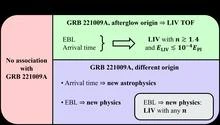
Gamma-ray burst GRB 221009A flared so brightly that it was dubbed the 'brightest of all time.' The LHAASO observatory detected gamma rays from it with energies up to 13 TeV — thousands of times more energetic than particles in an X-ray machine.
Cosmic rays are particles that arrive from deep space. When such a particle hits the atmosphere, it triggers a whole shower of new particles, like a billiard ball breaking a rack, sending balls scattering in all directions. To predict what such a shower will look like, we need to know how the primary particle interacts with the nuclei of air atoms.
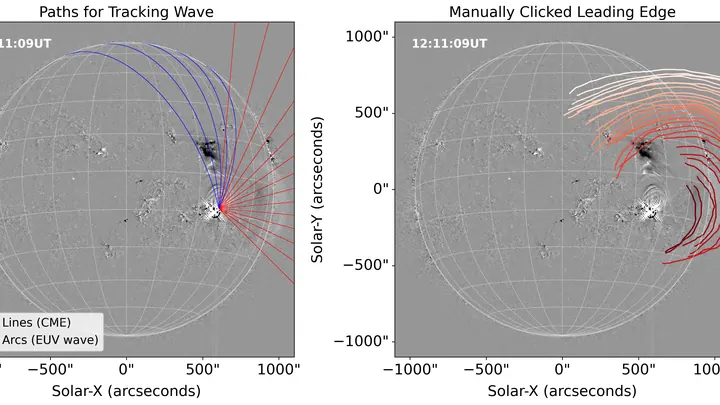
A shock wave in the Sun's corona is like the sonic boom from an airplane, except instead of air there is scorching plasma, and instead of sound there is a jump in density and magnetic field. On March 10, 2024, such a wave swept across the western part of the solar disk.
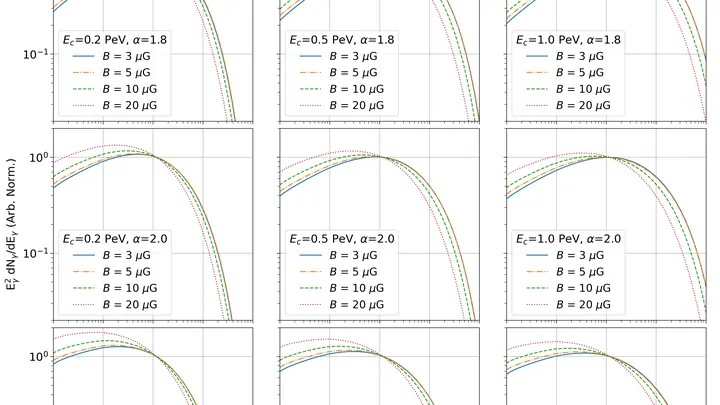
Gamma rays with energies above one hundred trillion electronvolts are like stones thrown with incredible force. For a long time, it was believed that only protons, heavy particles accelerated in cosmic accelerators, could launch such 'stones.' But new work shows that sometimes light electrons are enough.
Cosmic rays are not light but charged particles bombarding Earth from all directions. Most of them are protons (hydrogen nuclei), but heavier nuclei also show up: helium, nitrogen, iron.
Deep in the constellation Aquila lies a nebula that looks like an expanding bubble. It is inflated by a tiny star the size of a city — a pulsar that makes several rotations per second and loses rotational energy. Usually, such bubbles shine exactly as brightly as their pulsar is powerful.
In 2017, protons at the Large Hadron Collider collided with an energy of 5.02 TeV. The CMS detector recorded these collisions, and among billions of events, physicists hunted for a rare occurrence: the production of a single top quark without its antiparticle.
A high-speed collision knocked a neutron out of a helium-8 nucleus, and for an instant a helium-7 nucleus appeared, like an overloaded shelf shedding three books at once. This fleeting 'sound' of decay was captured for the first time: three neutrons flew apart, leaving behind an ordinary helium-4 nucleus.
In October 2022, the cosmos put on a fireworks show that every detector on Earth noticed. The explosion, named GRB 221009A, was so bright that it was called the brightest ever observed. It's a gamma-ray burst — a short but incredibly powerful flash that releases as much energy in seconds as the Sun will produce in its entire lifetime.
Twenty-eight seconds: that's how long it took for an automated camera to lock onto a flash in a constellation whose light had traveled for more than nine billion years.
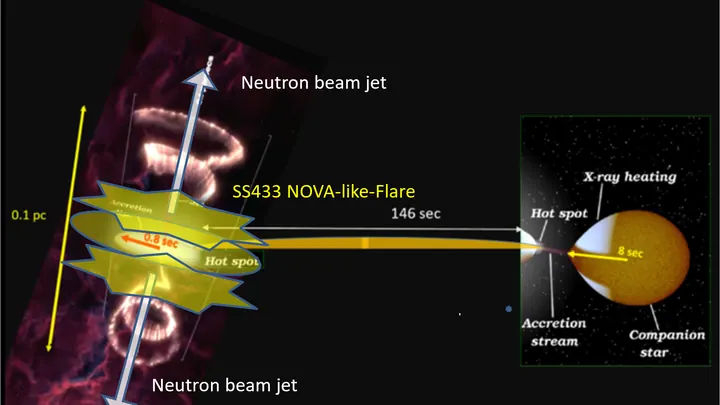
The binary system SS433 is known for its black hole stripping matter from a neighboring star. Some of the gas falls into the hole, while the rest is ejected in two narrow jets that wobble like a spinning top. These jets are visible in radio and X-rays.
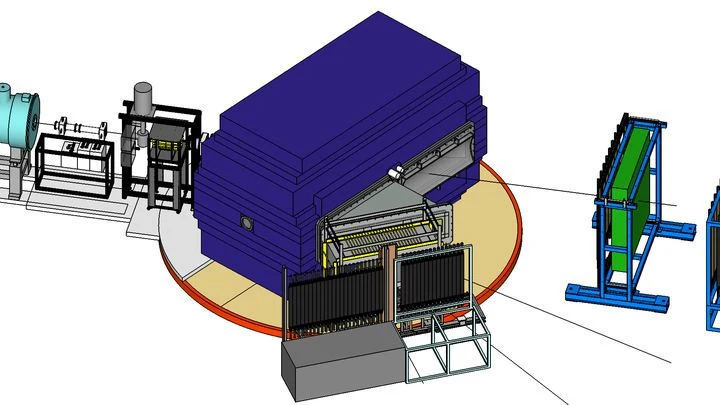
The top quark is the heaviest known building block of matter, but theory predicts a stealthy twin, the T-quark, which could be several times heavier. To coax it into the open, physicists collide protons with muons — the electron's unstable relatives.
A solar flare is like an explosion in the atmosphere: bright, fast, with different 'voices.' X-rays come from electrons that have been accelerated and then abruptly slowed down, losing energy. But in 2017, detectors on the Fermi satellite caught a different signal — gamma rays that didn't fit this picture.
In a collider detector, each proton collision leaves a trail of dozens of particles, like the splash from a stone thrown into water. Making sense of that splash and understanding what exactly happened at the moment of impact is a task that humans can no longer handle alone.
The electron is a tiny particle, but inside a crystal it behaves as if it had a different mass. Physicists call this the effective mass. To measure it, they make electrons run in circles in a magnetic field, like a speed skater on an ice rink who is kept from leaving the orbit.
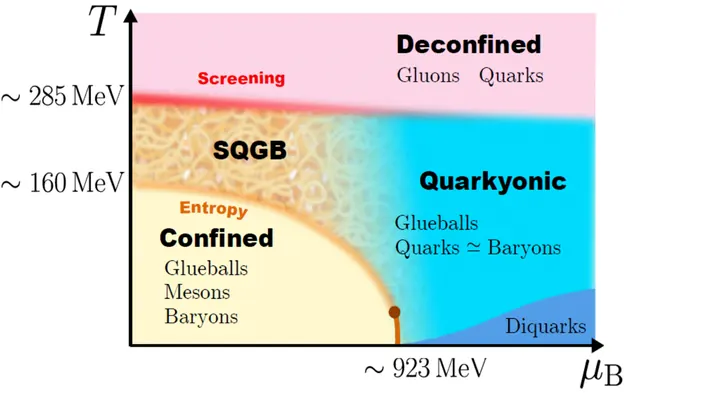
Water in a kettle heats to 100 degrees, and stops being water, turning into steam. Something similar happens to atomic nuclei when they are smashed together at enormous speeds in the Large Hadron Collider.
Galaxies in the Universe are not scattered randomly: neighboring ones move in the same direction, like a school of fish, while distant ones each go their own way. Where the boundary between 'together' and 'apart' lies has been unclear until now.
Just as in a crowded room each new person sharply increases the pressure on the walls, in a neutron star increasing density leads to a rise in internal resistance. But even this resistance has an absolute ceiling.
In October 2022, the LHAASO observatory measured the spectrum (energy distribution) of gamma-ray burst GRB 221009A — the brightest on record. Its light traveled for two billion years and was so intense that it disturbed the upper layers of Earth's atmosphere.
On October 9, 2022, the cosmos put on a show unlike anything astronomers had seen in the history of observations. Gamma-ray burst GRB 221009A, the most powerful cosmic explosion that produces a flash of gamma radiation, blinded detectors in orbit and on Earth.