The gigaelectronvolt (GeV) is a unit of energy equal to one billion electronvolts. In particle physics, it is the standard scale for describing the masses of particles and the energies involved in their interactions. For context, the mass of a proton is about 0.938 GeV/c², and the energy of a single photon in the visible spectrum is roughly a few electronvolts, so a GeV is a billion times larger. This unit is essential for quantifying phenomena from cosmic rays to the collisions inside particle accelerators.
History
The electronvolt was introduced in the early 20th century, and the prefix 'giga-' (meaning billion) was adopted as particle physics reached higher energies in the mid-20th century. The unit became standard with the development of accelerators like the Bevatron in the 1950s, which reached energies in the GeV range.
How it works
The electronvolt is defined as the kinetic energy gained by a single electron when accelerated through an electric potential difference of one volt. A gigaelectronvolt is simply 10⁹ times that amount. In practice, physicists use GeV to express the rest masses of particles via Einstein's E=mc², and to describe the energies of particle beams in accelerators or of individual particles in cosmic rays. When a particle with a mass of, say, 1 GeV/c² is created, it carries that much rest energy, and its total energy can be measured in the same units.
In practice
GeV is used to specify the energies of particle beams in accelerators like the LHC, to describe the masses of hadrons and bosons, and to characterize the energy spectrum of cosmic rays and gamma-ray bursts.
Fun fact
The energy of a flying mosquito is roughly a trillion GeV, so a single GeV is about a trillion times smaller than the kinetic energy of a mosquito in flight.
Systems:SInaturalOne gigaelectronvolt is equal to 1.602176634e-10 joules, defined as 10^9 times the electronvolt.
An assembly line spits out parts one by one per cycle. If the cycle is short and defects are few, the line runs fast. In quantum optics, a single-photon source plays the role of such a line: it must emit exactly one quantum of light per cycle, and the more cycles per second, the more photons go into the fiber.
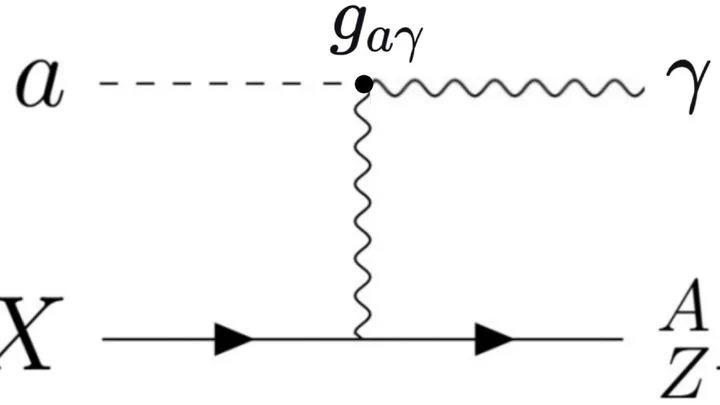
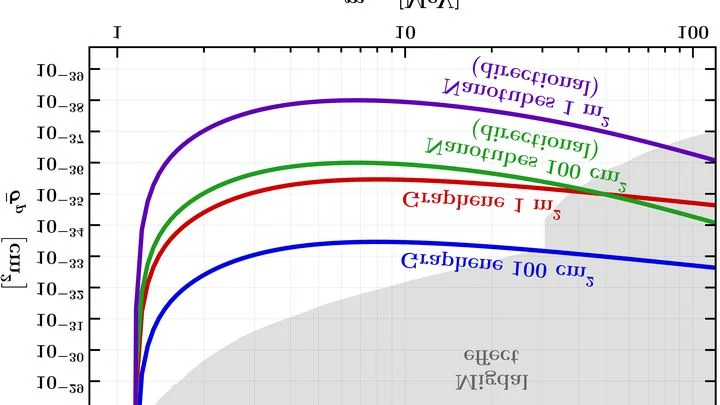
Inside the Sun, reactions can produce light, almost undetectable particles called axions. One such reaction yields axions with an energy of 5.49 MeV, as if each one carried the energy of a tennis ball moving at 100 km/h. These particles pass freely through Earth, but occasionally they might collide with a xenon atom.
Cosmic rays are particles that race across our Galaxy at enormous speeds. Their energies can be millions of times higher than those of particles in the most powerful accelerator on Earth. But the higher the energy, the fewer such particles there are: the plot of their numbers shows a noticeable kink, which is called the knee.
A proton beam aimed at a tumor cuts through soft tissue like a knife through butter, but its range depends on the subtle properties of water, the stuff we're mostly made of. Water is the body's main component, and how quickly protons slow down in it determines exactly where they deposit their energy.
The universe sometimes resembles an old fabric: after rapid cooling, wrinkles could have remained — thin, almost invisible threads of monstrous density. They are called cosmic strings. Usually, at the center of such a string hides a singularity — a point where the laws of physics lose their meaning.
In an orchestra, each musician plays their own part, but at a certain moment all instruments pause on a single note. Cosmic rays behave somewhat like this — particles flying toward us from distant stars.
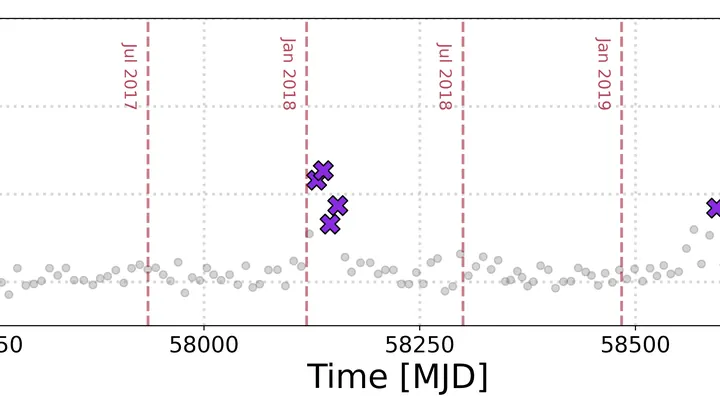
A spotlight shines ever brighter, but at some limit the bulb suddenly burns out, and no more light comes through. Astrophysicists have seen something similar in the distant blazar Markarian 421. This is an active galaxy whose jet of superheated plasma points almost straight at Earth, like the beam of a cosmic lighthouse.
Hydrogen is the most common element. Its atoms are like antennas: they emit and absorb light at very specific frequencies. Einstein predicted that spacetime can ripple: these are gravitational waves.
A detector filled with superfluid helium-4 is like a perfectly still lake. The liquid doesn't slosh or bubble: it's frozen in a single quantum state. An invisible guest, a dark matter particle, flies through it. It doesn't shine or leave a track. But sometimes it nudges a helium nucleus.
A drop of water stretches in a strong electric field. The deuterium nucleus, a bound pair of a proton and a neutron, behaves the same way, except here the field comes from a passing gamma ray, and instead of just stretching, the nucleus can simply fall apart.
Light twisted in one direction hits a proton. The particle can absorb the photon or deflect it — depending on how its own spin, a tiny internal top, is oriented. In the experiment at the MAMI accelerator in Mainz, a beam of polarized photons struck targets of polarized protons and deuterons (nuclei of heavy hydrogen).
When two particles fly at almost the same speed in the same direction, their signals in the detector merge, like two voices in unison. Telling a duet from a soloist is an art in itself.
From 2016 to 2018, at the Large Hadron Collider at CERN, protons collided at energies of 13 teraelectronvolts, as if two peas were accelerated to speeds where their impact spawns a whole swarm of new particles.
Gamma-ray burst GRB 221009A flared so brightly that it was dubbed the 'brightest of all time.' The LHAASO observatory detected gamma rays from it with energies up to 13 TeV — thousands of times more energetic than particles in an X-ray machine.
Cosmic rays are particles that arrive from deep space. When such a particle hits the atmosphere, it triggers a whole shower of new particles, like a billiard ball breaking a rack, sending balls scattering in all directions. To predict what such a shower will look like, we need to know how the primary particle interacts with the nuclei of air atoms.
In the basement of a laboratory in Jyväskylä, a trap holds a single atom aloft, like a magician balancing a ball on a fingertip. The tin-113 atom is unstable: sooner or later it captures one of its own electrons and becomes indium-113, emitting an elusive particle — the neutrino. How much energy is released in the process was previously known only approximately.
Light in an optical fiber is a stream of photons, and quantum communication requires single photons that can be sent one at a time. But making them emerge quickly while remaining indistinguishable from one another is a tough challenge.
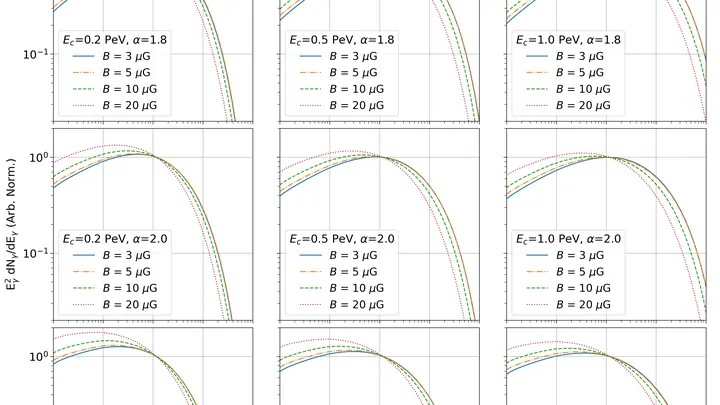
Gamma rays with energies above one hundred trillion electronvolts are like stones thrown with incredible force. For a long time, it was believed that only protons, heavy particles accelerated in cosmic accelerators, could launch such 'stones.' But new work shows that sometimes light electrons are enough.
A high-speed collision knocked a neutron out of a helium-8 nucleus, and for an instant a helium-7 nucleus appeared, like an overloaded shelf shedding three books at once. This fleeting 'sound' of decay was captured for the first time: three neutrons flew apart, leaving behind an ordinary helium-4 nucleus.
A gamma-ray burst is like a shot from a cosmic cannon: a brief but dazzling flash that outshines an entire galaxy for a few seconds. But when observed in the hardest gamma-ray band (photons with energies above a gigaelectronvolt), the signal often gets lost in the noise, like a whisper in a noisy hall.
Twenty-eight seconds: that's how long it took for an automated camera to lock onto a flash in a constellation whose light had traveled for more than nine billion years.
A proton can't be seen as a simple ball. If you hit it with a photon, it can absorb energy and jump into an excited state, like a bell that starts ringing at a certain frequency after being struck. These states are called nucleon resonances, and they live very briefly before decaying into other particles.
An electron inside a molecule behaves like a tiny magnet, and its 'strength' can be measured with enormous precision. Physicists took the molecular ion HD⁺ — a nucleus made of a proton and a deuteron (heavy hydrogen), with a single electron circling around it — and placed it in a strong magnetic field of 4 teslas (roughly 80,000 times stronger than…
Dark matter is invisible, but you can catch it on the rebound. Hydrogen embedded in a carbon film acts like a billiard ball: when a dark matter particle hits it, the proton flies out. That ejection is the signal you're looking for.
The neutron is a particle with no charge but with internal structure. Like a ball that looks smooth on the outside but has a complex filling inside. Scientists have long wanted to understand how electric and magnetic forces are distributed inside the neutron. To do this, you need to "feel" it — collide it with its antiparticle and see what happens.
In a collider detector, each proton collision leaves a trail of dozens of particles, like the splash from a stone thrown into water. Making sense of that splash and understanding what exactly happened at the moment of impact is a task that humans can no longer handle alone.
Light hits a silicon wafer, and a single electron is born inside it. An ordinary instrument wouldn't notice — the signal is too faint. The new detector not only hears it but also determines its energy with an accuracy of 589 millielectronvolts. That's like distinguishing the footsteps of an ant at arm's length.
Inside the detector, a particle knocks an electron out of a silicon atom. This takes 0.
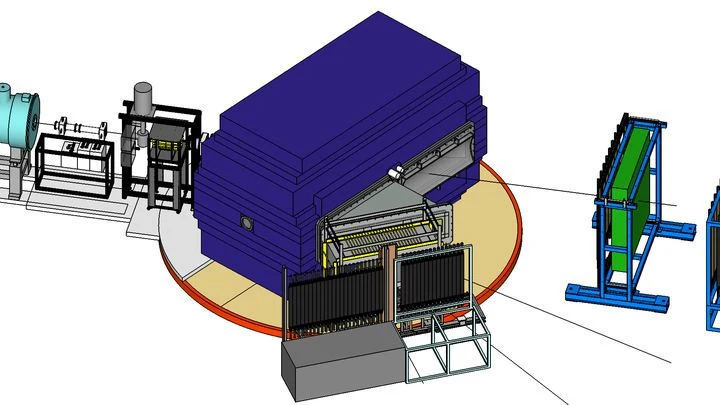
At Jefferson Lab, electrons are accelerated to 12 GeV and smash into protons to pry out their secrets. But existing detectors are like cameras with a narrow field of view: you either see a lot but dimly, or brightly but only a tiny patch. Electron scattering is the main tool, but statistics are insufficient for subtle effects.
At night over the Siberian taiga, a faint blue light sometimes flickers. It's not the aurora borealis but a cosmic-ray shower: a single particle from deep space slams into the atmosphere and shatters into millions of secondary particles. They race toward the ground in a broad front, like a ripple from a stone dropped into water, and make the air glow.
In the quiet harbor of the Local Bubble, a rarefied cavity of hot gas around the Sun, an explosion recently thundered. A supernova went off tens of parsecs away, and its echo still lingers in the neighborhood, reshaping the cosmic-ray landscape.
High above Antarctica, a balloon carried an instrument that caught electrons from space. These particles come from distant stellar explosions and other powerful events. The instrument measured their energy, like the force of an impact. And in one energy range, there were more impacts than calculations predicted.
In the stream of cosmic rays, particles flying toward us from the depths of the Galaxy, titanium is rare. Its nuclei are almost indistinguishable from iron: both are heavy, and both leave similar tracks in detectors.