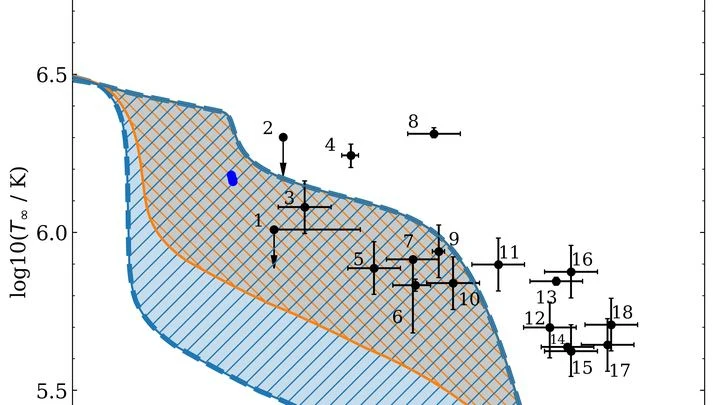
Neutrino emission from neutron stars is a key process that cools these extremely dense remnants of supernova explosions. Neutrinos are nearly massless, weakly interacting particles that are produced in vast numbers during the star's formation and continue to be emitted from its interior for thousands of years. Because they interact so rarely with matter, neutrinos can escape directly from the core, carrying away energy and providing a unique window into the otherwise hidden interior of a neutron star. Detecting these neutrinos is challenging but offers invaluable information about the star's composition, temperature, and the physics of matter at nuclear densities.
History
The theoretical prediction of neutrino emission from neutron stars dates back to the 1930s-40s, following the discovery of the neutron and the development of the neutrino concept by Wolfgang Pauli in 1930. The first detection of neutrinos from a supernova (SN 1987A) in 1987 confirmed the basic picture and marked the beginning of neutrino astronomy.
How it works
Inside a neutron star, neutrinos are produced through various processes, such as the Urca process (involving beta decay and electron capture) and neutron-neutron bremsstrahlung. These neutrinos stream out of the star without scattering, cooling it over time. On Earth, detectors like Super-Kamiokande in Japan or IceCube in Antarctica can catch a small fraction of these neutrinos. For a supernova event, a burst of neutrinos arrives before the optical light, allowing astronomers to detect the explosion early and study the neutron star's birth.
In practice
Neutrino detectors are used to monitor the sky for supernova events and to study the properties of neutron stars, complementing observations in electromagnetic radiation and gravitational waves.
Fun fact
The neutrinos detected from supernova SN 1987A arrived about three hours before the light from the explosion, because neutrinos escape the star's core immediately while the shock wave takes time to reach the surface.
Imagine two spinning tops set on a table. If they spin in the same direction, their combined rotation is large; if they spin toward each other, the total rotation can be zero even though each top spins rapidly on its own. In a pair of neutron stars approaching merger, their individual rotations, spins, play the role of such tops.
Deep beneath the ice of the South Pole, nearly two and a half kilometers down, an unusual telescope is at work. It is not pointed at the sky but through the Earth. Its quarry: neutrinos, nearly elusive particles that pass through planets and stars without interacting with anything.
When two neutron stars, the ultra-dense cores of dead stars, collide, a kilonova is born: an explosion a thousand times brighter than a typical nova. This is the universe's true smelting works. In the scorching cloud racing outward at near-light speeds, a furious flux of neutrons transmutes atomic nuclei into gold, platinum, osmium.
A sub-Neptune is a planet that falls between Earth and Neptune in size. These worlds are abundant in our galaxy, but their internal structure has been hotly debated. New research shows that in their youth, these planets behave like a sponge soaked with water.
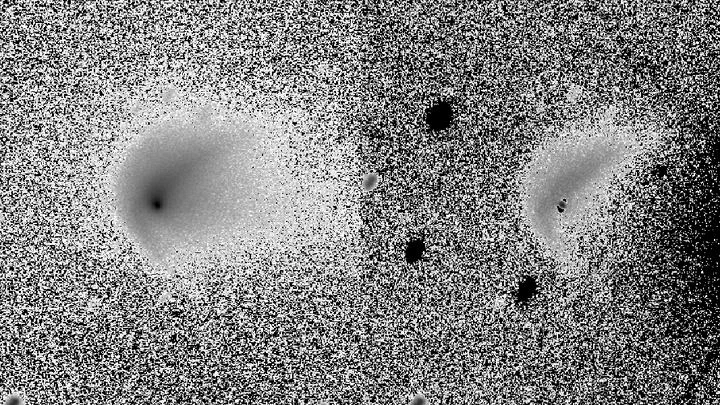
In the summer of 2021, comet 7P/Pons-Winnecke put on quite a show. A network of telescopes, the Las Cumbres Observatory, tracked it for nearly three months and counted eight sudden outbursts.
Nearly a decade and a half ago, the Fermi gamma-ray telescope spotted mysterious "bubbles" — giant plasma blobs, as if inflated by invisible lungs, towering tens of thousands of light-years from the Galactic center.
When a massive star dies, its core collapses, and a supernova explosion occurs. The cataclysm births streams of particles — like ripples from a thrown stone. The first to arrive are swift neutrinos, which pierce the Earth, hardly interacting. Then, hours later, ghost particles with a tiny charge appear.
In April 2021, in a galaxy 35 megaparsecs away, supernova SN 2021foa erupted. It immediately puzzled astronomers: its spectrum feverishly switched between hydrogen and helium lines — as if the star, in agony, was frantically shedding its outer layers.
Beyond Neptune, in the icy belt, astronomers watched as object (612533) 2002 XV93 momentarily occulted a distant star. Using метод прохождений (when a planet dims the star's light for a second, like a fly in front of a lamp), Уильям Боруки and Дэвид Шарбонно determined: the light not only dimmed but also shifted…
A laser hits a target of thin wires, and within tens of femtoseconds (billionths of a billionth of a second) knocks out a stream of protons. These protons fly into a converter made of lithium and deuterium, where neutrons are born.
Inside a neutron star, the density doesn't change smoothly but drops abruptly at sharp cliffs — density staircases. At these steps, the void suddenly births pairs: neutrinos and antineutrinos.
Deep beneath the Apennine Mountains, in a tank holding three tons of liquid xenon, something gives a barely perceptible shudder every few days. It's a solar neutrino, a ghostly particle born in the Sun's thermonuclear furnace, that has traveled 150 million kilometers through empty space and solid rock to finally collide with a xenon nucleus.
When a massive star explodes, its remnants fly apart like fragments of fireworks. But how do we know how far away such an explosion occurred? Astronomers have found a way: they look at the gas clouds that these remnants collide with.
The idea is simple. Supernova remnants are often surrounded by clouds of cold molecular gas.
A high-speed collision knocked a neutron out of a helium-8 nucleus, and for an instant a helium-7 nucleus appeared, like an overloaded shelf shedding three books at once. This fleeting 'sound' of decay was captured for the first time: three neutrons flew apart, leaving behind an ordinary helium-4 nucleus.
Neutrinos are tiny particles that barely interact with matter. They pass straight through a star like bullets through fog. When a massive star is gearing up to explode, its core contracts, temperatures soar, and neutrinos start streaming out.
A neutron star is the remnant of an exploded star, compressed to the size of a city. In its core, matter is packed so densely that a teaspoon of such material would weigh as much as a mountain. At such densities, as predicted by the theory of strong interactions, particles acquire 'twins'—parity partners.
In April 2023, Japanese satellites detected a super-intense X-ray burst on the neutron star MAXI J1752–457. The star cooled down in 4 days — five times faster than usual. Like someone cracked open a cosmic window.
When a star like the Sun runs out of hydrogen, it swells into a red giant, and helium piles up in its core. At some point, the helium ignites — in a few seconds, it releases as much energy as the star had radiated over thousands of years. This is a helium flash.
A multitude of atoms can act like a synchronized orchestra: if each emits light in unison with the rest, the flash becomes many times brighter. This is superradiance — a phenomenon well studied in the lab, but almost never sought in space. Now astrophysicists suspect that such collective 'notes' also play out in interstellar space.
A quasar is a supermassive black hole at the center of a galaxy that devours matter and shines brighter than all the stars around it. Some of that energy goes into radio emission, which, it was thought, could heat or expel cold gas — the raw material for new stars.
Deep inside a dying star eight times heavier than the Sun, a quiet fever begins a few days before the final explosion. The star's core contracts and heats up, releasing neutrinos — tiny particles that barely interact with matter. This stream is like a faint whisper before a loud cry: the supernova hasn't flashed yet, but it's already sending a signal of its imminent demise.
When a massive star explodes as a supernova, its material slams into the surrounding shell of cosmic dust and gas, like an invisible fur coat. The impact spawns myriads of neutrinos, ghostly particles that zip through planets without swerving.
Inside a neutron star, matter is squeezed so tightly that a teaspoon of its material would weigh as much as a mountain. We can't directly see what happens to particles under such conditions, but stars tell us about themselves through gravitational waves and light when two such stars merge.
At the center of many galaxies lurks a black hole — an object predicted by solutions to the equations of Karl Schwarzschild. Around it stretches a scorching corona — a region of tenuous plasma heated to billions of degrees.