The protonmass is the rest mass of the proton, a subatomic particle found in every atomic nucleus. Its value is approximately 1.6726219 × 10⁻²⁷ kilograms, or about 938.272 MeV/c² in particle physics units. The proton is not elementary; it is composed of three quarks (two up, one down) held together by the strong nuclear force, mediated by gluons. The mass of the proton is a key parameter in nuclear physics, chemistry, and astrophysics, influencing everything from atomic spectra to stellar fusion rates.
History
The proton was identified as a fundamental particle by Ernest Rutherford in 1919, though its mass was measured more precisely over the following decades. The modern understanding of its mass as dominated by strong-force energy emerged with quantum chromodynamics in the 1970s.
How it works
The proton's mass arises not from the masses of its constituent quarks (which contribute only about 1% of the total) but from the binding energy of the strong force and the kinetic energy of the quarks and gluons inside. This is a consequence of Einstein's mass–energy equivalence, E = mc². The proton's mass is measured through techniques like mass spectrometry and from the cyclotron frequency of protons in magnetic fields, yielding one of the most precisely known constants in physics.
In practice
The protonmass is used in calibrating particle accelerators, in medical proton therapy for cancer treatment, and as a reference standard in mass spectrometry for determining molecular masses.
Fun fact
The proton's mass is so stable that it is used as a mass standard in some contexts, but its exact value remains a challenge for lattice QCD calculations, which aim to derive it from first principles.
Inside an atomic nucleus, protons and neutrons don't sit still like peas in a pod. Each particle occupies its own orbit — a region of space where it can be found. The larger the orbit, the more 'smeared out' the particle is.
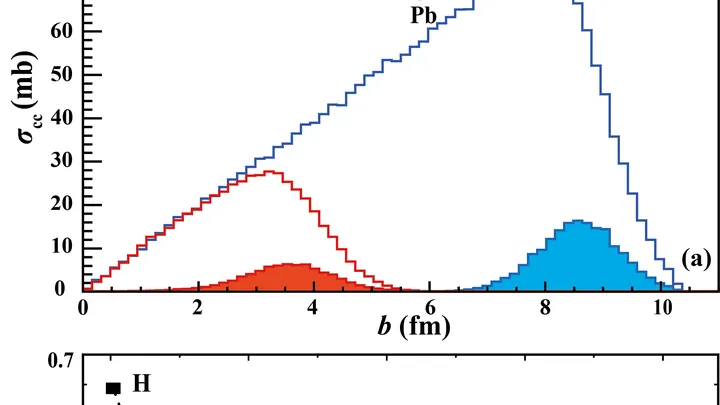
To determine the size of the proton cloud in an atomic nucleus, physicists collide an unstable nucleus with a target and observe how many protons it loses. The larger the projectile nucleus, the more often it grazes target nuclei and loses particles.
When a ψ(2S) particle decays into a proton and an antiproton, two different mechanisms act simultaneously: the strong interaction, like glue holding quarks together, and the electromagnetic one, like light pushing charges apart. Their contributions add up with a certain phase shift.
A proton beam aimed at a tumor cuts through soft tissue like a knife through butter, but its range depends on the subtle properties of water, the stuff we're mostly made of. Water is the body's main component, and how quickly protons slow down in it determines exactly where they deposit their energy.
At the center of every atom lies a nucleus — a dense ball of protons and neutrons. These particles don't just crowd together randomly; they fill strict energy levels, much like floors in a skyscraper. When a floor is completely filled, the nucleus becomes especially stable — physicists call this a magic number.
Imagine a perfectly tuned orchestra, where every instrument is adjusted with flawless precision, trying to play in a noisy hall. That noise is quantum gravity — the microscopic ripples of spacetime. It constantly threatens to throw the musicians off.
A noisy train station at rush hour. Thousands of people hurry past, voices merging into a dull roar. Somewhere in the crowd, two people try to shake hands with a special, barely visible gesture. Spotting such a handshake is nearly impossible.
A firework bursts, and one point explodes into four sparks at once. That's how the Z boson, the particle that carries the weak force, behaves when it decays into four charged leptons (electrons or muons). The process is extremely rare: for every million Z bosons produced, only about five decay this way.
An ordinary rain gauge collects water in a bucket and shows the total volume of precipitation. But the new device is like a sensitive palm that feels every falling drop and keeps count, even when the drops number in the thousands.
That's exactly what physicists have built.
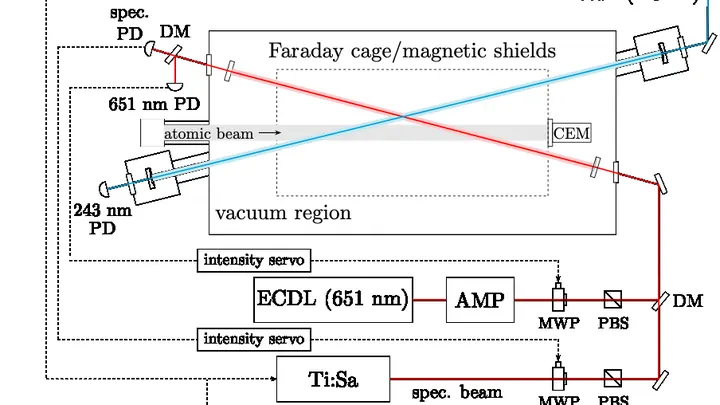
Hydrogen is the simplest atom: one proton and one electron. You'd think there's nothing left to study. But it's precisely on hydrogen that physicists test the most delicate laws of the microcosm. The electron in an atom can occupy different energy levels, like steps on a ladder.
The outer crust of a neutron star is like a layered cake, where each layer is a strictly defined filling. It's a crystalline lattice of atomic nuclei immersed in a sea of electrons. The deeper you go, the stronger the pressure, and the heavier the nuclei that can exist there without falling apart.
Two tin nuclei collide at about two-thirds the speed of light. For an instant, a hot, dense cloud forms, and protons fly out in all directions. If you catch pairs of protons and measure how often they fly off in the same direction, you can work out the size of that cloud. This method is called femtoscopy: it works like a microscope for nuclear scales.
Tiny magnets inside atoms, nuclear spins, can 'freeze' for long minutes in a cold crystal. This hinders the quick tuning of quantum sensors: everything takes too long to reach the desired state. Physicists have found a way to nudge them with light.
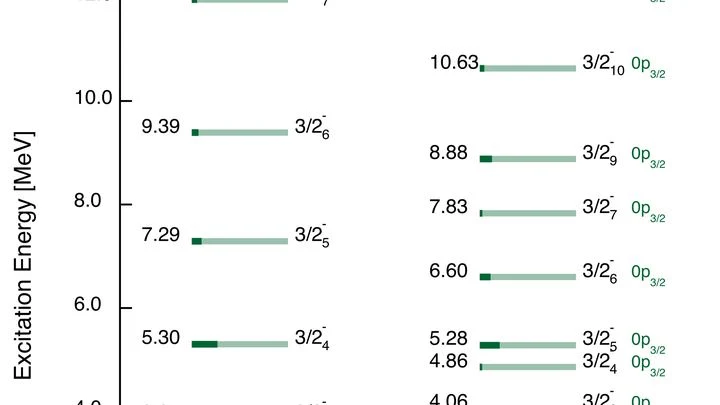
Imagine a multi-story building where protons and neutrons live on each floor. The floors are energy levels, and usually there's a stairwell of a certain height between the sixth floor and the one above — the so-called gap. In the oxygen-20 nucleus, this gap acts as a barrier that particles find hard to cross.
In the LHCb detector, where protons collide, one unusual track was found among billions of decays. The particle, named $$D_{s1}$$(2933)^+, appears for a moment and immediately decays into other particles. Its lifetime is so short that it cannot be observed directly — only through its decay products can its existence be reconstructed.
To uncover the proton's true size, physicists swapped the electron in a hydrogen atom for its heavy copy — the muon. Acting like a magnifying glass with thousandfold power, the muon gets right up against the nucleus and 'probes' the proton with unprecedented precision.
Light twisted in one direction hits a proton. The particle can absorb the photon or deflect it — depending on how its own spin, a tiny internal top, is oriented. In the experiment at the MAMI accelerator in Mainz, a beam of polarized photons struck targets of polarized protons and deuterons (nuclei of heavy hydrogen).
Inside every atom lives a proton. For a long time, it was considered as eternal as matter itself. But theories that unify all forces of nature predict that, sooner or later, the proton will decay. The only question is how long we have to wait.
In the Japanese detector Super-Kamiokande — a giant tank of ultra-pure water — physicists searched for signs of such a decay.
Cosmic rays are particles that arrive from deep space. When such a particle hits the atmosphere, it triggers a whole shower of new particles, like a billiard ball breaking a rack, sending balls scattering in all directions. To predict what such a shower will look like, we need to know how the primary particle interacts with the nuclei of air atoms.
Colliding two lead nuclei at the Large Hadron Collider is like throwing two hefty bags of marbles at each other. Usually, the marbles scatter in all directions, but sometimes one bag passes so close that the marbles don't collide: they just exchange glances.
Protons accelerated to enormous energies slam into a thick metal plate, like bullets into armor. Inside the metal, a J/ψ particle is born for an instant, which immediately decays into two muons — light relatives of the electron. These muons fly out of the target, and detectors catch their tracks.
The scientists compared the number of caught muons with predictions from a computer model.
Two particles flying apart in opposite directions behave as a single whole: measuring one instantly determines the state of the other. Such quantum entanglement has long been known for light particles, but now it has been observed for the first time in heavy Z bosons — the carriers of the weak force.
At the Large Hadron Collider, protons collide at nearly the speed of light. Sometimes they don't smash apart but exchange photons — particles of light. These photons can produce a pair: one particle the detector sees, and another that flies off unnoticed.
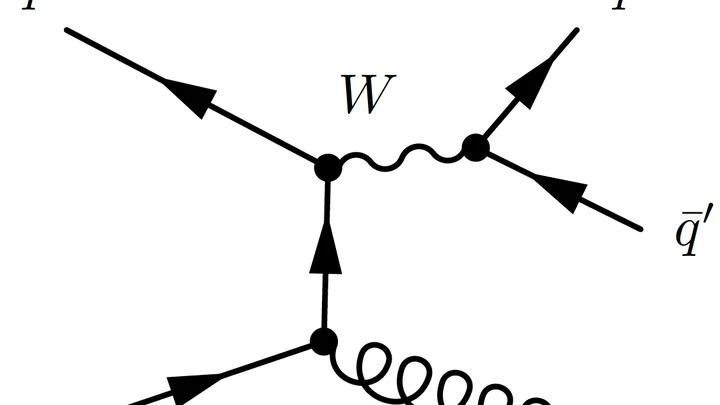
When a W boson, the particle that carries the weak force, decays into a quark and an antiquark, these two fragments fly off in nearly the same direction at the collider's immense speeds.
A tiny ghostly particle zips through a piece of germanium. Usually it leaves no trace, but sometimes, like a billiard ball, it smacks into an atom's nucleus. The nucleus recoils, and that jolt can be detected. At Oak Ridge National Laboratory, the Ge-Mini detector caught such recoils for two years.
Neutrinos are the most elusive of known particles.
In an underground ring 27 kilometers in circumference, protons are accelerated to nearly the speed of light and smashed head-on. At the collision point, conditions briefly recreate those of the first trillionth of a second after the birth of the universe.
In 2017, protons at the Large Hadron Collider collided with an energy of 5.02 TeV. The CMS detector recorded these collisions, and among billions of events, physicists hunted for a rare occurrence: the production of a single top quark without its antiparticle.
A high-speed collision knocked a neutron out of a helium-8 nucleus, and for an instant a helium-7 nucleus appeared, like an overloaded shelf shedding three books at once. This fleeting 'sound' of decay was captured for the first time: three neutrons flew apart, leaving behind an ordinary helium-4 nucleus.
Two teams of radio telescopes pointed their antennas at two gas clouds: one at the very center of the Milky Way, the other in its quiet outskirts. Both clouds contain methanol molecules — an alcohol that acts as a tiny pendulum in space: it absorbs and emits radio waves at strictly defined frequencies.
The proton is not a solid ball. Its charge, mass, and other properties are distributed differently in space, and each property has its own radius. Physicists have long been able to measure where the proton's charge is concentrated and where its mass lies.
Every time deuterium and tritium fuse in a fusion reactor, a fast neutron flies out. It can turn one substance into another — for example, create valuable isotopes for medicine.
Today such neutrons cost a fortune, because there are few experimental facilities and they rarely operate.
When matter accumulates on the surface of a neutron star, the ultra-dense remnant of a dead star, an explosion occurs, akin to a giant thermonuclear bomb. In this inferno, nuclei of elements not found on Earth are born within seconds. To understand which ones, their masses must be known with great precision.
Long before that, Fritz Zwicky predicted that a supernova explosion gives birth to a tiny neutron star. Years later, Jocelyn Bell Burnell caught its pulses, discovering pulsars.
A proton can't be seen as a simple ball. If you hit it with a photon, it can absorb energy and jump into an excited state, like a bell that starts ringing at a certain frequency after being struck. These states are called nucleon resonances, and they live very briefly before decaying into other particles.
When two protons collide at enormous speed, a narrow beam of particles (a jet, like the spray from a stone thrown into water) shoots out from the point of impact. In collisions of heavy lead nuclei, things are more complicated: a hot cloud forms inside, which interferes with the jet's straight flight.
The atomic nucleus is not a solid ball but a drop of liquid that can be squeezed. To understand how elastic it is, physicists accelerate gold nuclei and smash them into each other. On impact, the matter compresses to densities like those in a neutron star, then flies apart. The shape of this debris tells us about the properties of the matter inside.
At the Large Hadron Collider, physicists accelerate protons to nearly the speed of light and smash them together. Usually, the protons themselves take part in such collisions, but sometimes they pass close by without touching, and it is their electric fields that interact.
A muon is like an electron, but about 200 times heavier. When it stops in a piece of silicon, it gets pulled into the atomic nucleus like a nail to a magnet. The nucleus gains extra energy and starts to "boil": various particles fly out — protons, deuterons, tritons, and alpha particles.
At night over the Siberian taiga, a faint blue light sometimes flickers. It's not the aurora borealis but a cosmic-ray shower: a single particle from deep space slams into the atmosphere and shatters into millions of secondary particles. They race toward the ground in a broad front, like a ripple from a stone dropped into water, and make the air glow.