H. Takeda

8 articles · 30 co-authors · latest: 2026-07-21
7,086 citations · h-index 34 · 117 papersData: Semantic Scholar

We have retold 8 papers by this author. 1 of them with a full read. most often about: black hole merger, neutron star, nucleosynthesis. 30 co-authors across our retellings.

Links in the knowledge graph
Nuclear Experiment2026-02-271 minarXiv:2602.23776express
Precision Scales for a Stellar Explosion
When matter accumulates on the surface of a neutron star, the ultra-dense remnant of a dead star, an explosion occurs, akin to a giant thermonuclear bomb. In this inferno, nuclei of elements not found on Earth are born within seconds. To understand which ones, their masses must be known with great precision.
Nuclear Experiment2026-03-111 minarXiv:2603.10859express
The Helium-7 Mystery: Three Neutrons Set Free
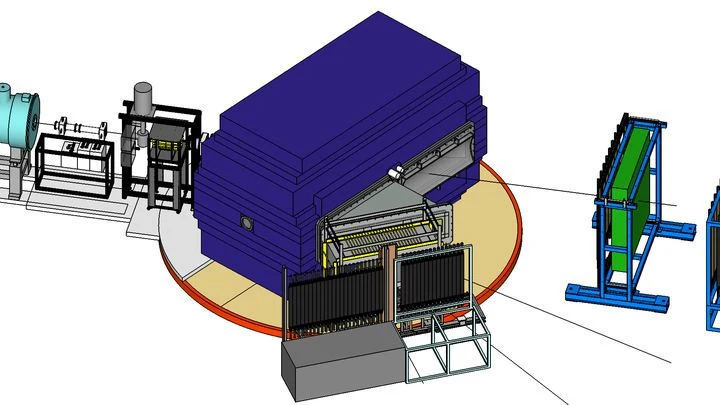
A high-speed collision knocked a neutron out of a helium-8 nucleus, and for an instant a helium-7 nucleus appeared, like an overloaded shelf shedding three books at once. This fleeting 'sound' of decay was captured for the first time: three neutrons flew apart, leaving behind an ordinary helium-4 nucleus.
General Relativity2026-03-261 minarXiv:2603.25938express
Tuning Into the Hum of Spinning Stars
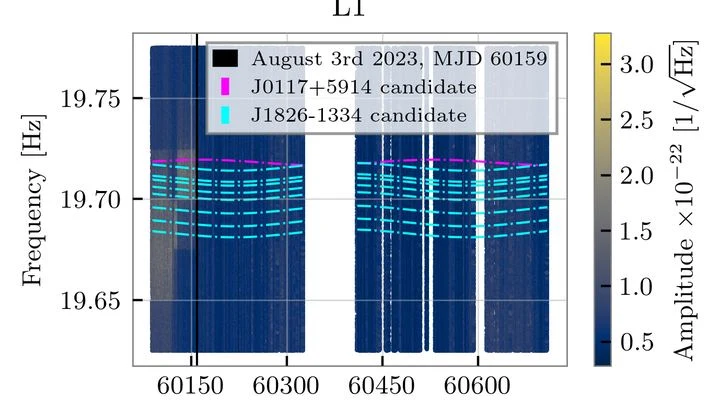
After a supernova explosion, a neutron star neutron star remains: a city-sized ball of unimaginably dense matter, spinning hundreds of times per second. Any tiny bump on its surface would make it wobble like an off-balance spinning top, humming faintly through the fabric of space.
Nuclear Experiment2026-04-282 minarXiv:2604.25107express
Tin Nucleus Reveals Its Size
Two tin nuclei collide at about two-thirds the speed of light. For an instant, a hot, dense cloud forms, and protons fly out in all directions. If you catch pairs of protons and measure how often they fly off in the same direction, you can work out the size of that cloud. This method is called femtoscopy: it works like a microscope for nuclear scales.
General Relativity2026-05-261 minarXiv:2605.27225express
Cosmology2026-05-262 minarXiv:2605.27227express
Gravitational waves measure the expansion rate of the universe
Imagine a giant inflatable balloon with galaxies painted on it. As it inflates, the pattern stretches and neighboring dots move apart. The rate of that stretching is the Hubble constant. Astronomers usually catch light from distant stars and see how much it has reddened due to the stretching of space.
General Relativity2026-07-212 minarXiv:2607.19293express
Gravity Passes Another Test: 168 Mergers Confirm Einstein
A huge bowl of water. Drop a stone into it — ripples spread across the surface. The fabric of spacetime works much the same way: when two massive stars merge, they create ripples — gravitational waves. These waves travel to Earth and are picked up by giant detectors like LIGO and Virgo.