Atomic String and Harmony of Frequencies express
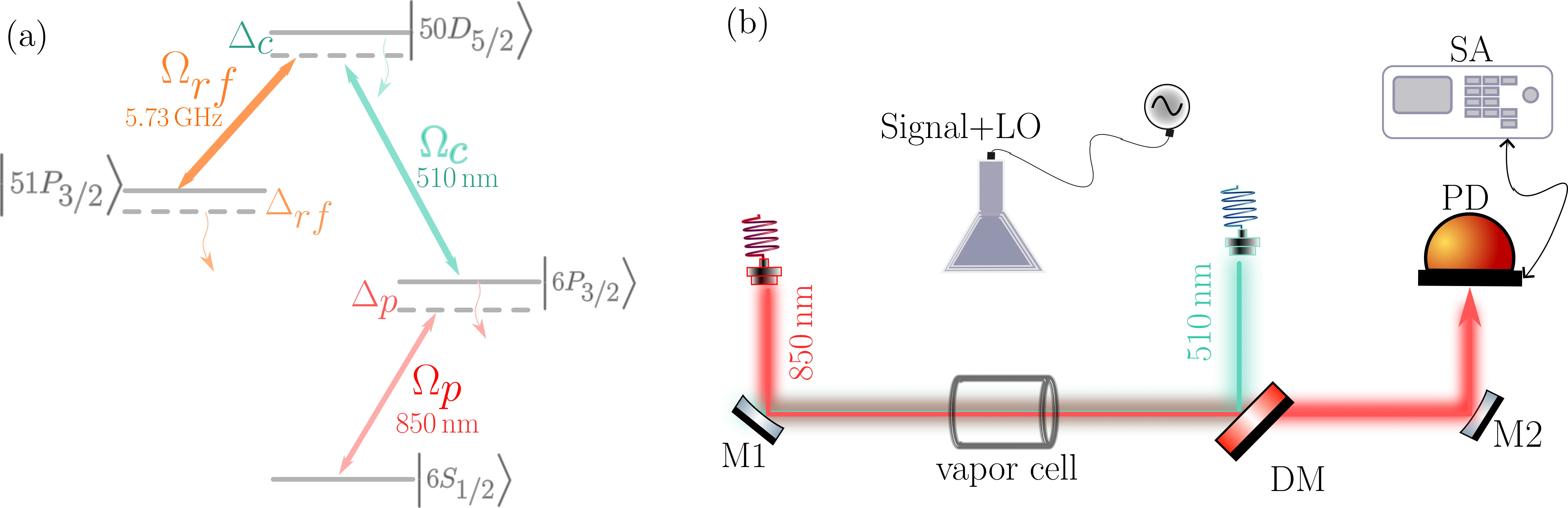
A cloud of cesium atoms was made to behave like a single quantum string. By shining a laser and letting the particles interact, scientists launched self-sustaining oscillations — a rhythm emerged without an external conductor.
Radio waves acted like frets on a fingerboard: it was possible to smoothly vary the sounding frequency. And under powerful influence, the string gave birth to overtones — a multitude of equally spaced frequencies appeared, resembling the teeth of a comb. Such a frequency comb is a key tool for ultra-precise clocks.
Detailed analysis of the glow (spectroscopy) and precise measurement of its brightness (photometry) allowed building a simple model, similar to a classical oscillator. It explained the behavior of the quantum string and opened the way to creating controllable quantum simulators — platforms for studying collective rhythms in the microworld.
Original abstract
as written by the authors arXiv:2603.12170
Driven nonlinear oscillators constitute a universal paradigm for understanding synchronization, frequency pulling, and frequency comb formation in nonequilibrium systems. Here, we realize such an emergent nonlinear oscillator in strongly interacting cesium Rydberg vapor, where coherent optical excitation, dissipation, and long-range interactions give rise to a driven-dissipative time crystal phase with intrinsic oscillation frequencies. Applying a radio-frequency (RF) field allows controlled tuning of the intrinsic oscillation frequency. Under RF heterodyne conditions, we observe intermodulation, frequency pulling, and, at strong drive, the emergence of a comb-like spectrum in the atomic coherence. We quantitatively capture these observations using a four-level mean-field model and demonstrate a classical analogue with a driven Van der Pol oscillator. Our results establish interacting Rydberg ensembles as a tunable platform for exploring nonequilibrium time-crystalline order, nonlinear synchronization, and frequency comb generation in many-body atomic systems.
A guitar string also produces more than one sound: the fundamental tone is surrounded by overtones with multiple frequencies — a natural frequency comb.
Perhaps one day such quantum strings will sing the most complex symphonies, controlled by a single beam of light.