Simple

Atomic String and Harmony of Frequencies ⚡ экспресс

Original: "Frequency Comb Behavior of Time Crystals in an RF-Driven Dissipative Rydberg System"
arXiv:2603.12170 · 2026-03-12 · CC BY 4.0 · ⏱ 1 min · Atomic Physics Quantum Physics
A cloud of cesium atoms was turned into a quantum string: it began to sound on its own, and physicists extracted a chord of multiple frequencies from it.
Abstract

Scientists have created a new type of ‘atomic clock’ where cesium atoms, illuminated by a laser, start pulsing by themselves, like an orchestra playing in rhythm. By adding radio waves, they learned to change the rhythm and observe musical effects—from frequency capture to the appearance of a comb of new frequencies. This will help understand synchronization in the quantum world. What else can we make dance in unison?

Links in the knowledge graph 1

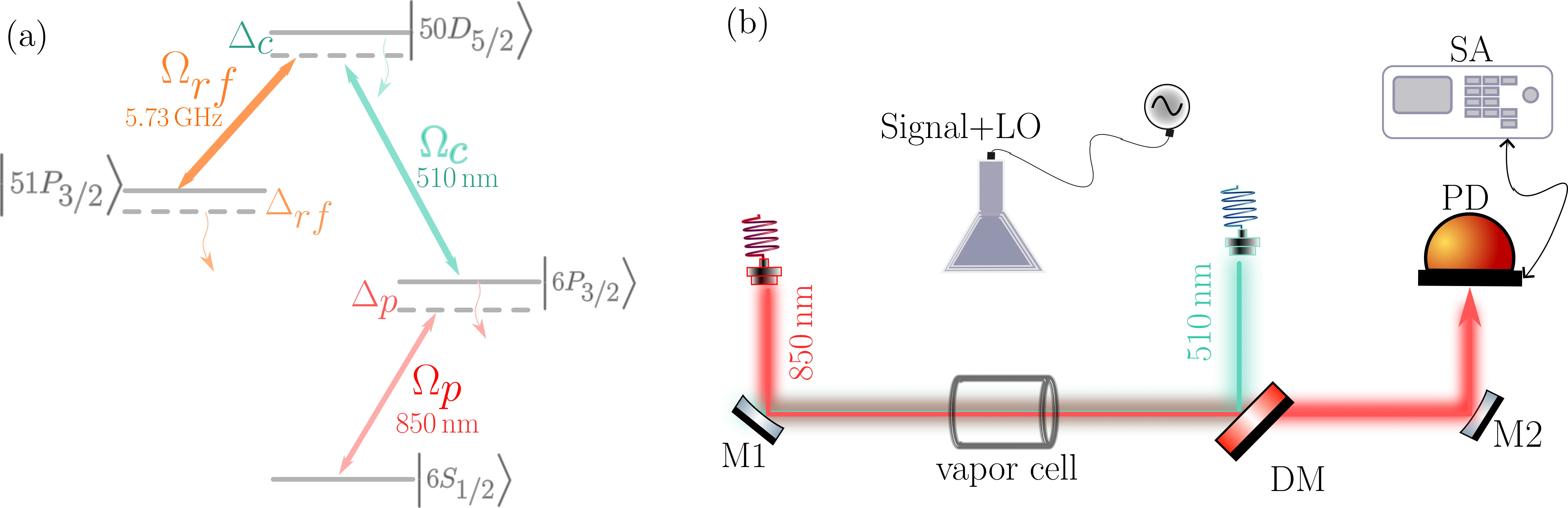
A cloud of cesium atoms was made to behave like a single quantum string. By shining a laser and letting the particles interact, scientists launched self-sustaining oscillations — a rhythm emerged without an external conductor.

Radio waves acted like frets on a fingerboard: it was possible to smoothly vary the sounding frequency. And under powerful influence, the string gave birth to overtones — a multitude of equally spaced frequencies appeared, resembling the teeth of a comb. Such a frequency comb is a key tool for ultra-precise clocks.

This doesn't violate the laws of thermodynamics: the quantum string doesn't create energy, but merely maintains order where entropy (a measure of disorder) inexorably grows.

Detailed analysis of the glow (spectroscopy) and precise measurement of its brightness (photometry) allowed building a simple model, similar to a classical oscillator. It explained the behavior of the quantum string and opened the way to creating controllable quantum simulators — platforms for studying collective rhythms in the microworld.

🎯 A guitar string also produces more than one sound: the fundamental tone is surrounded by overtones with multiple frequencies — a natural frequency comb.

🎬 Perhaps one day such quantum strings will sing the most complex symphonies, controlled by a single beam of light.

Scientists
Christian DopplerD. B. McLaughlinDidier QuelozMichel MayorR. A. RossiterJacob Bekenstein
Tags
spectroscopy entropy photometry
Laws
second law of thermodynamicsDoppler effectBekenstein-Hawking entropyMaxwell's equationsPlanck's lawPlanck–Einstein relation
Original: arXiv:2603.12170 · CC BY 4.0 · bridge42worlds