Magnetic swings: why order never comes express
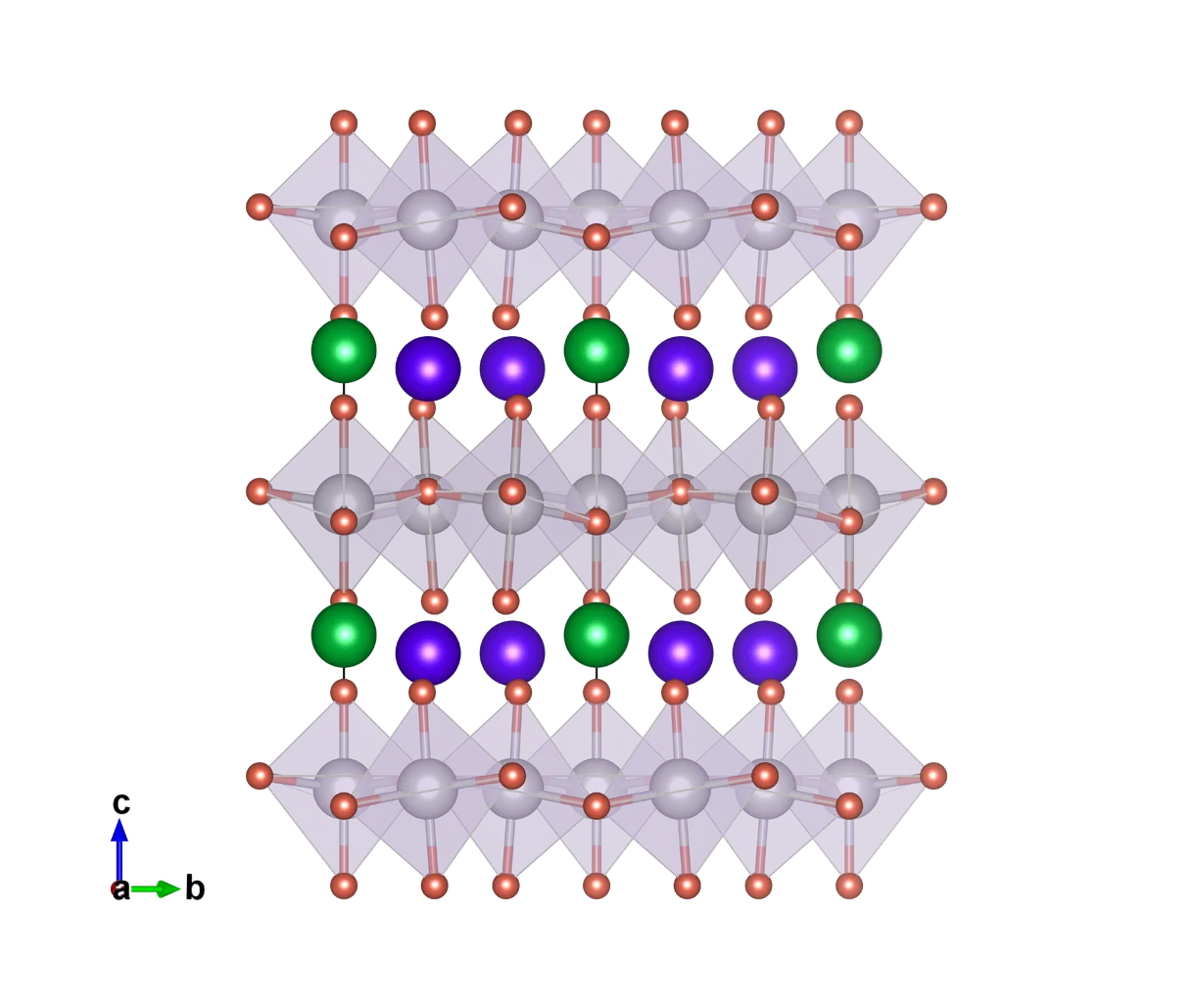
Magnetic atoms in a solid are like compass needles: usually, when cooled, they align in one direction: that's how magnetism arises. But in TbInO3, the terbium needles sit on a triangular lattice where it's impossible to please all neighbors at once. One needle wants to point north, another south, and in the end none can settle into a stable position.
The scientists grew an ultrathin film of this material and cooled it to 20 millikelvin — a hundred times colder than the temperature at which the needles should have aligned according to simple estimates. Even at such cold, order did not emerge: the needles kept fluctuating, like a liquid that never freezes into ice. To observe this, the physicists used superconducting resonators — devices that pick up weak magnetic signals from tiny samples, like a keen ear catching a whisper in a quiet room.
This result is an important step toward detecting a quantum spin liquid. In this state, magnetic needles do not freeze even at absolute zero but continuously fluctuate, forming an entangled collective state. Understanding such materials could help create new quantum technologies where information is stored in elusive collective motions rather than in individual particles.
Original abstract
as written by the authors arXiv:2603.14545
Minimizing the energy of a many body system tends to favor order, but classical frustration and quantum fluctuations destabilize that order. The tension between these effects can produce exotic quantum states of matter. Quantum spin liquid (QSL) states emerge in models of localized magnetic moments where the crystal lattice connectivity frustrates ordering, and the exchange interaction of neighboring spins strengthens quantum fluctuations. Experimentally identifying a QSL in a real material is challenging from the lack of an order parameter. Piecing together evidence from varied techniques is necessary for diagnosing the nature of the ground state -- QSL or otherwise -- of a frustrated spin system. In this work, we use coplanar superconducting resonators to probe magnetic excitations in epitaxially grown thin films of a spin liquid candidate TbInO3. Adapting microwave techniques from the field of circuit quantum electrodynamics, we measure responses of these thin films whose volume is too low for applying conventional bulk techniques. In-plane susceptibility extracted from the spin resonance signal indicates extreme frustration of magnetic order down to 20 mK, over two orders of magnitude lower than the Curie-Weiss energy scale. Through a crystal field analysis, we identify the doublet eigenstates comprising the ground state. As a consequence of improper ferroelectricity, Tb moments split into two flavors with distinct g-factors reflecting the local crystal field environment of each site. Spin-orbit coupling, crystal fields, magnetic frustration and improper ferroelectricity distinctively combine to shape the magnetic ground state of TbInO3. This work establishes a measurement technique using superconducting resonators to probe thin films of frustrated magnets, and applies this technique towards building a coherent understanding of the magnetic properties of TbInO3.
A temperature of 20 millikelvin is 0.02 degrees above absolute zero. That's colder than interstellar space, where the temperature is about 2.7 kelvin.