A SQUID (Superconducting Quantum Interference Device) is an extremely sensitivemagnetometer that can measure minuscule magnetic fields, down to a few femtoteslas (10^-15 T). It operates based on the principles of superconductivity and quantum interference. SQUIDs are used in a variety of fields, from medical imaging (magnetoencephalography) to geophysical surveys and fundamental physics experiments, such as searching for gravitational waves or detecting dark matter particles.
History
The SQUID was invented in 1964 by Robert Jaklevic, John Lambe, Arnold Silver, and James Mercereau at Ford Research Labs, building on the earlier theoretical work of Brian Josephson on tunneling in superconductors. The first practical SQUID magnetometer was developed shortly thereafter, and they have been continuously refined since.
How it works
A SQUID consists of a superconducting loop interrupted by one or two Josephson junctions. When a magnetic field passes through the loop, it induces a superconducting current that modulates the voltage across the junctions. The device's output is periodic in the magnetic flux quantum (Φ₀ = 2.07 × 10^-15 Wb), allowing for extremely precise measurements of magnetic field changes. The sensitivity arises from the quantum interference of Cooper pairs tunneling through the junctions, which is highly sensitive to the magnetic flux threading the loop.
In practice
SQUIDs are used in magnetoencephalography (MEG) to map brain activity, in non-destructive testing to detect flaws in materials, in geophysics to measure magnetic properties of rocks, and in quantum computing as readout devices for qubits.
Fun fact
SQUIDs are so sensitive that they can detect the magnetic fields produced by the electrical activity of a single neuron in the brain, making them invaluable for studying neural networks in real time.
A tiny black hole flies through a hydrogen cloud and stretches atoms like taffy. That is what a superconductor looks like when it traps a persistent current: a material in which electricity flows without losses turns into a miniature permanent magnet.
In a quiet room with no magnets anywhere, two electrons in a silicon trap still feel a faint trembling. It comes from the nuclei of silicon and germanium atoms, which spin randomly like the needles of broken compasses. This trembling was once considered noise, but now it has become a measuring instrument itself.
The orchestra plays, but the conductor hears only a general hum. Each instrument plays its own part, but you can't tell where the flute is and where the double bass is. You need a spectrum analyzer — a device that breaks down sound by frequency.
A patchwork quilt where each patch is a recording of activity from a small brain region. One patch was stitched on Monday in London, another on Tuesday in New York, and a third a month ago in Tokyo. This mosaic covers the brain only partially, and there is no common seam to join them.
Ordinary magnetic sensors lose sensitivity as they shrink. But scientists turned a tiny diamond into a light-based compass. Unlike jewelry diamonds, what matters here isn't purity but artificially created defects — these are what turn the crystal into a compass.
A tiny ball weighing a fraction of a milligram, suspended in a magnetic field and cooled to near absolute zero, oscillates for 110 hours without stopping: this is record isolation. The energy loss is so small that the system's entropy barely increases, making any external influence noticeable.
A bridge of aluminum just a few atoms thick is the heart of many quantum devices. Current flows through such a bridge without resistance, and it can be controlled with a magnetic field. These bridges are called Josephson junctions, after the British physicist who described their behavior.
Earth's magnetic field, the one that swings a compass needle, is strong. The new sensor picks up fields a hundred thousand times weaker, and it needs neither liquid helium nor bulky setups. Everything fits on a circuit board, just like the one inside your smartphone.
A regular laser is a light amplifier in which atoms, after receiving energy, collectively emit waves of a single frequency. A maser does the same thing, but for microwaves — the invisible radiation that heats food in a microwave oven and carries signals in phones.
A single electron in a magnetic field is like a tiny top that spins and weakly "squeaks" at its own frequency. Hearing that squeak directly is nearly impossible: it gets lost in the noise. Scientists have devised a resonator: a superconducting microwave strip that works like a tuning fork tuned to the same note.
Magnetic atoms in a solid are like compass needles: usually, when cooled, they align in one direction: that's how magnetism arises. But in TbInO3, the terbium needles sit on a triangular lattice where it's impossible to please all neighbors at once. One needle wants to point north, another south, and in the end none can settle into a stable position.
An ordinary superconducting qubit is like a swing that any gust of wind can set rocking. The slightest change in electric charge nearby, and the quantum state is already spoiled.
A white dwarf is what remains of a star like the Sun after it sheds its outer layers. What's left is a hot core the size of Earth but with a mass close to that of the Sun. A teaspoon of this material would weigh as much as a truck. Some of these stars have extremely strong magnetic fields — a billion times stronger than Earth's.
In laboratories where atoms are cooled to near absolute zero, even a tiny change in the magnetic field throws off all the settings. Conventional sensors, Hall plates or coils with ferrite cores, sit a few centimeters away from the vacuum chamber because they themselves create interference.
A fridge magnet attracts a paperclip: we can feel that field with our hands. Now shrink that field by a billion times. Atoms inside our bodies emit such weak signals, and they are very hard to catch.
Scientists built the sensor from special molecules that themselves behave like tiny magnets.
An ordinary ultra-sensitive magnetic field sensor is like a scale that starts lying when you put too heavy a weight on it. The signal becomes distorted, and you have to add complex electronics to straighten out the readings. That electronics adds noise and slows things down.
The new sensor, bi-SQUIPT, works differently.
There is always noise in the microworld. Even in absolute emptiness, something trembles, and these quantum fluctuations interfere with precise measurements. But noise can be "squeezed," like a balloon: if you squeeze it from the sides, one part gets thinner while the other bulges.
A photon is like a car in a multi-story parking lot, where each floor is its frequency (color). Usually it gets stuck on one level, but scientists added an elevator — a programmable modulator that moves the photon between floors on command.
A nanowire is like a tiny cable: inside is a magnetic core, outside is an aluminum shell that can conduct current without resistance. But they don't get along easily: a strong magnetic field destroys superconductivity, like noise drowns out a quiet melody.
Inside the receiver of a telescope aimed at the oldest glow in the universe sits a tiny thermometer chip. It's so sensitive that the heat from a single photon can warm it noticeably. But to hear that whisper of heat, you need a middleman — an amplifier that doesn't add its own noise.
Pluck a guitar string, and it vibrates — the air around it carries the tremor to your ear. Spacetime vibrates differently: when a gravitational wave passes through, it stretches and squeezes slightly. Spotting such a tremor at frequencies from 10 kilohertz to 100 megahertz is the challenge that new detectors are being built for.
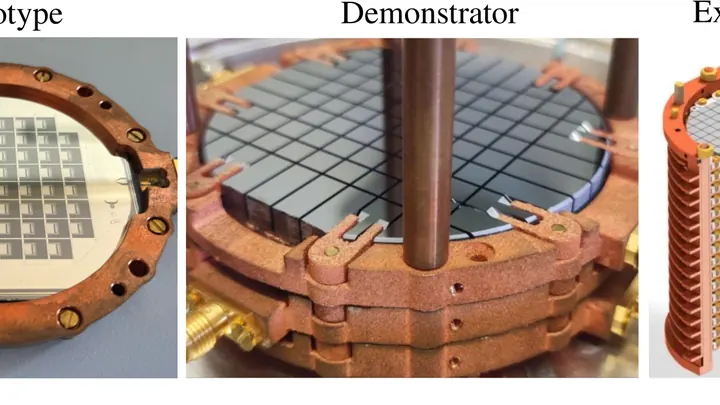
Dark matter is the invisible substance that holds galaxies together, yet it has so far escaped direct detection. The BULLKID-DM detector is designed to catch candidate particles with a mass around 1 GeV (roughly that of a proton) and an extremely weak interaction with ordinary matter — a…
The needle tip that you drag across a surface to feel its bumps has now grown an ultrasensitive "nose" for magnetic fields. Scientists have assembled a tiny superconducting loop on the end of a cantilever (a thin, flexible beam like the one in an atomic force microscope) that catches the slightest fluctuations in magnetic flux.
Accurate measurements of gravity are needed by geologists and navigators alike. But conventional gravimeters are bulky instruments that take a long time to 'settle' after each measurement. What if you need to track rapid changes in gravity — say, while moving underground or in flight? That calls for a device that is small and responsive.
A superconducting circuit is like a frictionless swing, only possible at temperatures of liquid helium (–273 °C). In such cold, electric current runs in a loop without fading, keeping its rhythm.
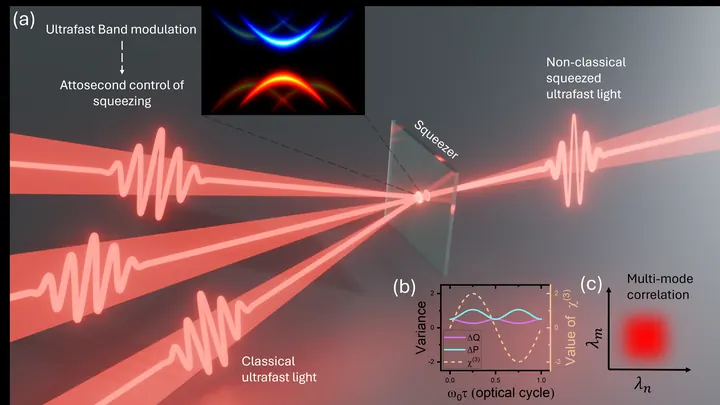
Ordinary light always jitters a bit: its brightness and color fluctuate, like the air in a balloon after a tap. In 'squeezed' light, these fluctuations are redistributed — as if you squeeze the balloon from one side, making it thinner here and thicker there, but the total volume stays the same.
The void is deceptive. William Unruh showed that an accelerating observer perceives the vacuum as hot. The effect resembles the particle birth near black holes, predicted by Stephen Hawking, but instead of spacetime curvature, acceleration is at work.
A chain of atoms on a light-guiding chip behaves like a row of pendulums on a shared support: swinging in opposite directions, they barely transfer energy to the air and freeze for a long time.
Building ultrasensitive sensors for light measurements and spectroscopy starts with tiny chambers where light ricochets like an echo in a canyon. Previously, engineers chased the quality factor — the duration of this echo: the longer it rings, the more noticeable the slightest changes.
The theory of gravity by Einstein — general relativity — rarely intersects with quantum physics in direct experiments. Here, scientists built a 50-kilometer glass labyrinth on a table and sent single photons through it.