A femtotesla (fT) is a unit of magnetic flux density equal to 10⁻¹⁵ tesla, or one quadrillionth of a tesla. For context, the Earth's magnetic field is about 50 microtesla (5 × 10⁻⁵ T), so a femtotesla is roughly 50 billion times weaker. Measuring fields at this scale requires extremely sensitive instruments, often using quantum effects such as spin precession in atomic vapors or superconducting interference.
How it works
To detect femtotesla-level fields, instruments typically measure the influence of the magnetic field on the quantum states of atoms or electrons. For example, atomic magnetometers use lasers to prepare and read out the spin states of alkali atoms; a tiny magnetic field shifts the energy levels, which changes the light absorption. By carefully isolating the sensor from environmental noise (using magnetic shielding and gradiometry), these shifts can be resolved at the femtotesla scale.
In practice
Femtotesla sensitivity is used in magnetoencephalography (MEG) to map brain activity, in geophysical surveys to detect mineral deposits, and in fundamental physics experiments searching for exotic particles.
Fun fact
The human brain produces magnetic fields of about 10⁻¹³ T (100 femtotesla) during a single neural event, which is why femtotesla-level sensors are needed for non-invasive brain imaging.
Systems:SIOne quadrillionth of a tesla, equal to 10^-15 tesla.
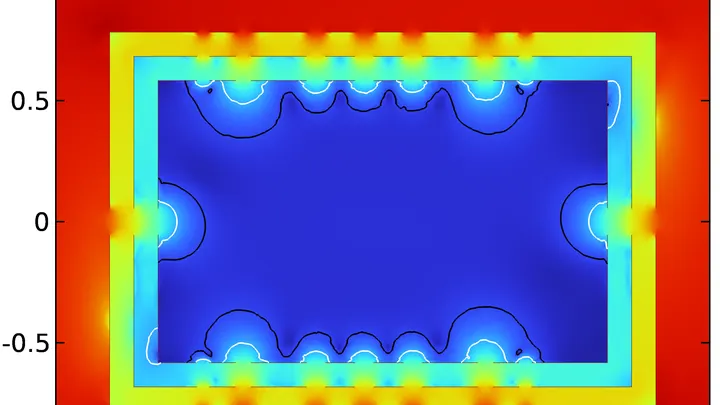
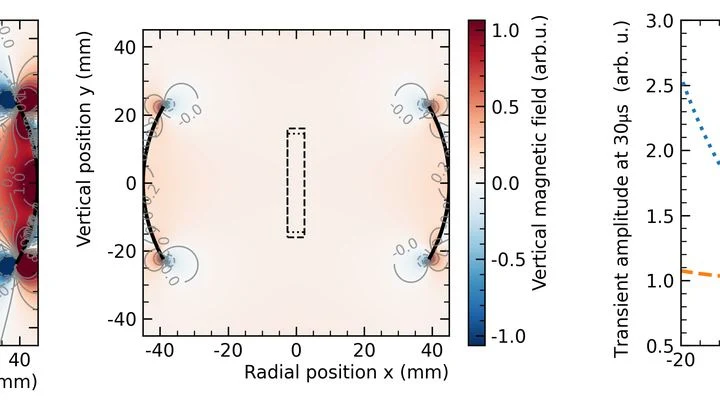
The magnetic field in this setup must be as smooth as glass: the slightest ripple would blur the signal. The engineers built two coils that cancel each other's field externally and packed them in three layers of ferromagnetic plates.
A magnet weighing just a few grains of sand hovers in midair with no support. It doesn't touch the walls, doesn't rub against bearings — it just hangs in a magnetic trap like a speck of dust in a sunbeam. Researchers have turned this tiny object into an ultra-sensitive compass: the device detects changes in the magnetic field of 23 femtotesla.
A pendulum weighing a few grains of sand swings on a hair-thin glass fiber. Its motions are so faint that the thermal jostling of air molecules seems like a hurricane. Yet such a pendulum is the key to witnessing quantum wonders in the world of large objects.
Fast radio bursts — millisecond radio pulses arriving from distant galaxies — long remained a puzzle. Their colossal energy, compressed into instants, pointed to cataclysms on neutron stars, perhaps pulsars or magnetars.
In a giant ring of magnets outside Chicago, muons whirled like figure skaters on an ice rink. But instead of music, there's a magnetic field, and instead of spinning, there's a barely perceptible wobble of the spin. Physicists call this wobble the anomalous magnetic moment.
A neat stack of atomic layers lies on a substrate. An invisible beam of terahertz light shines down on it, with a magnetic field applied from the side. After reflection, the beam's polarization rotates slightly.
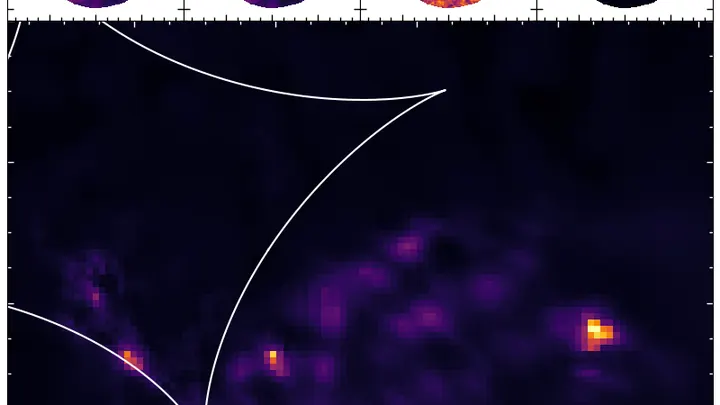
A magnifying glass focuses sunlight into a bright point. If the glass has a tiny flaw, the spot of light becomes distorted. Gravitational lensing works in a similar way: a massive galaxy bends light rays from a more distant source, creating an enlarged and sometimes distorted image.
Magnetic sensors smaller than a match head can already detect weak fields — from a beating heart or a distant planet. But making them even more sensitive involves a trade-off: improve one part, and you lose performance in another.
Magnetic atoms in a solid are like compass needles: usually, when cooled, they align in one direction: that's how magnetism arises. But in TbInO3, the terbium needles sit on a triangular lattice where it's impossible to please all neighbors at once. One needle wants to point north, another south, and in the end none can settle into a stable position.
An ordinary superconductor expels magnetic fields, but this ring does the opposite: it creates a magnetic field inside itself. The ring is made of Fe(Te,Se) — a compound of iron, tellurium, and selenium that loses its electrical resistance at very low temperatures.
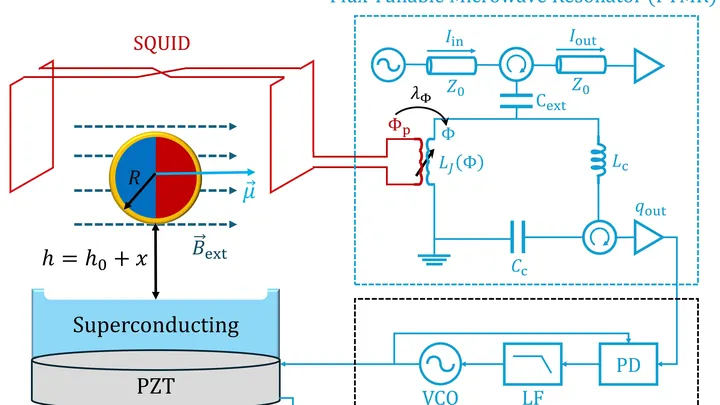
A magnetic sphere hangs in a vacuum above a cold metal plate. No strings, no stands — only the invisible field of a superconductor keeps it from falling. Give the sphere a gentle nudge, and it starts to oscillate up and down; the frequency of those oscillations depends on how strongly the plate pulls on it.
Dark matter is five times more massive than ordinary matter, yet it emits no light. Its nature remains unknown. One candidate is the ultra-light axion particle. Axions could pierce right through the planet, barely noticing atoms.
Using a method similar to spectroscopy (magnetic sensing), scientists pass a current through a multilayer film and observe the orientation of the microscopic magnetic arrows inside. Previously, everything was predictable: in some materials, the arrows aligned only along the current, in others — strictly across it. But in bismuth ferrite with a platinum coating, a glitch occurred.