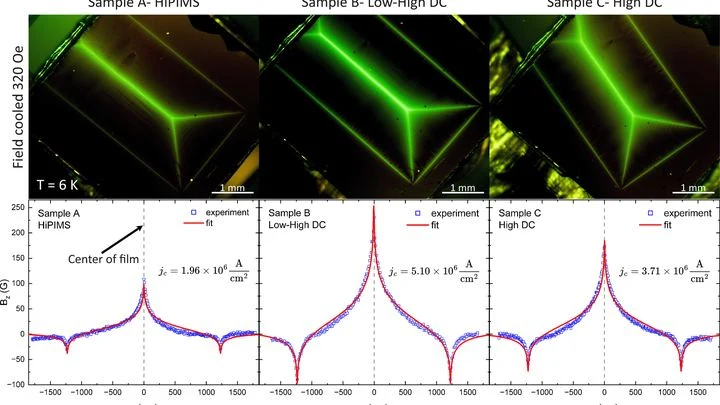
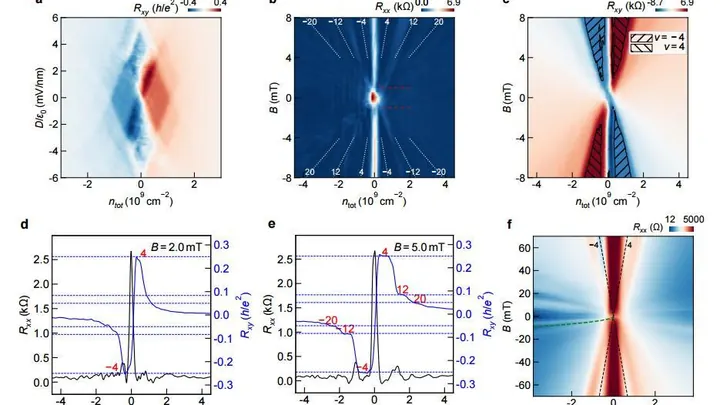
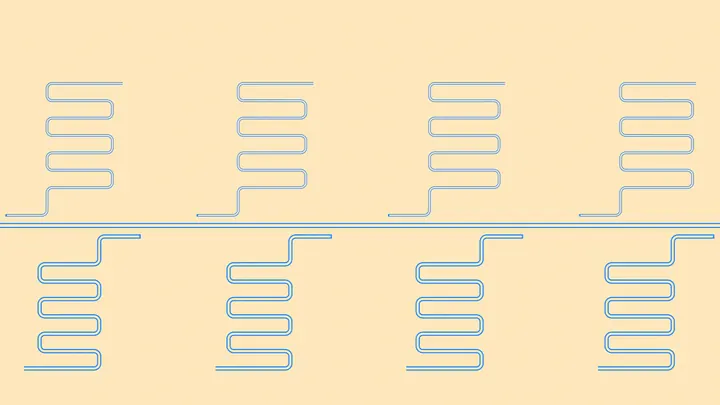
Thin film properties refer to the dramatic changes in electronic, magnetic, structural, and optical behavior that materials exhibit when they are formed into layers only nanometers to micrometers thick. At such scales, the surface-to-volume ratio becomes enormous, and quantum confinement effects, strain from the substrate, and interfacial interactions can dominate the material's behavior. This is why a film of zinc oxide can change shape in a magnetic field, or why the thickness of a film alters the energy levels of electrons within it, effectively changing its 'note'.
History
The systematic study of thin films began in the mid-20th century with the development of vacuum deposition techniques, but the field expanded rapidly with the advent of molecular beam epitaxy in the 1960s and 1970s, enabling atomic-level control of layer thickness.
How it works
When a material is reduced to a thin film, its properties are no longer determined solely by its bulk crystal structure. The lattice mismatch with the substrate can strain the film, altering its electronic band structure and magnetic ordering. Quantum confinement, where electrons are restricted in one dimension, leads to discrete energy levels that depend on film thickness. Additionally, the surface and interfaces become significant, allowing external fields to couple strongly to the film's properties, as seen in the magnetostrictive response of zinc oxide films.
In practice
Thin films are ubiquitous in modern technology, from the semiconductor layers in microchips and solar cells to the magnetic layers in hard drives and the optical coatings on lenses and mirrors.
Fun fact
The color of a soap bubble is a natural example of thin-film interference, where the film's thickness determines which wavelengths of light are reflected.
A sheet of paper left on a wet table warps and lifts its edges. No one controls that motion, but it follows the same laws as plant growth: some areas of the sheet shrink more than others, and the flat form becomes three-dimensional. Engineers have long dreamed of taming this process so that a flat blank folds itself into a desired sculpture. In the new work, that trick succeeded with accuracy down to one percent.
A magnetic field usually acts like a strict traffic cop: for heat to turn into electricity, it must stand across the road. If the field lies along the heat flow, the effect disappears, or so it was believed for decades.
Scientists took an ultra-thin film of a magnetic oxide — a material where electron spins are aligned in a plane, like compass needles on a table.
A thermometer that turns a heat flow into an electrical signal: that's the anomalous Nernst effect: in a magnetic material, heat generates a transverse voltage. Until now, engineers could only tweak this signal slightly by changing the proportions of two metals.
Two magnets on a table either attract or repel — depending on how their poles are oriented. Inside each piece hide tiny regions where all the magnetic arrows point in the same direction. These regions are called domains, and their arrangement determines how the material behaves in an electrical circuit.
In altermagnets, a new class of materials, domains are trickier.
A crystal that looks like a stack of pancakes was placed on a smooth substrate of magnesium oxide. The result was a film only a few hundred atoms thick. When they ran a current through it and switched on a magnet, the resistance jumped by nearly a quarter—22.5% in a 9-tesla field.
Inside the film, electricity is carried by two streams of particles.
A single-atom-thick sheet of tungsten telluride is like thin foil: electrons can't pass through because there's a band gap between their possible states, like a moat you can't jump across. Add two more layers, and the moat disappears; the material becomes a metal, and current flows. Add more layers, and the properties change again, as if someone is flipping modes with a single button.
In a strong magnetic field, electrons in a thin metal film move along circular orbits. When the film thickness is comparable to the size of such an orbit, the resistance starts to oscillate: these are Sondheimer oscillations, known since the mid-20th century as a purely geometric effect.
Bismuth is a metal used to make low-melting alloys and additives to steel. But when you sputter it onto a substrate in a very thin layer, its behavior depends on how cold the substrate is. Physicists compared two methods: one at ordinary room temperature, the other at liquid nitrogen temperature, about −196 °C.
A rug lies flat, but if you push it from the edge, wrinkles run across it. In a thin film of tantalum sulfide (1T-TaS2), wrinkles made of electrons, charge waves, freeze as if the rug were stuck to the floor. To move them, you need to apply force. Scientists have found a way to control this force using an electric field and a magnet.
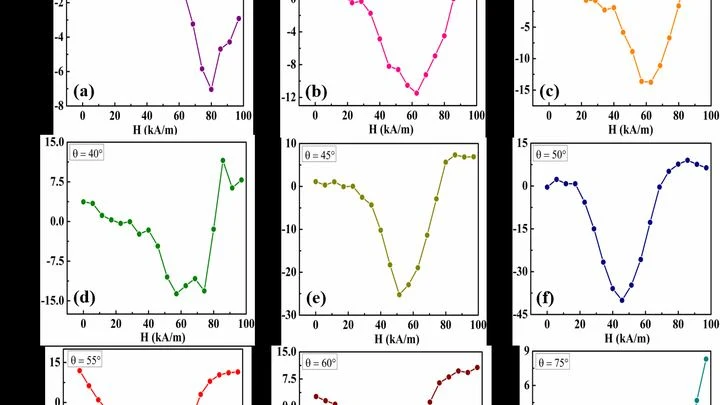
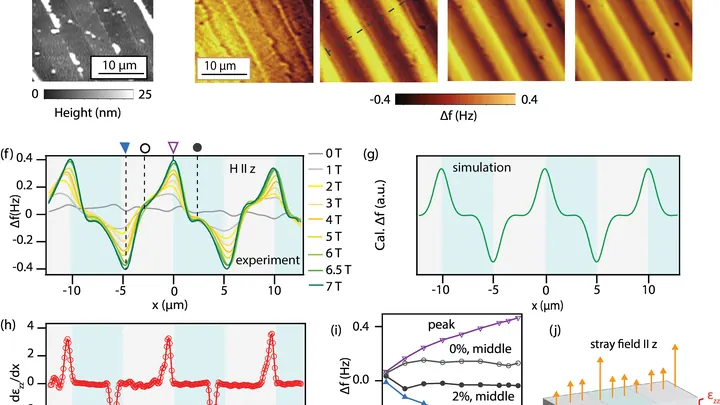
A piece of zinc oxide film lies on a table. A magnet is brought near, and slowly rotated around the film. The film, thinner than a human hair, begins to change its dimensions: now contracting, now stretching. This property is called magnetostriction — the ability of a material to deform under a magnetic field.
A swimmer cutting through water at the speed of the waves running on it finds themselves in a strange position: the waves they themselves generate can neither overtake them nor fall behind. They pile up at the swimmer's bow and freeze. A similar phenomenon occurs when a light source moves inside a medium at a speed matching the speed of energy transfer of the waves.
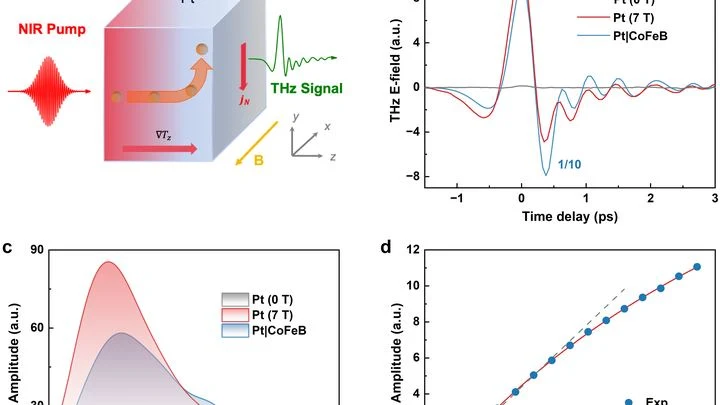
Usually, to generate terahertz waves (light between microwaves and infrared), researchers build a sandwich of different metals. One layer acts as the source, another as the receiver of charges. In such designs, platinum was assigned the role of a simple conductor. But it turns out it can work alone.
A thin film of nickel oxide, tens of nanometers thick, is like a sheet of paper folded hundreds of times thinner. At room temperature, it conducts electricity, but cool it slightly and it becomes an insulator.
The tear film on the eye is an ultrathin layer of fluid that protects the cornea and keeps vision sharp. It’s usually pictured as a perfectly smooth surface, but the real cornea, even a healthy one, is covered in microscopic bumps.
Magnetic atoms in a solid are like compass needles: usually, when cooled, they align in one direction: that's how magnetism arises. But in TbInO3, the terbium needles sit on a triangular lattice where it's impossible to please all neighbors at once. One needle wants to point north, another south, and in the end none can settle into a stable position.
A beam of charged particles, like a fine pen, draws an invisible pattern on a metal film. Where it touches, the material changes its internal atomic order: from a close-packed arrangement, like a pyramid of oranges in a crate, the atoms rearrange into a looser one, like cubes stacked in a box.
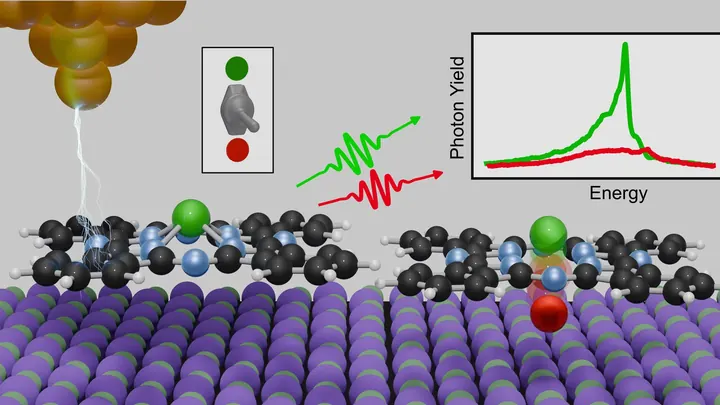
A glowing dot the size of a molecule. Run a current through it, and it flashes like a tiny lightbulb. That's what the experiment with dye molecules on a thin salt film looks like.
When current enters a molecule, one electron hands it energy. The molecule immediately gives that energy back, as light. It's like a swing: give it one push, and it rocks and then stills.
A piece of gold doesn't attract paperclips. But if you take a thin film of a gadolinium-gold-germanium alloy and start bending it, magnetic regions can appear. Scientists did this not with their hands, but with a beam of helium ions that penetrated the material through a patterned mask.
A handful of sand on a vibrating table is like a crowd on a dance floor that still holds the rhythm of the old song for a second after the DJ has switched to a new one. Scientists made a thin layer of grains bounce on a vertically shaking platform and abruptly changed the shaking intensity.
A quantum computer is like an orchestra where every musician must play in perfect harmony. If even one instrument is off-key, the melody falls apart. Superconducting qubits play the role of these musicians, and their "off-key" is the loss of quantum coherence.
Magnetic materials can store oscillatory energy, like a tuning fork that keeps ringing after being struck. When such a material is placed in a microwave cavity, its oscillations (magnons) start interacting with light (photons).
If you dump a handful of coins on a table, the surface becomes bumpy. But add more coins, and they spread out into a flat layer on their own. Something similar happens when you deposit ultra-thin films of individual molecules onto a substrate.
At first, islands appear on the surface — molecules cluster together like people in a queue. The film gets rougher and rougher.
Graphene is a carbon sheet just one atom thick, a fantastic conductor. But its surface is crinkly, like a wrinkled tablecloth that hasn't been ironed. Scientists built a 'sandwich': two of these sheets pressed together with a non-conductive spacer in between. They iron out each other's folds, like two halves of a sandwich making the surface perfectly even.
Empty space is never truly still. It teems with tiny energy fluctuations, like a sculptor's raw clay. In a new experiment, a thin film of superconducting material was placed inside a cavity designed to trap terahertz light, a form of invisible radiation. The cavity acted as a mold, shaping the vacuum fluctuations around the film.
At the centers of many galaxies lurk supermassive black holes, surrounded by disks of gas, cosmic dust, and stars. Their collisions can spawn gravitational waves — ripples in spacetime.
A magnetic field of 8 tesla is 200 times stronger than Earth's field. Under such a field, superconductivity in a thin film of palladium ditelluride not only survives but persists down to 20 millikelvin, which is a hundred times colder than outer space. For comparison, a thick film of the same material has a critical field 80 times smaller.