Pressure Awakens Superconductivity in a Thermoelectric Material express
A piece of silver antimony telluride is like a sponge: it readily soaks up heat and turns it into electricity. Such materials are called thermoelectrics, and they already work in space probes and car refrigerators. But if you squeeze this sponge, it starts behaving like a superconductor — current flows with zero resistance.
Already at a pressure of 0.38 GPa (as if a 4-ton weight were placed on every square centimeter), the material loses resistance at 3.2 kelvin — colder than outer space. The stronger the squeeze, the higher the transition temperature: at 31.9 GPa it reaches 6.9 kelvin. And when the pressure was released, superconductivity didn't vanish immediately but even strengthened slightly — up to 7.4 kelvin.
The most surprising part: the crystal lattice remained cubic up to 21.7 GPa, then lost long-range order — atoms stopped lining up in strict rows. But upon releasing pressure, the structure fully recovered, like a spring. This means the material can be squeezed and released many times without damage.
This discovery shows that pressure is a simple and reversible way to switch the properties of thermoelectrics. In the future, such materials could not only convert heat into current but also serve as superconducting elements in electronics or sensors.
Original abstract
as written by the authors arXiv:2603.17846
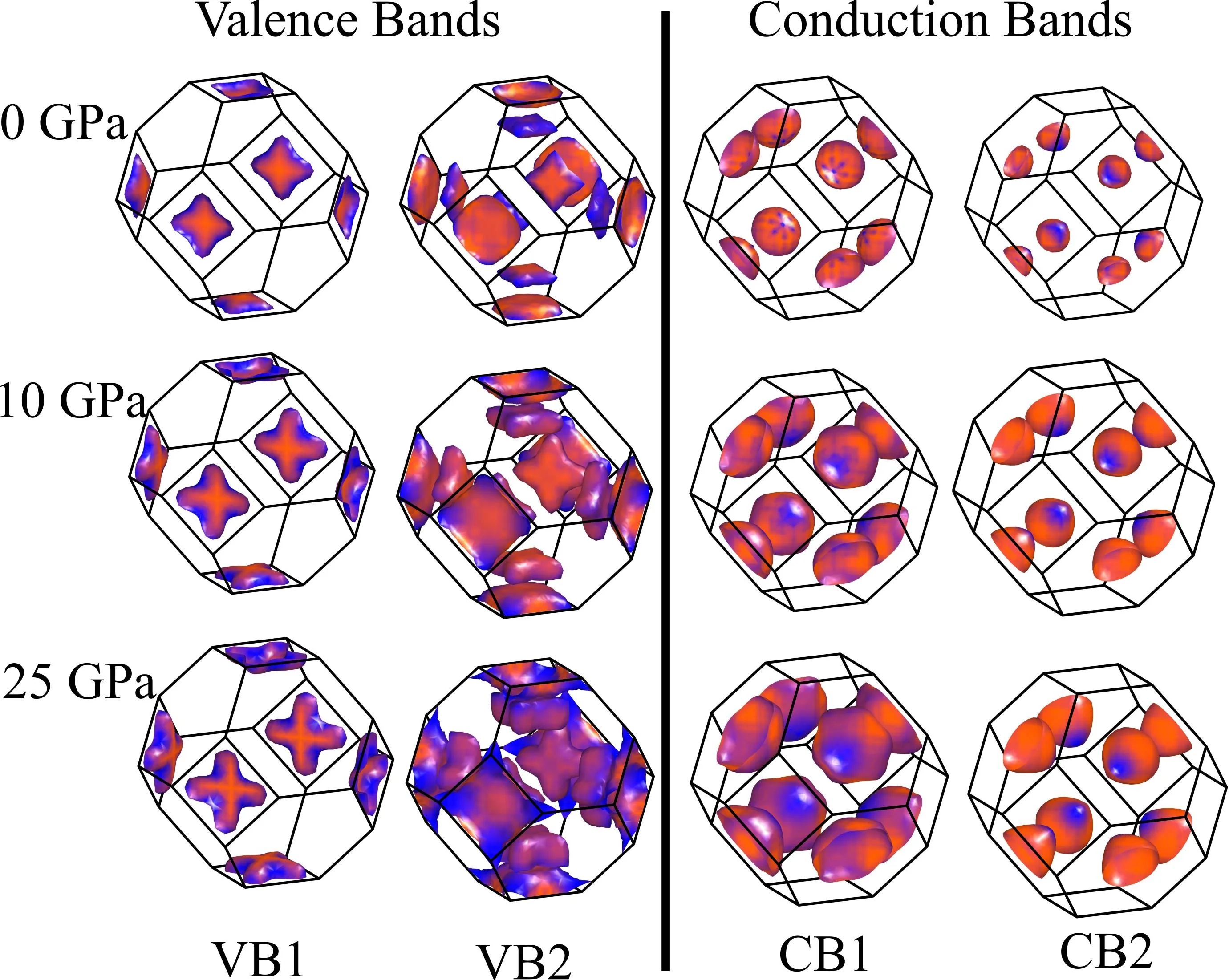
AgSbTe2 is a well-known thermoelectric material with a high Seebeck coefficient and intrinsically low thermal conductivity, but its behavior under pressure remains largely unexplored. Here we report a systematic investigation of the structural, electronic, and transport properties of non-stoichiometric AgSbTe2 under high pressure. At ambient pressure, the material can be described as having a cubic crystal structure that remains stable up to 21.7 GPa beyond which it loses long-range structural order, while its crystal system fully recovers upon decompression. Remarkably, superconductivity emerges at a very low pressure of 0.38 GPa with an onset superconducting critical temperature (Tc) of 3.2 K. Tc increases with increasing pressure, reaching 6.9 K at 31.9 GPa, and peaks at 7.4 K during decompression. Magnetic-field-dependent transport measurements and electronic structure calculations reveal an evolution of the superconducting state driven by an enhanced electronic density of states at the Fermi level under compression. Our findings uncover pressure-induced superconductivity in AgSbTe2 and demonstrate that pressure can effectively tune the electronic ground state of thermoelectric materials, extending their functionality beyond thermoelectric energy conversion.
The pressure of 0.38 GPa at which superconductivity appears is about 3800 times atmospheric pressure, like placing a car on your thumbnail.