Supernova Exhaled Carbon Monoxide express
When a massive star runs out of fuel, it sheds its hydrogen envelope and explodes, like a final, desperate exhale. That’s exactly the kind of supernova (type Ib) astronomers observed. 62 days after the blast, in the cooling debris, they caught a faint infrared glow: it turned out to be the signature of carbon monoxide (CO). The material was hurtling at a terrifying 6,000 kilometers per second — fast enough to cover the Earth–Moon distance twenty times in an instant. Because of this speed, its spectroscopic fingerprint was blurred into a broad hump. Around it, cosmic dust glowed at 637°C, and helium lines confirmed the explosion’s class.
The breath of dying stars: that's what the world is made of.
Original abstract
as written by the authors arXiv:2603.23877
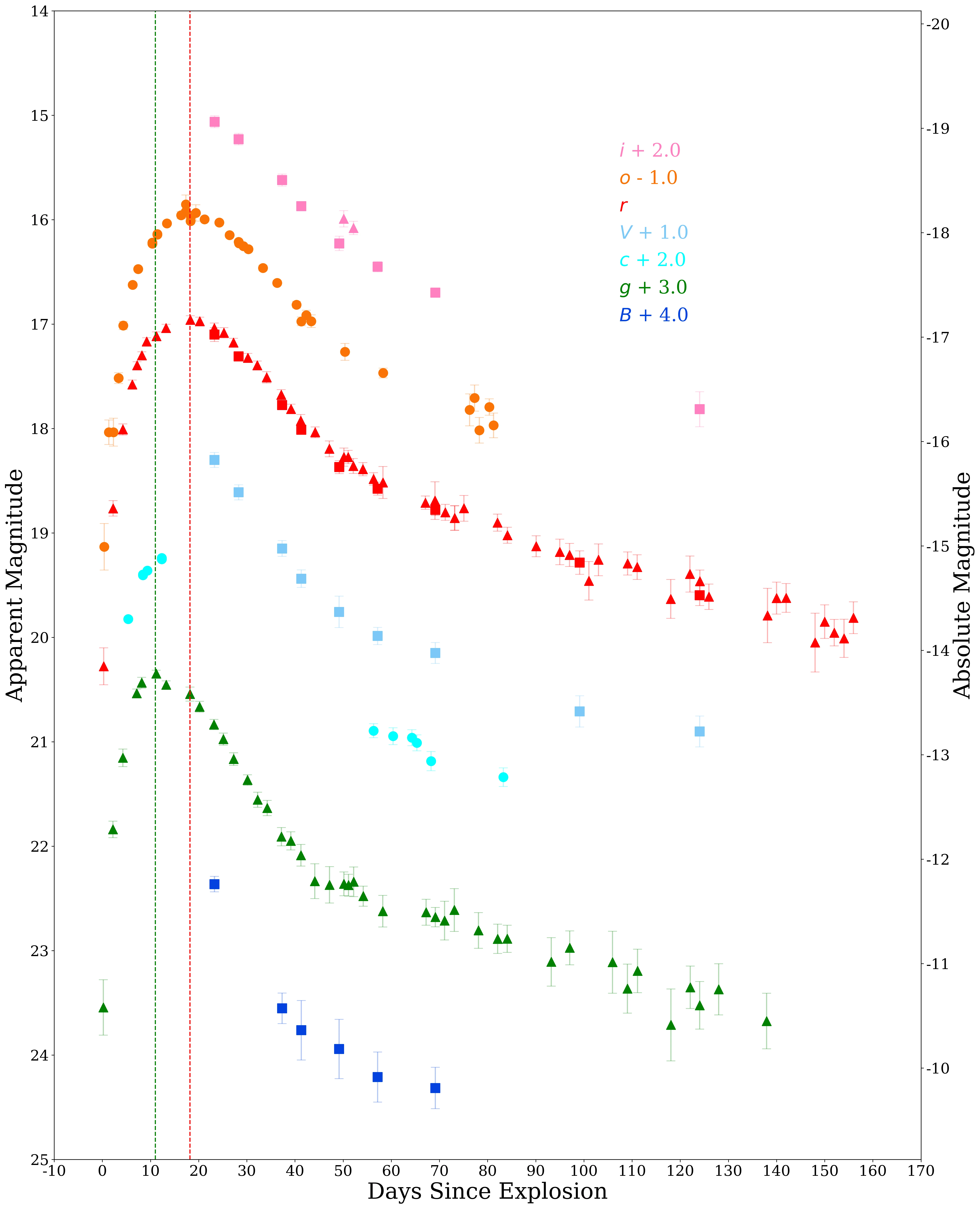
We present optical and near-infrared (NIR) observations of the Type Ib supernova (SN) 2024rbc. Emission from the first CO overtone, resting on a dust continuum at $$2.3-2.4$$ $$\mu$$m, was observed at 62 days post-explosion. The CO band heads are not resolved, and the emission appears broad, lacking sharp spectral features. This is the first observation of CO in the ejecta of a Type Ib SN reported in literature. The spectra of SN 2024rbc exhibit strong He I lines and numerous neutral and ionized metal lines. Comparing the spectral evolution of SN 2024rbc to other Type Ib, Ic, and IIb SNe indicates it is a Type Ib SN. We compare the velocities of key optical lines to examine the evolution of the ejecta. Additionally, fitting SN light curve models of helium star progenitors computed with the STELLA code to photometric observations indicates a $$^{56}$$Ni mass of $$0.07$$ $$M_\odot$$ and an ejecta mass of $$1.7$$ $$M_\odot$$. Fitting a LTE model to the CO overtone implies a CO mass of 5.2 $$\times$$ 10$$^{-4}$$ $$M_{\odot}$$, a CO temperature of $$4040$$ K, and a CO velocity width of $$5905$$ km s$$^{-1}$$. We also fitted a modified blackbody model to the dust continuum, deriving a dust temperature of $$910$$ K and a dust mass of $$1.3$$ $$\times$$ $$10^{-3}$$ $$M_{\odot}$$. The CO provides direct evidence for the onset of dust formation, and the observed dust continuum likely originates from newly formed dust in the ejecta. However, robust dust mass estimates require MIR observations.
The amount of carbon monoxide in SN 2024rbc is so vast that its mass exceeds the weight of Earth's entire atmosphere by billions of times. Yet compared to the star's mass, it's just a trace impurity.
The phrase 'we are all made of stardust' is not just a metaphor. In the movie 'Interstellar,' this idea resonates with particular poignancy.