Jesper Sollerman

5 articles · 30 co-authors · latest: 2026-07-24
46,597 citations · h-index 100 · 807 papersData: Semantic Scholar

We have retold 5 papers by this author. 1 of them with a full read. most often about: primordial black hole, gamma-ray burst, tidal disruption event. 30 co-authors across our retellings.

Links in the knowledge graph
High Energy2026-02-101 minarXiv:2602.10180express
Invisible Black Hole Shreds Star in a Galactic Suburb
The center of a galaxy is a bustling metropolis where a giant black hole often snatches inattentive stars. But telescopes caught a flare in a quiet suburb, tens of thousands of light-years from the core. This gave away a wandering black hole — an invisible predator, flung out of the center after an ancient galaxy collision.
High Energy2026-03-251 minarXiv:2603.23877express
Supernova Exhaled Carbon Monoxide
When a massive star runs out of fuel, it sheds its hydrogen envelope and explodes, like a final, desperate exhale. That’s exactly the kind of supernova (type Ib) astronomers observed. 62 days after the blast, in the cooling debris, they caught a faint infrared glow: it turned out to be the signature of carbon monoxide (CO).
Cosmology2026-04-092 minarXiv:2604.07983express
Cosmic Lens Amplified a Star's Explosion a Hundredfold
A distant lamp shines through uneven glass. The glass bends the rays, and instead of one flame on the wall, several appear — some brighter, some fainter. In much the same way, a massive galaxy bends the light of an exploded star. There was one explosion, but the images show four glowing points.
High Energy2026-05-082 minarXiv:2605.07827express
Helium in the Thermonuclear Fire of a Supernova
A match flares from both ends. First the head ignites, and a moment later the flame engulfs the wooden stick. Something similar may happen in some Type Ia supernovae — except the match is a white dwarf (a star the size of Earth), and the flame is a thermonuclear explosion.
Cosmology2026-07-242 minarXiv:2607.22050
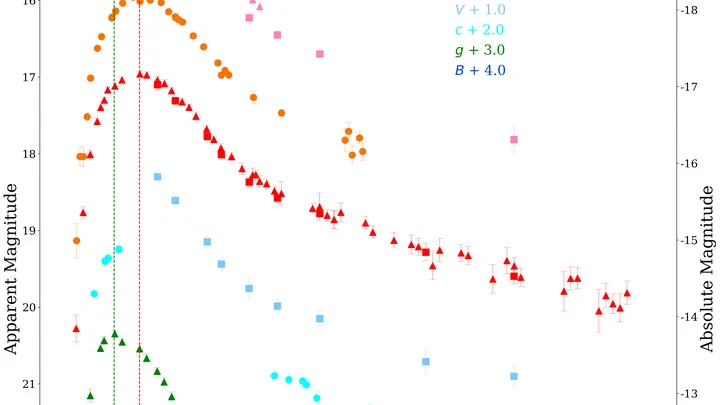
Bickford's fuse of a cosmic firework: what the early light of 17 supernovae revealed
17 supernovae from the ZTF DR2 sample lit up ahead of schedule. In the first hours and days after the explosion, they emitted more light than standard models predict. Astronomers compare this to a Bickford fuse: before the blinding flash tears across the sky, a precursor spark runs through the outer layers.