Waves Frozen Beside a Moving Source express
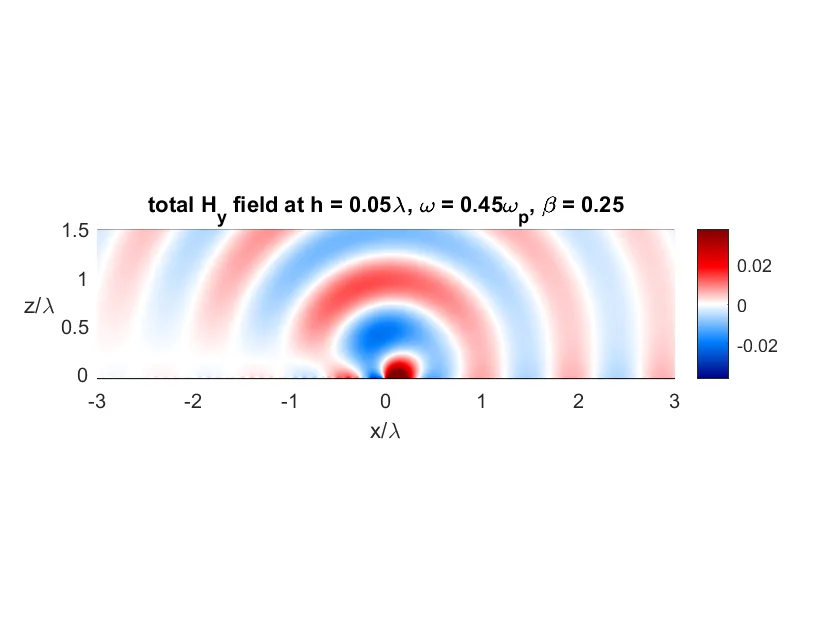
A swimmer cutting through water at the speed of the waves running on it finds themselves in a strange position: the waves they themselves generate can neither overtake them nor fall behind. They pile up at the swimmer's bow and freeze. A similar phenomenon occurs when a light source moves inside a medium at a speed matching the speed of energy transfer of the waves. The new work shows that for surface waves, those running along the interface between media, such a match leads to frozen wave patterns that are stationary relative to the source.
Usually, moving faster than the phase velocity produces Cherenkov radiation — a light cone, like that of a supersonic aircraft. But the authors considered a different case: the source's speed matches not the phase velocity (the speed of the crests) but the group velocity — the speed at which waves carry energy. In media where these speeds differ greatly, the effect appears at much lower source speeds. Surface waves are naturally slow, so for them this match is achievable even at moderate speeds.
The enhancement also shows up in mechanics: the source experiences increased optical forces and torques. This is like resonance swinging a swing — if you push in time, the amplitude grows without extra effort. Here, the source's motion plays the role of the pushes, and the surface waves play the role of the swing.
The practical value is that the effect is achievable not only with real motion but also with synthetic motion — when the medium's properties change in time as if the source were moving. This opens the way to controlling light and forces at micro- and nanoscales without mechanical movement.
Original abstract
as written by the authors arXiv:2603.27275
Spatio-temporal modulation enables synthetic motion at effective velocities approaching the speed of light, providing new regimes for light-matter interaction. Traditional Cherenkov-type effects arise when the velocity of an emitter matches or exceeds the phase velocity of electromagnetic modes supported by a medium. Here, we study dispersive systems in which phase and group velocities differ markedly. Specifically, we explore the case of group-velocity matching for surface waves, where the emitter moves at the same velocity as the flow of energy. This gives rise to frozen surface modes which are stationary in the emitter frame, accompanied by resonant energy accumulation. The result is a dramatic increase of the local density of optical states, the power extracted from the emitter, and the optomechanical forces and torques it experiences. Since surface modes naturally exhibit slow group velocities, this is accessible at lower relative speeds than phase-velocity effects. This phenomenon provides a route to enhanced light-matter interaction via real or synthetic motion.
The speed of surface waves can be hundreds of times slower than the speed of light in vacuum, so the speed match is achievable at relatively low source speeds.