Cherenkov radiation is a faint blue glow emitted when a charged particle travels through a transparent medium faster than light does in that medium. This phenomenon occurs because the particle outpaces the electromagnetic waves it generates, creating a shockwave of light, analogous to a sonic boom but for photons. Cherenkov radiation is a key tool in particle physics, allowing scientists to detect and identify high-energy particles.
History
Cherenkov radiation was discovered experimentally by Pavel Cherenkov in 1934, with theoretical explanation provided by Ilya Frank and Igor Tamm in 1937. The three shared the Nobel Prize in Physics in 1958.
How it works
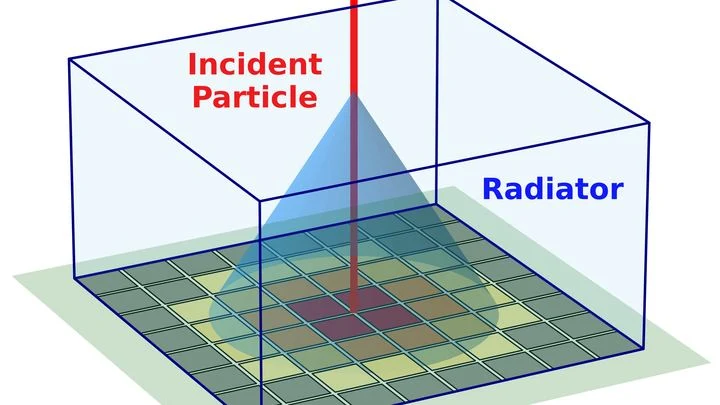
When a charged particle moves through a medium like water or glass, it polarizes the atoms along its path, which then relax and emit light. Normally, these emissions interfere destructively, but if the particle moves faster than the speed of light in that medium, the wavefronts add constructively, producing a coherent cone of light. The angle of the cone depends on the particle's speed and the medium's refractive index, allowing physicists to measure the particle's velocity.
In practice
Cherenkov detectors are used in neutrino observatories like Super-Kamiokande and in the IceCube experiment at the South Pole, where they detect the faint flashes produced by neutrino interactions in ice or water.
Fun fact
The blue glow seen in the water surrounding nuclear reactor cores is Cherenkov radiation, caused by fast electrons moving through the water faster than light does.
The blue glow in water around a nuclear reactor is light born when a charged particle outruns light in that medium. The effect was discovered by Pavel Cherenkov in 1934, with the theory provided by Igor Tamm and Ilya Frank.
The blue glow in water around a nuclear reactor is light born when a charged particle outruns light in that medium. The effect was discovered by Pavel Cherenkov in 1934, with the theory provided by Igor Tamm and Ilya Frank.
In July 1969, as Apollo 11 flew toward the Moon, astronauts noticed something unusual: brief flashes of light that appeared even with their eyes closed. At first, this was attributed to fatigue, but the flashes recurred in different crews. Gradually, it became clear: cosmic rays were to blame — tiny particles hurtling through space at tremendous speeds.
Every second, invisible projectiles from the depths of space pierce through us. These are cosmic rays — atomic nuclei accelerated to speeds nearly indistinguishable from the speed of light. Their energy is hundreds of millions of times greater than what our most powerful accelerators can achieve. Where does this monstrous force come from?
A swimmer cutting through water at the speed of the waves running on it finds themselves in a strange position: the waves they themselves generate can neither overtake them nor fall behind. They pile up at the swimmer's bow and freeze. A similar phenomenon occurs when a light source moves inside a medium at a speed matching the speed of energy transfer of the waves.
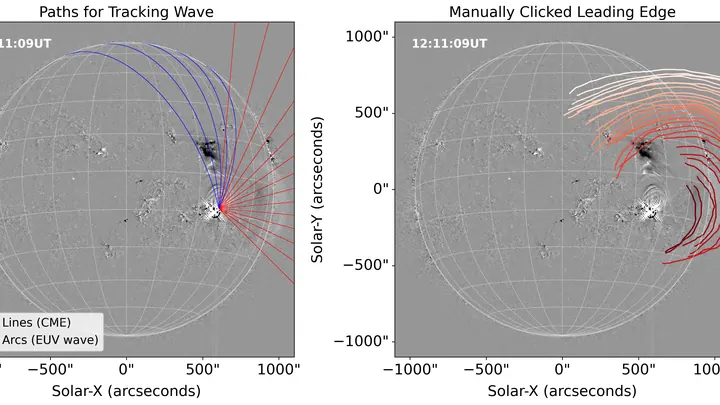
A shock wave in the Sun's corona is like the sonic boom from an airplane, except instead of air there is scorching plasma, and instead of sound there is a jump in density and magnetic field. On March 10, 2024, such a wave swept across the western part of the solar disk.
To align particle spins in one direction, physicists usually cool a substance to near absolute zero and place it in a strong magnetic field. That is expensive and bulky.
A new method resembles tuning many spinning tops with a gentle touch: mediator molecules temporarily bind to target atoms and pass on their order.
Twenty-eight seconds: that's how long it took for an automated camera to lock onto a flash in a constellation whose light had traveled for more than nine billion years.
When a particle zips through a transparent material faster than light can travel through it, it leaves behind a faint blue flash, just as a jet breaking the sound barrier creates a shock wave. This Cherenkov radiation fires instantly, with no delay, making it perfect for ultra-precise timing in the world of elementary particles.
In a tank of pure water, particles traveling faster than light in that medium leave bluish flashes, like a plane breaking the sound barrier creates a sonic boom. From these flashes, you can tell what kind of visitor passed through: a gamma quantum or a neutron. This is no idle task: at borders and warehouses, you need to quickly distinguish a harmless radioactive cargo from weapon-usable material.
In a dark room, you might notice a faint blue glow around some radiation sources. This is Cherenkov light: it appears when a charged particle travels through a medium faster than light can propagate in it. The result is a light shock wave, similar to the sonic boom from a supersonic jet, but made of photons.
When a massive star exhausts its thermonuclear fuel, its core collapses, and the outer layers are ejected into space at speeds of thousands of kilometers per second. This is how a supernova remnant is born — an expanding cloud of shock-compressed gas spanning light-years.
A firefly blinks for one ten-billionth of a second somewhere above the Siberian taiga. Seeing such a thing is impossible, but the TAIGA-HiSCORE array, spread across a valley in the Tunkinsky district of Buryatia, tried to catch exactly such flashes — not from insects, but from the depths of space.