A collective effect in physics refers to a phenomenon where many particles act together in a coordinated manner, producing behavior that cannot be predicted by studying individual particles in isolation. This is a cornerstone of condensed matter physics and quantum mechanics, where interactions between large numbers of particles give rise to emergent properties like superconductivity, superfluidity, and magnetism. Collective effects are also crucial in plasma physics, where charged particles respond to each other's electromagnetic fields, and in astrophysics, where gravitational interactions between stars shape entire galaxies.
History
The concept of collective effects gained prominence in the early 20th century with the development of quantum mechanics, particularly through the work of Wolfgang Pauli on electron behavior in metals and Lev Landau on quantum liquids in the 1940s.
How it works
When particles are densely packed or strongly interacting, their individual motions become correlated. For example, in a superconductor, electrons pair up into 'Cooper pairs' that move in lockstep, creating a frictionlessflow of current. In a laser, photons are stimulated to emit in phase, producing a coherentbeam. The key is that the system's behavior is governed by the collective state—such as a quantum wavefunction or a plasma oscillation—rather than by the sum of independent particle trajectories. This often requires mathematical tools like statistical mechanics or quantum field theory to describe the macroscopic outcome.
In practice
Collective effects are harnessed in technologies like MRI machines (nuclear spin alignment), semiconductor devices (electron band structure), and particle accelerators (bunching of charged particles).
Two floats on the waves. Throw a stone into water, and the ripples will spread, rocking both floats one after another — not simultaneously. In the quantum world, such rocking is called entanglement: particles, like floats, begin moving in sync.
Three dancers move as one: each feels all the others, and the overall harmony cannot be reduced to individual interactions. This is roughly how three particles behave, born from an electron and positron collision at the speed of light. They are a top quark, its antiparticle, and a Z boson.
A stone falls into a pond, and ripples spread across the water. Long waves and short ones travel at the same speed: that's how ordinary sound behaves in almost any medium. But in quantum liquids, things can be different.
Physicists considered a superfluid where particles move along a "flat" energy band.
A swarm of fireflies rarely collides, yet they synchronously change color by exchanging signals. This is how neutrinos behave in dense streams from collapsing stars: they collectively transform from one type to another, even though individually they interact extremely weakly.
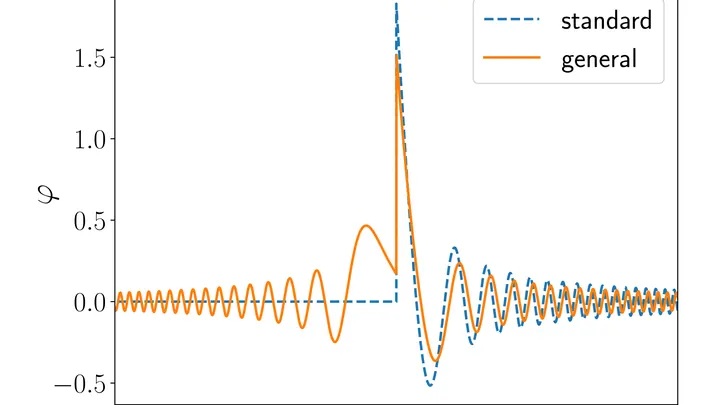
The universe is not a solid monolith, but a canvas of countless quantum threads. Spacetime doesn't flow like water, but vibrates like a tapestry in the wind. For a long time, physicists only saw the overall pattern, neglecting the tremor of individual threads.
In an orchestra, one musician plays so quietly that their sound is almost inaudible in the overall chorus. In the quantum world, such 'quiet' states are called dark: their energy barely escapes, like light in a darkened room. But if there are many musicians, their mutual influence can unexpectedly awaken even the most silent one.
A handful of rice thrown into a glass of water scatters — the grains spread apart. Now imagine each grain propels itself forward with stubborn persistence and bounces off softly upon collision. Such particles are called active: they spend their own energy to move, like bacteria or microscopic robots.
Near black holes and neutron stars, plasma churns like water in a boiling kettle. But this 'kettle' has no walls — only magnetic fields that twist and tear. At the tears, thin sheets form where magnetic field lines reconnect, giving particles a kick like a surfer catching a wave.
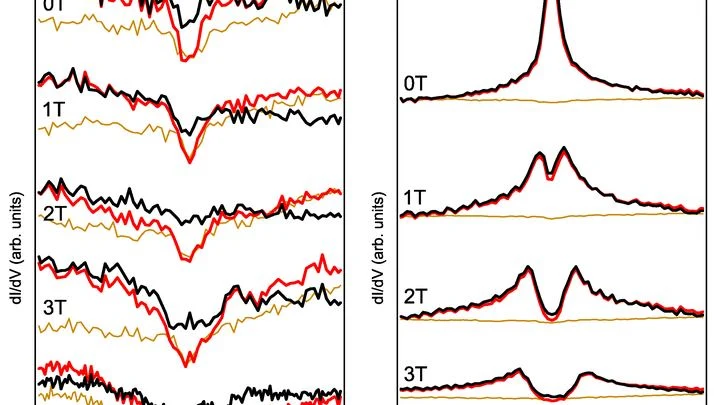
A tiny magnet, made from just two molecules, was placed on a metal surface, and it behaved like a temperamental conductor. Normally, electrons in a metal move in a coordinated way, like a crowd on an escalator. But when cooled significantly, this order breaks down, and the motion becomes unpredictable.
A swimmer cutting through water at the speed of the waves running on it finds themselves in a strange position: the waves they themselves generate can neither overtake them nor fall behind. They pile up at the swimmer's bow and freeze. A similar phenomenon occurs when a light source moves inside a medium at a speed matching the speed of energy transfer of the waves.
The familiar picture: gravity always attracts. But if a mass is in quantum superposition (that is, in two places at once, like an object in a double-exposure photograph) everything flips. Quantum theory allows a particle to be both here and there in a literal sense: its position is described by a wave function smeared across space.
An ordinary chemical reaction is like a ball rolling down a hill: it has one natural path. But if you place molecules in a tiny mirrored box, an optical microresonator, the light inside starts to interfere with the ball's motion. It can nudge it, hold it back, or even split its trajectory.
In a new study, physicists traced exactly how this happens.
A quantum particle quantum particle can exhibit backward motion even if its overall direction is forward. Imagine a river: the main current rushes toward the mouth, but individual currents suddenly swirl and momentarily dart against the flow, creating local disorder.
The Social Laser theory describes society by borrowing the inner workings of a laser. People, like atoms in a crystal, absorb streams of information and become charged by it. When the number of those charged with a single idea outweighs the indifferent, even a weak signal (a post, a call to action) makes everyone act as one.