Digital Twin Teaches a Laser to See express
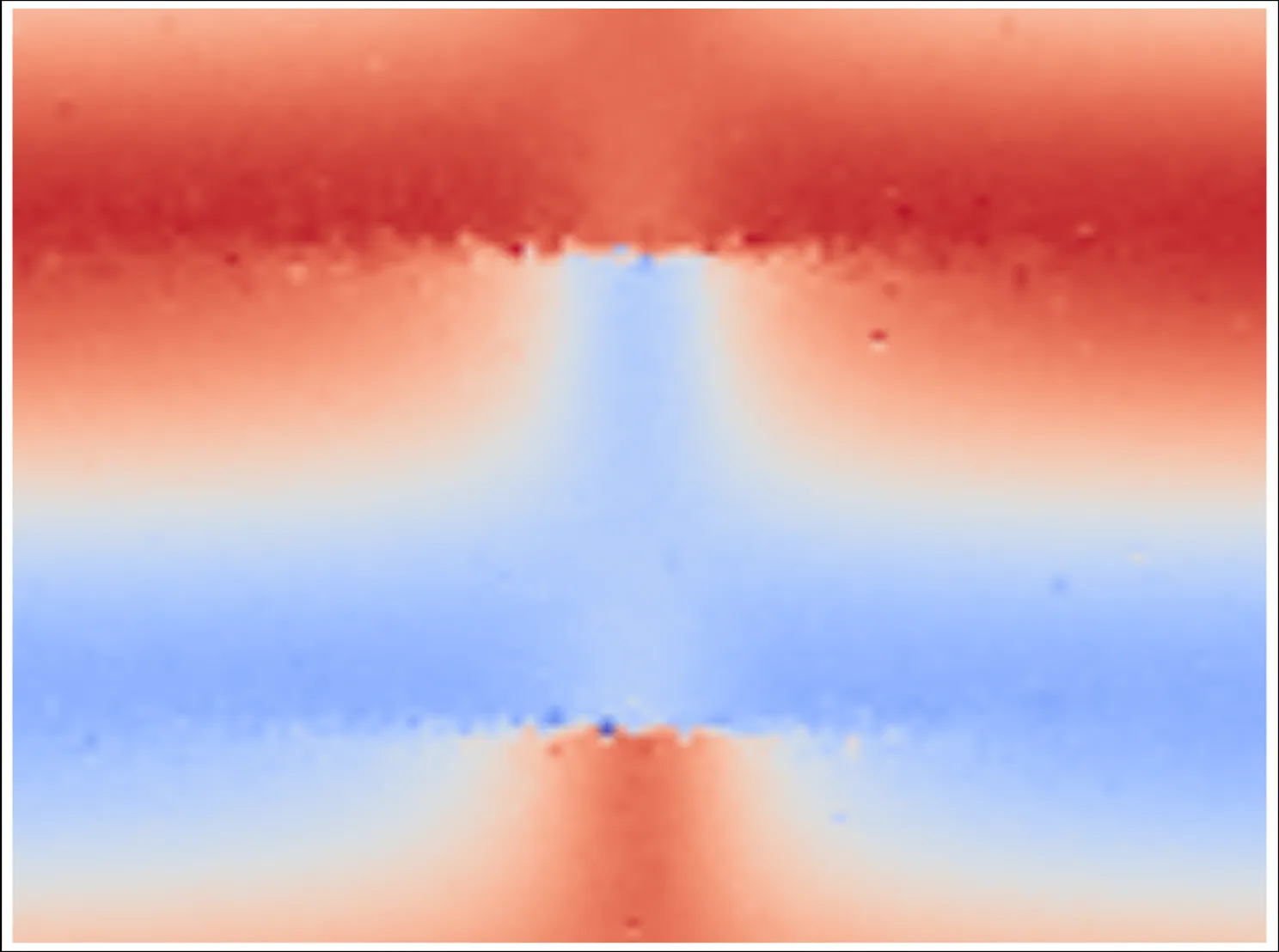
A laser strikes a tiny glass grating, and electrons passing through it are accelerated. You can't see inside, so you judge what's happening by the energy of the electrons after acceleration, like judging the shape of a stone by the splash it makes.
Scientists built a digital twin: a computer model that mimics the behavior of the real accelerator. They ran thousands of laser pulse variations through it and obtained thousands of energy spectra. Then the neural network learned the inverse — to determine what the pulse was from the spectrum.
Now, a single snapshot of electron energy reveals the tilt of the laser pulse front to within a degree, and the phase shift to within 0.36 radians (that's a difference of 0.4 femtoseconds in arrival time). The neural network does this in milliseconds, keeping up with 50 pulses per second. Thus, the accelerator becomes its own sensor, seeing what is hidden from direct measurements.
A laser pulse can be compared to a wave at a stadium: spectators stand up and sit down, passing the wave along. The tilt of the front is like the wave moving not straight but diagonally. The phase is the moment when an electron meets the crest of the wave. Both parameters are critical for acceleration, and now they can be controlled in real time.
Dielectric laser accelerators promise to be thousands of times more compact than traditional ones: instead of kilometer-long tunnels, a chip the size of a palm. But so far, they accelerate electrons only to a fraction of the energy of big machines.
In the series 'The Expanse,' ships are propelled by giant accelerators, but the future may belong to tiny chips that control light as precisely as the neural network from this work.