object

laser pulse

A short, concentrated burst of laser light used to interact with matter.
33 related articles

Description

A laser pulse is a brief, intense burst of coherent light, ranging from femtoseconds (10⁻¹⁵ s) to nanoseconds in duration. Unlike a continuous laser beam, a pulse concentrates energy into a tiny time window, achieving enormous peak powers — terawatts or even petawatts — while keeping the average power modest. This concentration allows laser pulses to drive extreme physical processes: ionizing atoms, accelerating electrons, generating X-rays, and probing molecular dynamics on ultrafast timescales.

History

The first laser pulse was produced by Theodore Maiman in 1960, but the key technique of mode-locking was developed in the mid-1960s by Hargrove, Fork, and Pollack. Chirped pulse amplification, which enabled petawatt pulses, was invented by Gérard Mourou and Donna Strickland in 1985, earning them the Nobel Prize in Physics in 2018.

How it works

Laser pulses are generated by mode-locking, where many longitudinal modes of a laser cavity are synchronized in phase, producing a train of short pulses. The pulse can be further amplified and compressed using techniques like chirped pulse amplification, which stretches the pulse, amplifies it, then recompresses it to avoid damaging the gain medium. When a focused pulse hits matter, its electric field can exceed atomic binding forces, tearing electrons from atoms and creating plasma. This plasma can then act as a medium for further light-matter interactions, such as self-focusing or wakefield acceleration.

In practice

Laser pulses are used in eye surgery (LASIK), material micromachining, time-resolved spectroscopy to study chemical reactions, and laser-driven particle accelerators that fit on a tabletop.

Fun fact

A femtosecond laser pulse is so short that in one pulse, light travels only about 300 nanometers — roughly the width of a virus.

Concept graph →

Related articles · 33

Plasma Physics2026-08-182 minarXiv:2608.17555express
Twin X-ray Flashes from a Plasma Accelerator
When a laser beam hits a gas, it tears electrons from atoms and accelerates them to nearly the speed of light. As these electrons fly through the plasma, they emit X-rays, like a glowing trail from a fast particle. In the new work, physicists made a single laser pulse create not one but two such trails in succession.
Plasma Physics2026-08-151 minarXiv:2608.15039express
Laser Corkscrew Accelerates Electrons
A regular laser beam travels straight, like the light from a flashlight. But light can be twisted into a spiral, like the thread of a corkscrew. Such a beam carries orbital angular momentum: it doesn't just illuminate, it also spins anything it encounters.
Optics2026-08-121 minarXiv:2608.12040express
How Electrons Jostle Each Other
Two electrons that leave a metal needle tip almost simultaneously start to repel each other, like two people trying to squeeze through a narrow door at the same time. The closer they are, the more they get in each other's way.
High Energy2026-08-091 minarXiv:2608.08754express
Lone Radio Pulsars: The Mystery of Rare Bursts
Pulsars are rapidly spinning neutron stars that emit radio pulses like a lighthouse. But some of them stay silent almost all the time, occasionally emitting a single pulse. Such objects are called rotating radio transients (RRATs). They were discovered nearly twenty years ago, but they remain a mystery.
Cosmology2026-07-272 minarXiv:2607.24912express
Dark Matter as Ripples on a Cosmic Pond
The galaxy is not a smooth lake but a pond with ripples. These ripples are created by ultralight dark matter (particles billions of billions of times lighter than an electron).
Quantum Physics2026-06-192 minarXiv:2606.21675express
The Laser That Decided to Throw a Tantrum
A string sounds perfectly pure until a draft touches it. That's roughly how a superradiant laser works: a beam of atoms, pre-charged with energy, flies through a room made of two mirrors — an optical resonator (a trap where light bounces back and forth).
Plasma Physics2026-06-052 minarXiv:2606.07147express
Industrial laser accelerates electrons
A factory laser that cuts and welds metal on production lines has been made to work as a particle accelerator for the first time. Physicists took a standard ytterbium laser, its heart is a crystal the size of a palm, and turned its flashes into a tool for accelerating electrons to nearly the speed of light.
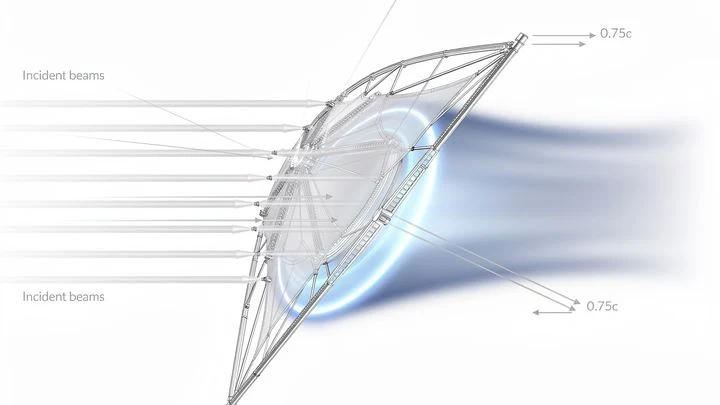
Dance of Photons: When the Solar Sail Becomes Its Own Brake
Imagine a three-faced dancer on the crest of a light wave. One face is a catcher, absorbing incoming photons. The second is a perfect mirror, throwing light back. The third is frosted glass, scattering rays in all directions. As long as speed is low, the dance is harmonious. But at near-light speeds, the choreography breaks. This is like a surfer chasing a wave.
Optics2026-05-162 minarXiv:2605.17092express
A Rainbow at Your Fingertip
Light can be more than just a beam: it can be a precision ruler. If you take very short pulses, shorter than a fly's wingbeat, and fire them one after another, you get an optical comb: a set of colors spaced at exactly equal intervals, like the teeth of a comb. This rainbow lets you measure distances, time, and the composition of materials with unimaginable accuracy.
Light Controls Nuclear Spins in Crystals
Tiny magnets inside atoms, nuclear spins, can 'freeze' for long minutes in a cold crystal. This hinders the quick tuning of quantum sensors: everything takes too long to reach the desired state. Physicists have found a way to nudge them with light.
Plasma Physics2026-04-261 minarXiv:2604.23913express
Laser Yarn of Neutrons
A laser hits a target of thin wires, and within tens of femtoseconds (billionths of a billionth of a second) knocks out a stream of protons. These protons fly into a converter made of lithium and deuterium, where neutrons are born.
Optics2026-04-221 minarXiv:2604.20084express
A Light Pulse Shorter Than an Instant
An ordinary camera flash lasts thousandths of a second. An attosecond pulse is a trillion times shorter — in the time it takes, light travels a distance smaller than the size of an atom. Such flashes act as an ultra-high-speed shutter: they freeze the motion of electrons, letting us see them jump between orbitals or take part in a chemical reaction.
Stellar2026-04-201 minarXiv:2604.17724express
Solar Loops Pulse Like a Heartbeat
A sunspot, a dark island on the scorching surface, breathes. Every three minutes, a wave spreads from it, runs along an invisible magnetic arch, and makes the plasma above a neighboring spot flare with a radio signal. Radio telescopes caught seven such flares in a row on February 14, 2024.
physics.acc-ph2026-04-111 minarXiv:2604.09969express
Attosecond X-ray Flashes from an Accelerator
An ordinary camera flash lingers for hundredths of a second, but for atoms, that's an eternity. Inside molecules, electrons jump in attoseconds: billionths of a billionth of a second. To capture that, you need a light pulse shorter than the event itself. Physicists take an electron beam in a linear accelerator and compress it so that individual bunches become thinner than a hair — in time.
Optics2026-04-051 minarXiv:2604.04005express
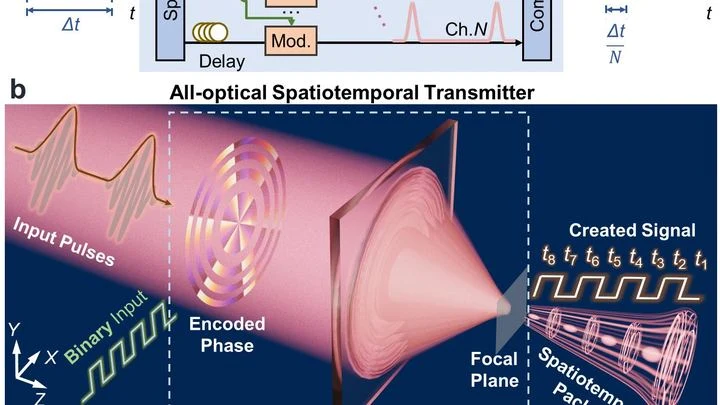
Light Instead of Wires: 3 Trillion Bits per Second
Light can carry information faster than any electronics. But usually, between a computer and a laser sits a digital-to-analog converter — a device that turns zeros and ones into electrical signals. It's the bottleneck. The new transmitter does away with this middleman.
Optics2026-03-291 minarXiv:2603.27554express
A Light Pulse That Won't Spread Out
A laser flash lasting 50 femtoseconds is like a shot that lasts one billionth of a second. In that time, light travels only 15 micrometers — less than the thickness of a human hair. But if you send such a flash through an amplifier, it starts to stretch like a rubber band and loses its sharpness.
How to Tell Dark Matter from Noise
Underground, in a former gold mine, sits a tank of liquid xenon. If a dark matter particle flies through it, the xenon flashes. But it also flashes from ordinary particles, like neutrinos or leftover radioactivity. The task is to tell which flash comes from dark matter and which from noise.
Optics2026-03-191 minarXiv:2603.18518express
Laser Draws an Invisible Key
A laser beam strikes a gold-and-silver film for just a few nanoseconds — in that time, light travels less than a meter. At the point of impact, the metal boils, splatters, and freezes into a random pattern of tiny particles. Each pattern is as unique as cracks in ice or tree branches.
High Energy2026-03-162 minarXiv:2603.15537express
The Cosmic Accelerator That Shouldn't Have Worked
Deep in the constellation Aquila lies a nebula that looks like an expanding bubble. It is inflated by a tiny star the size of a city — a pulsar that makes several rotations per second and loses rotational energy. Usually, such bubbles shine exactly as brightly as their pulsar is powerful.
Medical Physics2026-03-161 minarXiv:2603.15913express
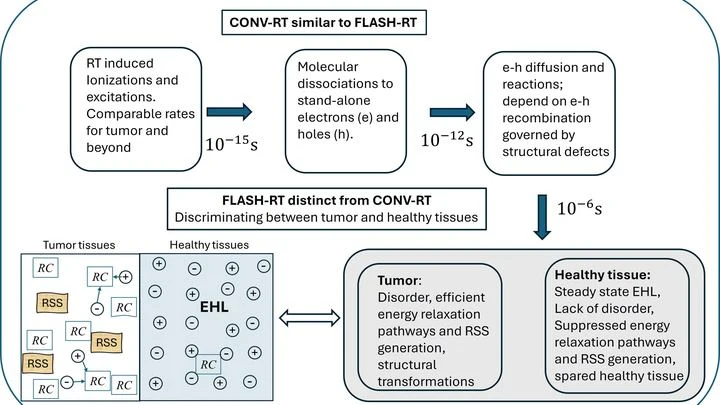
A Beam That Spares Healthy Cells
Two cities: one with neat, straight streets, the other with a tangle of alleys. If you send a powerful flood of water through both, in the first the water quickly drains away through channels, while in the second it swamps everything. That's roughly how tissues behave under ultrafast radiation therapy, known as FLASH.
High Energy2026-03-112 minarXiv:2603.10347express
How to Fish a Pulsar Out of the Noise
Rhythmic flashes of a lighthouse in thick fog: that's what searching for pulsars looks like. The lighthouse spins, and its beam periodically sweeps across the telescope. But the fog smears the light, making the period seem slightly different. If the same lighthouse was observed twice, you can compare: the periods should nearly match, and the smearing should be similar.
High Energy2026-03-062 minarXiv:2603.06476express
The Hidden Pulsar in a Globular Cluster
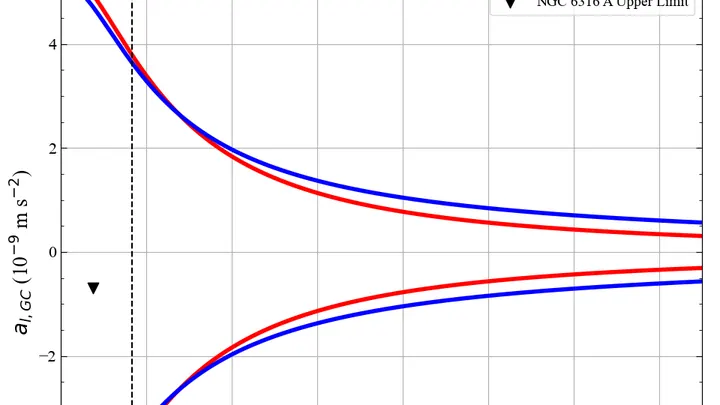
In a dense ball of hundreds of thousands of stars, what astronomers call a globular cluster, radio telescopes have picked up a faint but very steady rhythm. Every 2.45 milliseconds, that's 408 ticks per second, a radio pulse arrives.
High Energy2026-02-231 minarXiv:2602.20230express
A Magnetic Carousel Around a Dead Star
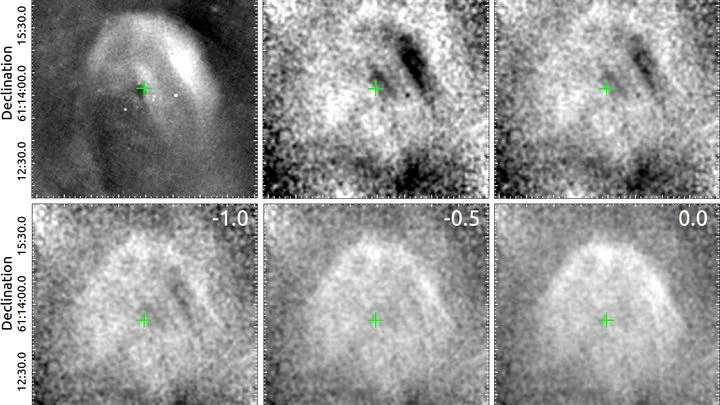
The VLA radio telescope peered into the Boomerang Nebula — a cloud inflated by the wind from a rapidly spinning neutron star. The new images reveal details as small as a lunar disk on the sky: an elongated core around the pulsar and a long arc curving around it from the north.
Optics2026-02-212 minarXiv:2602.18838express
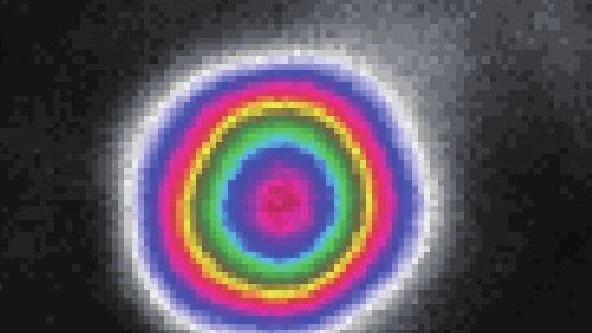
Light Springs: Twisting a Beam to Outrun Light
A laser beam usually travels straight, like a jet of water from a hose. But what if you twist that jet like the thread of a corkscrew? You get a light spring — a beam that, as it moves, also spins around its own axis. At every point in space, its brightness traces a spiral, and if you place a flat screen in its path, you'll see a rotating spot of light.
Plasma Physics2026-02-132 minarXiv:2602.13408express
Laser Beam in a Plasma Channel: How to Measure Its Speed
A laser pulse racing through plasma is like a runner carving a path through a crowd. It shoves electrons aside, leaving behind a rarefied channel, just as the crowd parts for a sprinter. In this channel, the crest of the light wave moves slightly faster than light in a vacuum, and it is this speed that determines how efficiently the pulse transfers energy to particles.
High Energy2026-02-051 minarXiv:2602.05601express
Blazar Flares: How to Tell Particle Accelerators Apart
A blazar is a distant galaxy with a plasma jet shooting from its center, aimed almost directly at us. Inside this jet, particles are accelerated to near-light speeds and emit powerful radiation.
physics.acc-ph2026-02-021 minarXiv:2602.01504express
Electron beam trapped in a ring the size of a dinner plate
A ring the size of a dinner plate made an electron beam run in circles. Its diameter is 22 centimeters, and a full turn takes just 4.7 nanoseconds. To put that in perspective: in one second, such an electron would complete more than two hundred million laps.
High Energy2026-01-261 minarXiv:2601.18596express
Runaway Pulsar's Tail Glows in Stripes
The neutron star PSR J1101-6101 is tearing through space at a breathtaking speed. It leaves behind a trail of charged particles, like a speedboat carving through water and dragging a foamy wake.
Quantum Physics2026-01-221 minarXiv:2601.15565express
How Squeezed Light Makes Microscopes Sharper
Even a laser beam has an invisible tremor — quantum noise. Physicists have learned to 'squeeze' it, like a balloon pinched at the waist: the noise quiets in one direction but amplifies in another. Scientists hid the excess noise where it doesn't interfere with precise light measurements.
High Energy2026-01-171 minarXiv:2601.11950express
Mysterious Flare from a Distant Galaxy
For twelve years, astronomers at the LPA radio telescope in Pushchino have been listening to the same patch of sky — the direction of the galaxy 3C 33. In that time, they caught just six short radio signals, each lasting from one to four minutes.
Optics2026-01-161 minarXiv:2601.11764express
Light in the Invisible Gap
There is a region of light that has long remained a blind spot: from 5 to 15 terahertz. It is not radio waves, nor infrared heat, but something in between, where molecules vibrate in particularly characteristic ways. Scientists from Germany have built a setup that finally peers into this 'new terahertz gap' and even beyond — past 25 terahertz. The secret lies in a crystal with the long name BNA.