ATLAS (A Toroidal LHC ApparatuS) is one of the two general-purpose particle detectors at the Large Hadron Collider (LHC) at CERN. It is designed to study what happens when protons collide at nearly the speed of light, capturing the debris of these high-energy impacts. The detector is a massive, layered instrument that records the paths, energies, and identities of particles produced in each collision, allowing physicists to test the Standard Model and search for new physics beyond it.
History
ATLAS was proposed in the early 1990s and built by an international collaboration of thousands of scientists and engineers. It began taking data in 2009, and in 2012 it was one of the two experiments that discovered the Higgs boson, a milestone that confirmed the last missing piece of the Standard Model.
How it works
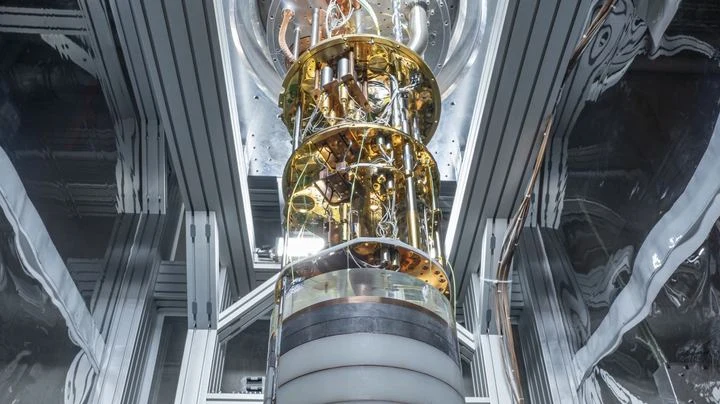
ATLAS is built like an onion, with concentric layers of different detector technologies. When protons collide at the center, the resulting particles fly outward. The inner tracker measures their momentum by bending them in a magnetic field; calorimeters absorb and measure their energy; and the muon spectrometer, the outermost layer, detects muons that penetrate everything else. The entire detector is cooled to very low temperatures for its superconducting magnets, and its electronics process millions of collision events per second, with sophisticated triggers selecting the most interesting ones for analysis.
In practice
Beyond fundamental physics, ATLAS has driven advances in detector technology, data processing, and grid computing, which have found uses in medical imaging, radiation therapy, and large-scale data analysis.
Fun fact
The ATLAS detector is about 46 meters long and 25 meters in diameter, roughly the size of a five-story building, and weighs about 7,000 tonnes.
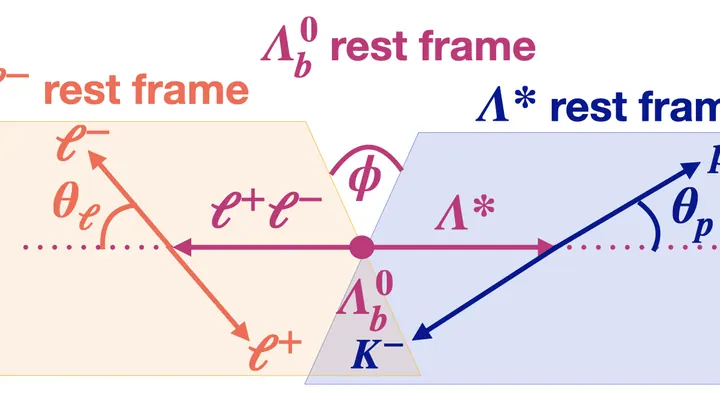
At the Large Hadron Collider, protons are smashed together, and among the debris, a heavyweight particle, the lambda baryon, sometimes appears. It lives for a tiny fraction of a second before decaying into other particles.
Three billiard balls scatter across the table after a strike: their trajectories depend only on the initial push. But in the world of atomic nuclei, things are more complex: particles sense each other on the fly, even if they are not bound together. For a long time, physicists could only measure pairwise interactions, while what happens when three meet remained behind the scenes.
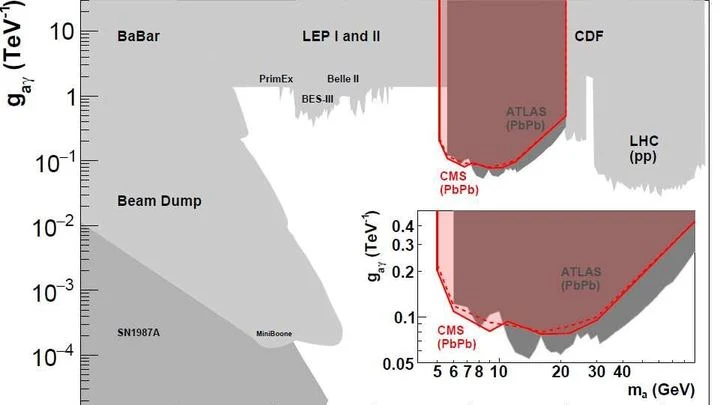
Dark matter is the invisible scaffolding of the universe. It's there, we know from the motion of stars and galaxies, but what this scaffolding is made of remains unknown. One guess is ultra-light particles similar to axions. They barely interact with ordinary matter, yet occasionally they do get involved.
Deep inside the ATLAS detector, like in a giant thermos, liquid argon sloshes — a transparent liquid at minus 184 degrees Celsius. When a particle flies through it, a weak electrical signal is born, like a quiet splash.
3I/ATLAS burst into the Solar System like an uninvited guest, a gift of fate for hunters of extraterrestrial intelligence. This comet-like wanderer from the depths of the Galaxy flew close enough to be heard in all its details — unlike distant exoplanets.
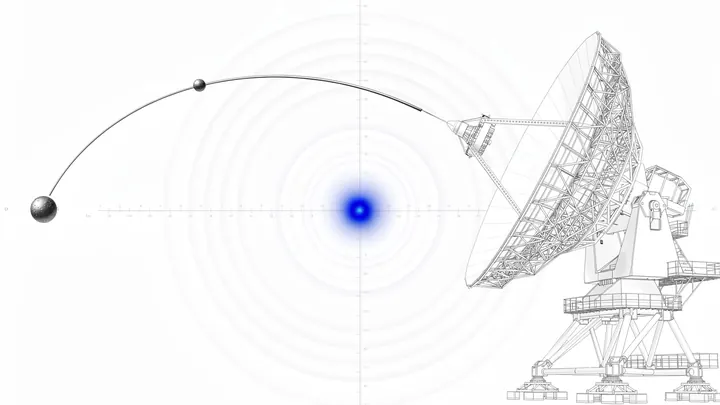
In absolute silence, you need to hear a feather drop. But someone keeps rustling a plastic bag. For the space-based LISA observatory, that 'rustling' will come from charged particles in space.
A charged particle streaks through a silicon sensor, leaving behind a trail of free electrons. The time it takes for this charge to be collected at the electrode depends on how deep in the crystal it was born. A particle entering head-on carves identical paths through neighboring pixels: their signals arrive almost simultaneously.
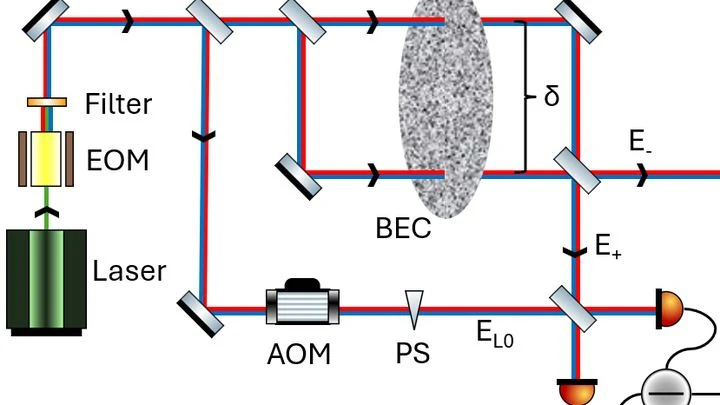
Physicists have proposed an experiment: a laser beam acts as a quantum detector and splits into two beam-ears. Each ear is directed through a tiny cloud of ultracold atoms — in this state, atoms merge into a single wave.
When matter is heated to millions of degrees, it turns into plasma — a mix of free electrons and ions, like a boiling soup of charged particles. You can't measure the temperature of such a 'soup' with an ordinary thermometer, but you can shine X-rays through it.
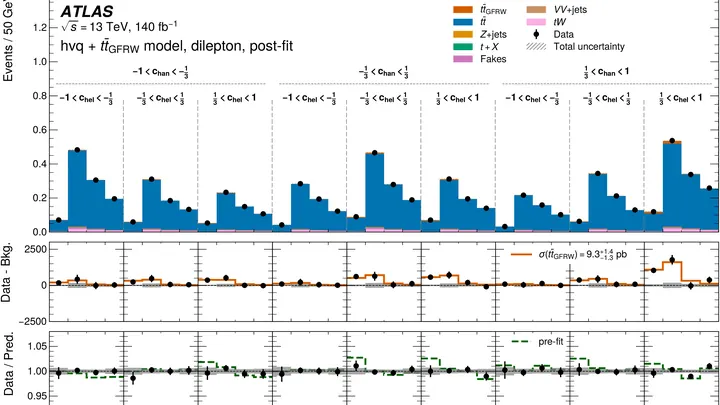
Oil droplets in boiling broth usually scatter apart, but if you bump them together very slowly, they may stick for a moment. Something similar happens with top quarks — the heaviest known building blocks of matter.
When two particles fly at almost the same speed in the same direction, their signals in the detector merge, like two voices in unison. Telling a duet from a soloist is an art in itself.
Cosmic rays are particles that arrive from deep space. When such a particle hits the atmosphere, it triggers a whole shower of new particles, like a billiard ball breaking a rack, sending balls scattering in all directions. To predict what such a shower will look like, we need to know how the primary particle interacts with the nuclei of air atoms.
A ring road around the Sun, where the traffic is not cars but clumps of matter. The diameter of this road is measured in light-years: it encircles our planetary system at its outer edge, in the Oort Cloud, where the star's weak gravity still holds sway.
A laser strikes a tiny glass grating, and electrons passing through it are accelerated. You can't see inside, so you judge what's happening by the energy of the electrons after acceleration, like judging the shape of a stone by the splash it makes.
Scientists built a digital twin: a computer model that mimics the behavior of the real accelerator.
Two particles flying apart in opposite directions behave as a single whole: measuring one instantly determines the state of the other. Such quantum entanglement has long been known for light particles, but now it has been observed for the first time in heavy Z bosons — the carriers of the weak force.
In the kitchen, two flashlight beams pass through each other without noticing. Light barely interacts with light. But if you accelerate particles to enormous energies, two photons can collide and give birth to something new.
At the Large Hadron Collider, protons collide at nearly the speed of light. Sometimes they don't smash apart but exchange photons — particles of light. These photons can produce a pair: one particle the detector sees, and another that flies off unnoticed.
In the ATLAS detector at the Large Hadron Collider, protons collide with enormous energy, and among the debris, a Higgs boson is sometimes born — the particle that gives mass to other particles.
The tau lepton is a heavy cousin of the electron, living less than a trillionth of a second. It usually decays into lighter particles, but never directly into three muons: such a transition is forbidden by known laws of particle physics. If it did happen, it would mean unknown forces are at play.
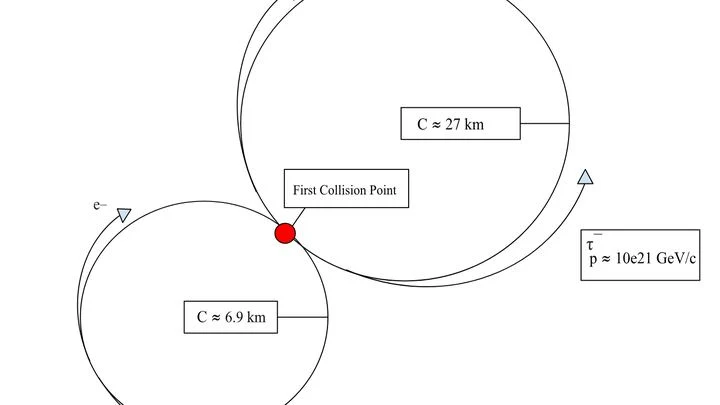
In an underground ring 27 kilometers in circumference, protons are accelerated to nearly the speed of light and smashed head-on. At the collision point, conditions briefly recreate those of the first trillionth of a second after the birth of the universe.
In the ATLAS detector at the Large Hadron Collider, particles leave tracks like skiers in the snow. Some tracks break off after a couple of centimeters: that's what a particle would look like if it were born, flew a little way, and then decayed into something invisible.
In a dark chamber where the temperature sits just four degrees above absolute zero, a sapphire crystal the size of a grain of rice lies waiting. When a neutrino, a ghostly particle that barely notices matter, flies through it, the crystal shudders and warms by a tiny fraction of a degree.
In collisions of heavy nuclei, a fireball of thousands of particles is born. Among them are pions and kaons, two kinds of light particles that look very much alike. To understand what happens in this fireball, physicists need to know exactly how many of each particle flew out.
A single antiproton, trapped and cooled to near absolute zero, behaves like a tuning fork that needs a very precise strike to produce a clean note. Catching that 'note' directly is nearly impossible — the signal is too weak.
Deep inside the Large Hadron Collider, lead nuclei collide with such force that, for an instant, matter hotter than the Sun is born. This is the quark-gluon plasma — a soup of the tiniest building blocks of matter that existed only in the first microseconds after the Big Bang.
In the ATLAS detector at the Large Hadron Collider, protons collide billions of times per second. From this stream, physicists fished out eight events in which the collision produced two Z particles and one photon.
Inside the Large Hadron Collider, protons are accelerated to nearly the speed of light and smashed head-on. At the collision point, a burst of energy is born for an instant, from which new particles can emerge. One of the heaviest is the top quark.
Interstellar wanderers are rocks and icy chunks that have broken free from their home planetary systems and now drift through the Galaxy. The first such visitor, 'Oumuamua, zipped past the Sun in 2017, followed by Comet Borisov and the ATLAS object. Where do they come from?
In an underground hall at Fermilab, a huge tank holds liquid argon — a transparent fluid at minus 186 degrees. When an invisible neutrino flies into the tank, it occasionally strikes an argon nucleus, and a short track of charged particles flashes.
In giant particle accelerators, particles fly at nearly the speed of light and smash head-on. But sometimes one beam is slightly denser than the other, like someone stepping onto a packed escalator the wrong way. Then collisions become uneven, and detectors start 'flickering,' throwing off measurements.
A pebble drops into a pond, and ripples spread across the water. But sometimes the pebble doesn't sink right away: it skims beneath the surface, travels a few meters, and only then surfaces, creating ripples in an unexpected spot.
Inside protons accelerated to nearly the speed of light, a particle heavier than a gold atom is sometimes born — the top quark. It lives for tiny fractions of a second and decays, leaving a trace in the ATLAS detector. Physicists collected such traces for four years to understand how often the top quark and its mirror twin, the antiquark, appear.
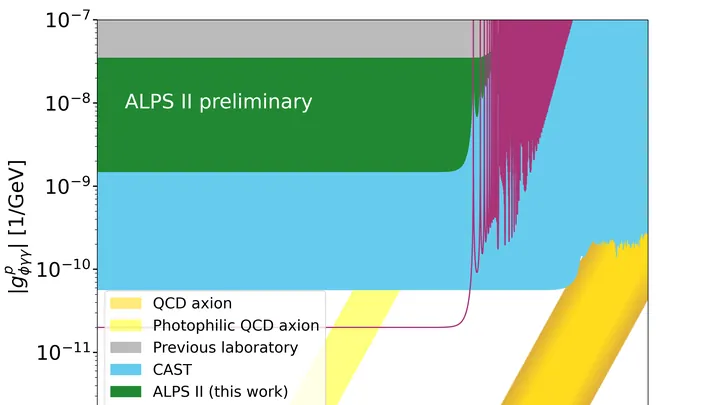
At the DESY lab, the ALPS II experiment was launched to hunt for axions — hypothetical ghost particles that might make up dark matter. This invisible mass acts like a skeleton, preventing galaxies from flying apart due to their spin.
In 1976, Canadian physicist Bill Unruh asked a simple question: what does an observer see when accelerating through empty space? The answer turned out to be strange: emptiness ceases to be empty. An accelerating observer bathes in thermal radiation with a temperature proportional to the acceleration.