Movies for the Nanoworld: Watching Atoms in Motion express
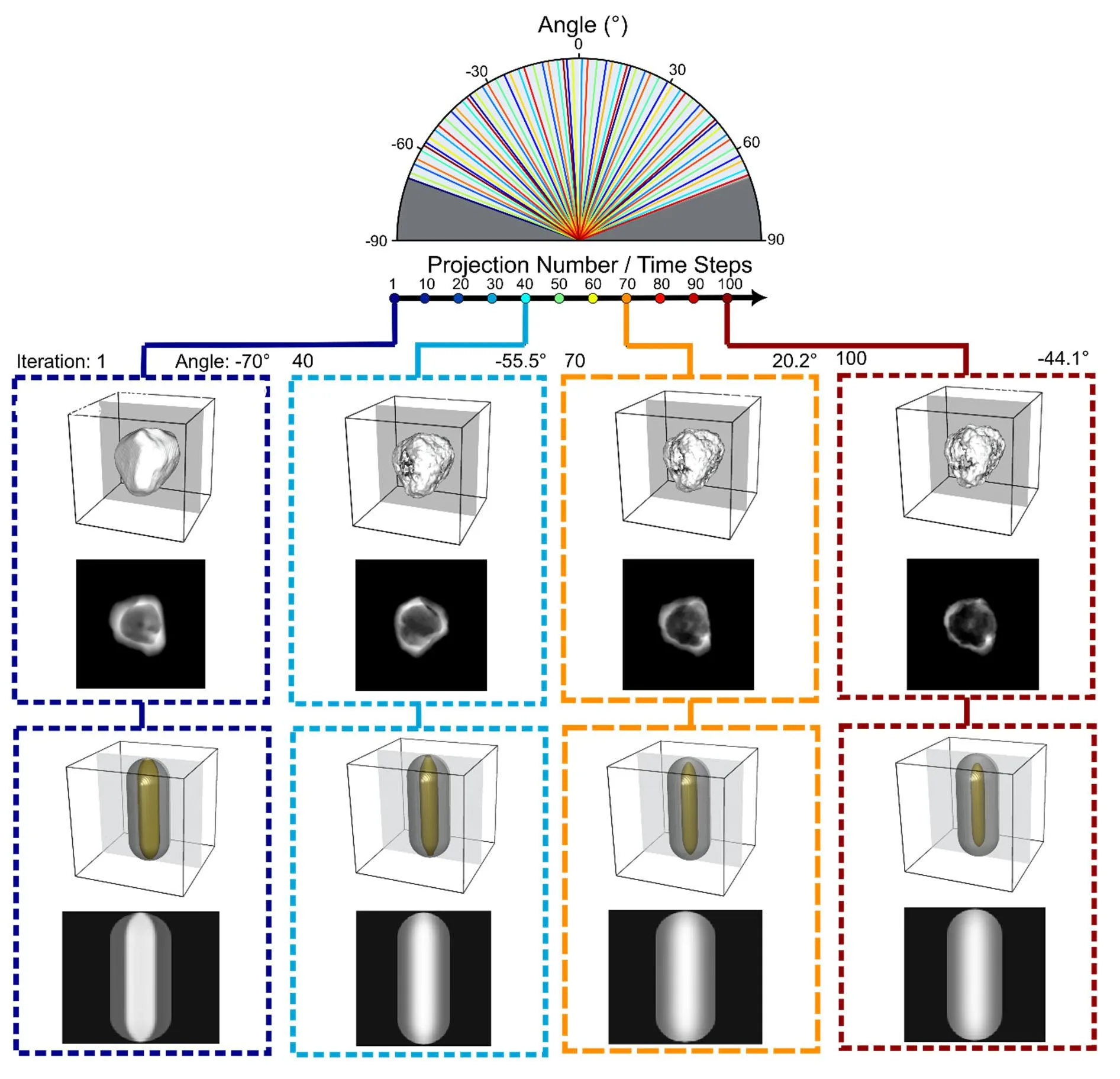
A tiny gold star melts under the beam of an electron microscope, its points slowly rounding off. In the past, such a process could only be seen in snapshots taken with long pauses, and the probing beam itself would alter the sample. Now, researchers shoot continuous footage: the sample tilts smoothly, and an algorithm assembles a three-dimensional picture from that stream for any point in time.
The secret is that the tilt never stops, and the computer learns from the data itself, without any hints. It understands how the particle's shape changes and fills in the gaps between frames. The electron dose is lower than in older approaches, so fragile structures, like silver nanoparticles with a gold shell, survive until the end of the recording.
The method was tested on two scenarios: how gold nanostars lose their sharp points when heated, and how gold and silver atoms mix inside a nanocube. In both cases, the evolution could be followed in 3D, not just on the surface. It's like watching not the shadow of a dancer, but the dance itself from all sides.
Now materials scientists can watch catalysts, batteries, or drug nanoparticles change right as they work, and do so gently, without worrying that the tool itself will ruin the experiment.
A gold nanostar smaller than a hundred nanometers loses its sharp points when heated and becomes droplet-like: this process is now visible in 3D and in real time.
This technique is reminiscent of cameras from science fiction films that capture holograms of moving objects, but here it all happens in the world of atoms.