Cosmic Lens Reveals the Chemistry of a Distant Galaxy express
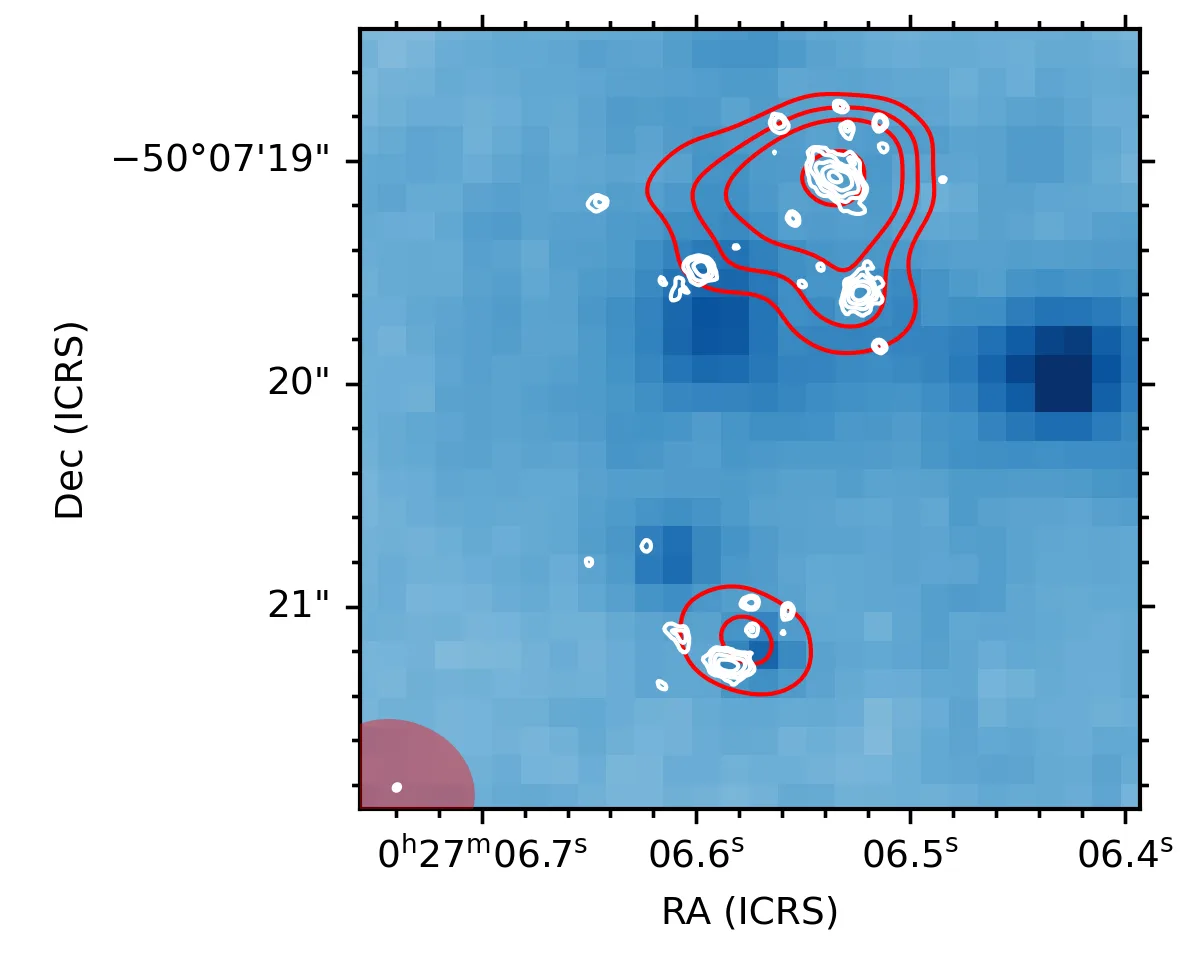
A giant magnifying glass made of gravity zoomed in on a distant galaxy, and astronomers got a peek into its chemical kitchen. The ALMA telescope in Chile's Atacama Desert has a new receiver that picks up radio waves at frequencies from 67 to 116 gigahertz, as if a radio, at last, could tune into a whole band of stations at once. Pointing it at the galaxy SPT-S J002706-5007.4, whose light has been traveling for nearly 12 billion years, scientists saw for the first time the emission of molecules that had previously slipped out of view.
Among the newcomers are carbon monoxide (CO) and hydrogen cyanide (HCN). Their signals revealed dense, hot clouds of gas bathed in harsh ultraviolet light from young stars. About 17% of the gas in such clouds: that's like finding 170 liters of water in every cubic meter of city air: surprisingly dense for ordinary interstellar space. Another instrument on the telescope, which sees at shorter wavelengths, showed that the galaxy is made of bright clumps where stars are born, and these clumps produce up to half of all its light.
The new ALMA receiver opens the door to precise distance measurements for galaxies from an era when the universe was a third of its current age. Molecules like CO emit at very specific frequencies, and by measuring how much those frequencies shift, you can calculate how fast a galaxy is moving away from us. It's like figuring out a train's speed from the change in pitch of its horn. In the coming years, this method will become a key tool for mapping the distant universe.
The hydrogen cyanide molecule (HCN) smells like bitter almonds, but in space it is abundant and serves as a tracer of the dense gas where stars form.