Little Red Dots: The Light That Gives Away Their Secret express
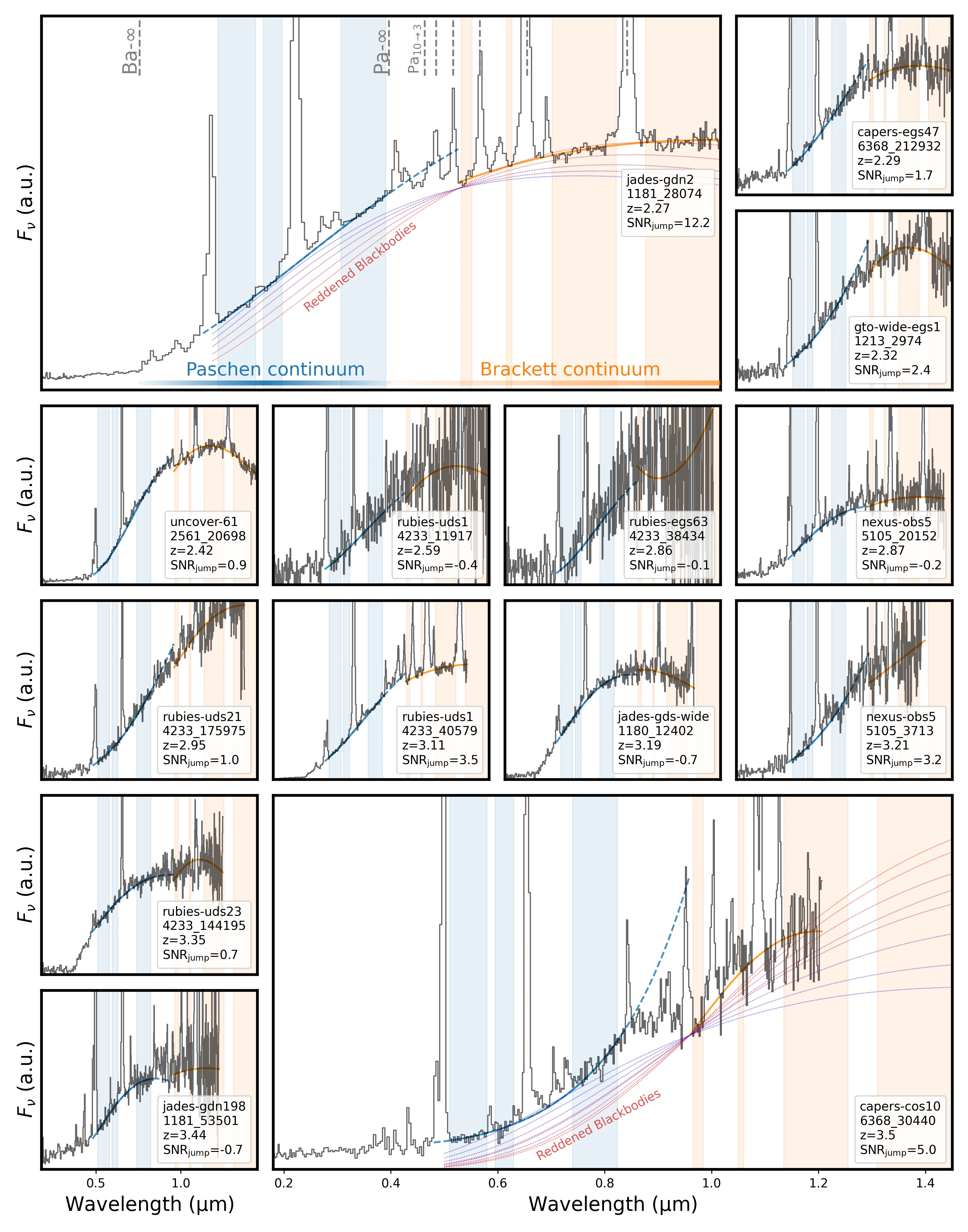
Out in the distant cosmos, there are galaxies that astronomers have nicknamed 'little red dots': in images they appear as tiny reddish specks, even though they are mind-bogglingly far away. Their light looks red not because they are cold, but because the expanding universe stretches light waves. But what exactly makes these galaxies shine so brightly has remained a puzzle.
Now scientists have examined the spectra of several such galaxies: that is, they split their light into colors, the way raindrops split sunlight into a rainbow. In the spectra, they found a 'step': at a certain wavelength, the brightness jumps sharply. This jump is called the Paschen jump. It occurs when a free electron in a hydrogen atom falls to the third energy level, releasing excess energy as light. The same process, but with a fall to the second level, produces the Balmer jump, familiar to astronomers.
It turns out that the gas in these galaxies is cold — no hotter than ten thousand degrees. For comparison, the Sun's surface is about six thousand degrees, while the gas around a black hole at the center of a galaxy is typically thousands of times hotter. So in 'little red dots,' there is almost no hot disk swirling around a black hole, greedily pulling in matter. Nor are there dense stellar atmospheres, which would also produce different light.
Instead, all the light, both the continuous glow and the bright hydrogen lines, is born in the same process: electrons and protons combine to form hydrogen atoms, and each such combination emits a photon. This process is called recombination. It happens in cold gas that may envelop the galaxy like a cocoon. So astronomers don't need to invent several different light sources to explain what they see: one, recombination in cold gas, is enough.
This discovery helps us understand how galaxies grew in the early universe. If 'little red dots' really have little hot matter around their black holes, then their black holes haven't yet had time to heat up the surrounding gas significantly. And cold gas is exactly the material from which new stars can form. So 'little red dots' might be teenage galaxies, still in the process of bulking up.
The Paschen jump is named after the German physicist Friedrich Paschen, who discovered the series of hydrogen lines in the infrared region back in 1908. Today, this jump helps astronomers study galaxies billions of light-years away.
In Carl Sagan's novel 'Contact,' the heroine listens to radio signals from distant civilizations. Astronomers studying 'little red dots' are also 'listening' to the light of galaxies to understand how they are put together.