Recombination is the process by which a free electron and a positively charged ion collide and bind together to form a neutralatom. In cosmology, 'recombination' specifically refers to the epoch about 380,000 years after the Big Bang when the Universe cooled enough for protons and electrons to combine into hydrogen atoms, releasing the cosmic microwave background (CMB) radiation. This event marks the transition from an opaque, ionized plasma to a transparent, neutral Universe.
History
The concept was introduced by George Gamow and his collaborators in the 1940s, who predicted the CMB as a relic of recombination. The CMB itself was discovered in 1965 by Penzias and Wilson, and detailed measurements of its anisotropies (e.g., by Planck) have since confirmed recombination's predictions with high precision.
How it works
In the early hot Universe, photons constantly scattered off free electrons, keeping matter and radiation in thermal equilibrium. As the Universe expanded and cooled to roughly 3,000 K, the average photon energy dropped below the ionization energy of hydrogen (13.6 eV). Electrons and protons then combined into neutralatoms, and photons decoupled from matter, free-streaming ever since as the CMB. The precise timing and duration of recombination depend on the density of baryons and the expansion rate, and it leaves subtle imprints in the CMB's temperature and polarization patterns.
In practice
Recombination physics is essential for interpreting CMB data, which constrains cosmological parameters like the Hubble constant, dark matter density, and the curvature of space. It also underlies the formation of neutral hydrogen that later collapsed into the first stars and galaxies.
Fun fact
The 'surface of last scattering' — the shell where recombination happened — is the farthest thing we can see with light, and it appears as a nearly uniform glow at 2.7 K in every direction.
In the first half-billion years after the Big Bang, galaxies grew like crazy. Gas fell in rapidly and collapsed into stars without any resistance. This period is called 'unimpeded star formation.' It's like frying pancakes on a scorching skillet without a lid: splatters fly, but nothing holds them back.
The quantum networks of the future resemble the Tower of Babel: each node speaks its own dialect. Some store information in the polarization of a photon — the direction of oscillation of the light wave. Others use time bins: that is, when exactly the pulse arrives.
The universe cooled like a giant bathtub after a hot start. At 400 000 years after the Big Bang, hydrogen was ready to recombine — protons capturing electrons to become neutral atoms. But somewhere in this dark water, a tap kept dripping.
The mystery of antimatter in space has long puzzled astrophysicists: where do positrons come from, settling like snowflakes into our detectors? The answer might lurk in the most ubiquitous gamma-ray background. The Universe is soaked in diffuse light — the cosmic photon background (CPB).
A lone potassium atom enters a dense cloud of sodium atoms cooled to near absolute zero. Such a medium is called a Bose–Einstein condensate — all particles merge into a single quantum wave. One might expect the impurity to simply pick up a single neighbor and form a pair. But the experiment showed something else.
A swing only gets going if you push it in rhythm. Miss the beat, and your effort is wasted. Light interacts with an atomic nucleus in much the same way: a photon is usually absorbed only when its energy exactly matches the gap between nuclear levels. But what if the photon's energy doesn't fit? The authors of a new study have found a workaround.
When the first stars ignited, their ultraviolet light began stripping electrons from hydrogen atoms. The universe transformed from a neutral fog into transparent plasma. This process, cosmic reionization, proceeded unevenly: slowly at first, like a fire catching in damp wood, then faster as the flames spread through dry tinder.
About 380,000 years after the Big Bang, the universe cooled enough for electrons and protons to finally combine into neutral hydrogen. Although this event is called recombination, it was actually their first meeting — the heat had kept them from sticking together until then.
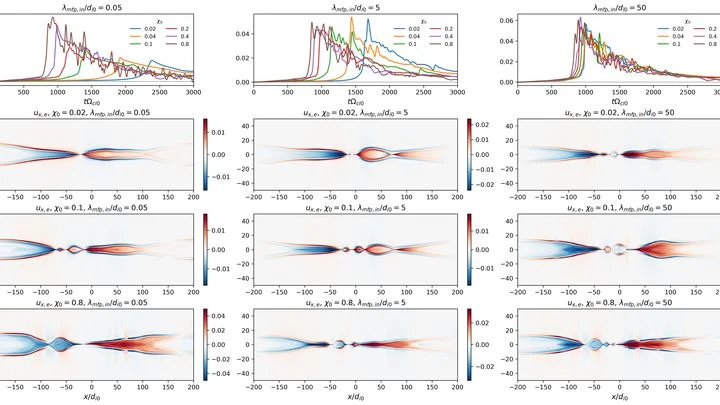
In plasma where some atoms remain neutral, magnetic field lines can rearrange at different speeds. This is like two rubber bands that are initially stuck together, then suddenly snap apart and contract, releasing energy.
A laser strikes a target, and a cloud of plasma, accelerated to hundreds of kilometers per second, shoots into the chamber. The chamber isn't empty: it's filled with a tenuous gas that plays the role of the cosmic medium. The plasma slams into this gas like a speedboat hitting still water, shoving it aside.
A few hundred million years after the Big Bang, the universe resembled an endless dark ocean, shrouded in a thick fog of neutral (non-ionized) hydrogen. Then something dispersed the gloom: ultraviolet radiation knocked electrons out of atoms, making the gas as transparent as pure water.