Rings Around a Black Hole express
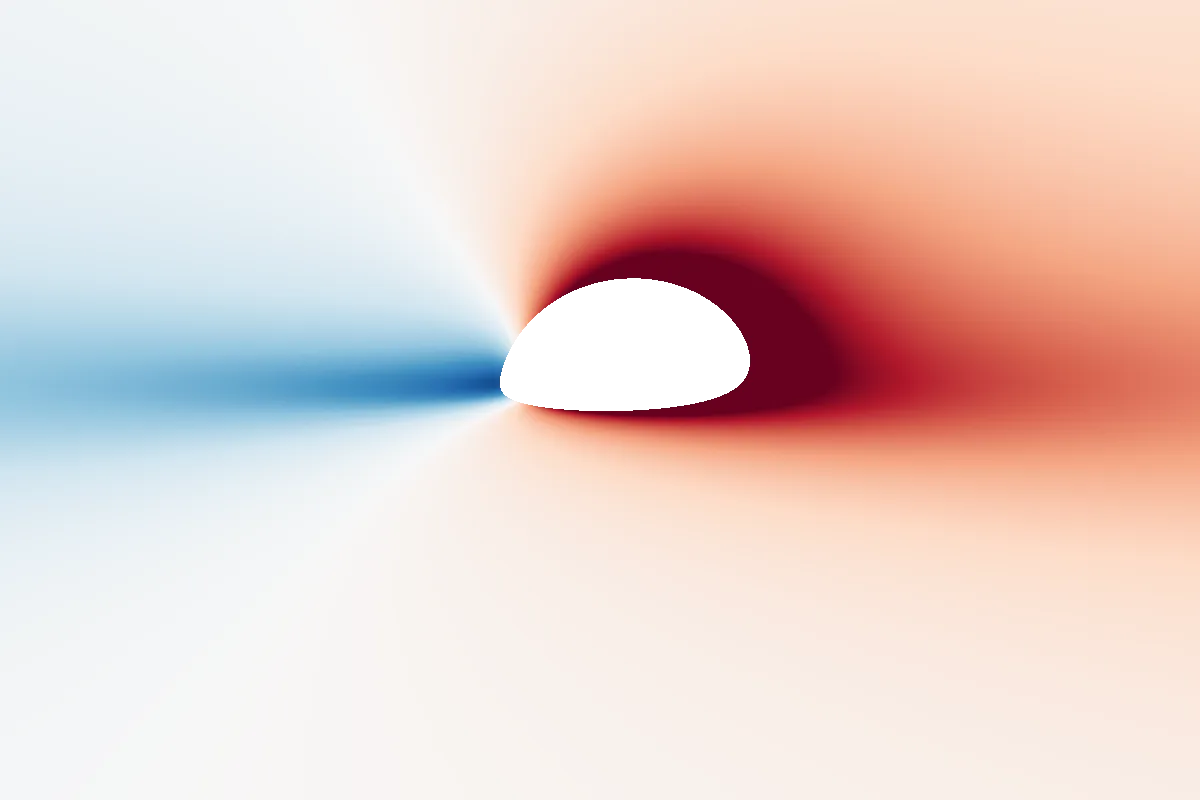
At the center of galaxy PDS 456 shines a quasar — a black hole devouring gas that glows brighter than hundreds of billions of stars. The X-ray telescope XRISM peered into this light and saw a picket fence of dark bands, like shadows cast by a fence at sunset. Each band is a cloud of gas that blocked part of the radiation. But the bands were shifted toward high energies, as if all the clouds were rushing toward us at tremendous speed.
Usually, such a shift was explained by a wind: the black hole blows gas away, and it streams off like smoke from a chimney. But then the clouds should be scattered far from the hole, and their speeds should be nearly the same. The observations showed something different: five groups of bands with different shifts, like five fences standing one behind the other. Each successive fence is closer to the hole and moves faster.
The authors proposed a simple picture: thin rings of gas lie just above the surface of the accretion disk — the rotating pancake of matter spiraling into the black hole. A ring at a smaller radius orbits faster, so its light is shifted more strongly. A model with five rings, placed from the very edge of the stable orbit out to a distance 15 times the gravitational radius, reproduced the entire pattern of bands exactly.
So the X-ray "fence" of lines is not random noise but a fingerprint of the structure at the disk's innermost edge. For the first time, we can see how the surface of this disk is arranged where matter is almost falling into the hole. And this is not just a pretty picture: how gas flows in the final moments before falling determines how much energy is released and how the black hole influences the entire surrounding galaxy.
Original abstract
as written by the authors arXiv:2604.09433
Recent XRISM observations of active galactic nuclei such as PDS 456 have revealed ``forests'' of absorption lines best modeled by five distinct absorption zones with varying large blueshifts. We propose a model in which these relativistic blueshifts originate from the motion of the accretion disc itself, rather than from a clumpy super-Eddington outflow at hundreds of gravitational radii $$r_g\equiv GM/c^2$$. We demonstrate that thin rings of absorbing material lying just above the accretion disc at varying radii can produce the observed energy shifts and separations of the absorption zones. In this model, the PDS 456 transmission spectrum is well reproduced by rings with widths $$\Delta r\lesssim1r_g$$ at locations between the black hole's innermost stable circular orbit (ISCO) and $$\approx15r_g$$. This model suggests that the absorption forests seen in XRISM observations can probe the surface structure of the innermost ($$\lesssim15r_g$$) regions of quasar accretion discs.
The gravitational radius of the black hole in PDS 456 is about 4.5 million kilometers, three times the diameter of the Sun. The rings in question lie at distances from 1 to 15 such radii, that is, in the hottest and fastest zone of the disk.
In the movie Interstellar, the characters see the accretion disk of the black hole Gargantua up close, such ring structures at its inner edge can now be studied in real X-ray spectra.