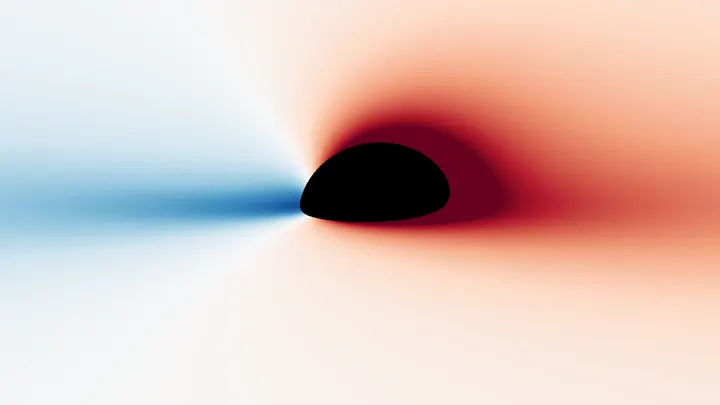
Blueshift is the decrease in wavelength (and increase in frequency) of electromagnetic radiation emitted by an object moving toward the observer. It is the opposite of redshift, which occurs when the source moves away. Blueshift is a direct consequence of the Doppler effect, applied to light and other waves. In astronomy, it reveals the motion of stars, galaxies, and other celestial bodies along the line of sight.
History
The Doppler effect was proposed by Christian Doppler in 1842 for sound waves, and later applied to light by Hippolyte Fizeau in 1848, who suggested it could be used to measure stellar velocities.
How it works
When a source of waves moves toward an observer, each successive wave crest is emitted from a position closer to the observer, so the waves are compressed. This compression shortens the wavelength and raises the frequency. For light, a shorter wavelength corresponds to a shift toward the blue end of the spectrum, hence the name. The effect is quantified by the formula Δλ/λ = v/c for non-relativistic speeds, where v is the relative velocity and c is the speed of light.
In practice
Blueshift is used in astronomy to measure the velocities of nearby galaxies, stars, and exoplanets, and in radar and lidar systems to detect the speed of approaching objects.
Fun fact
The Andromeda Galaxy is blueshifted, meaning it is moving toward the Milky Way, and will eventually collide with it in about 4.5 billion years.
A spotlight with an adjustable beam width sweeps along the shore. Its light is the long ocean waves that are born in the surf zone and spread in both directions: toward the beach and out to the open sea. Previously, this spotlight was considered a point source, but the actual breaking zone, where short waves break, has a finite width, and it changes as the wave front advances and retreats.
A bright lantern in thick fog seems dim, while a weak flame in clear air can be seen a kilometer away. A similar oddity baffled astrophysicists almost half a century ago.
For over a century, astronomers puzzled over the capricious behavior of RR Lyrae stars: their brightness periodically waxed and waned with unpredictable amplitude, like a lighthouse with a faulty mechanism. The Blazhko effect, discovered in 1907, taunted scientists for decades.
At the center of galaxy PDS 456 shines a quasar — a black hole devouring gas that glows brighter than hundreds of billions of stars. The X-ray telescope XRISM peered into this light and saw a picket fence of dark bands, like shadows cast by a fence at sunset.
If you look at a map of distant galaxies, it is not perfectly uniform: on one side of the sky there are slightly more, on the other — slightly fewer. This lopsidedness has been noticed in several sky surveys, and it does not look like a random fluke. Usually, it is explained by the fact that our Galaxy itself is flying somewhere, making distant objects appear shifted.
A gamma-ray burst is a short but incredibly powerful explosion in a distant galaxy. In a few seconds, it releases as much energy as the Sun will emit over billions of years. The Neil Gehrels Swift satellite catches such flashes with a special telescope called BAT, which detects gamma rays.
The ACT telescope in Chile's Atacama Desert stared at the sky from 2007 to 2022. Its target: the cosmic microwave background, light that has been traveling toward us for 13.8 billion years. This light is polarized: its waves oscillate in specific planes, like strings stretched in different directions.