A stable orbit is a trajectory that persists over time without decaying or escaping, such as an electron circling a nucleus or a planet around a star. In classical mechanics, stability arises from a balance of forces, but in quantum theory, the stability of electron orbits was a puzzle until the advent of quantum mechanics. The seed definition points to a specific explanation: resonance with the zero-point field, a concept from stochastic electrodynamics, where the electron's orbit is maintained by absorbing energy from the vacuum's fluctuating electromagnetic field.
History
The idea of explaining atomic stability via the zero-point field was explored in the 1960s and 1970s by researchers like Timothy Boyer and others in the field of stochastic electrodynamics. It never gained mainstream acceptance, as quantum mechanics provides a more complete and successful description.
How it works
In stochastic electrodynamics, the zero-point field is a background of random electromagnetic fluctuations present even at absolute zero. An electron in a circular orbit would classically radiate energy and spiral inward, but the zero-point field can, under certain conditions, supply energy to the electron, counteracting the loss. When the electron's orbital frequency matches a resonance with the field's fluctuations, a stable orbit emerges. This mechanism is proposed as an alternative to the quantum mechanical explanation of atomic stability, though it remains a fringe theory.
In practice
This concept has no direct technological applications, but it has influenced theoretical studies of the vacuum and the foundations of quantum mechanics.
Fun fact
The zero-point field is not just a theoretical curiosity—it is responsible for the Casimir effect, a measurable force between closely spaced metal plates.
A laser beam is like a swift vortex that briefly captures a passing electron. As the particle moves through the pulse, its spin (the intrinsic rotation, like a tiny top) experiences a weak kick. After leaving the beam, the top no longer points in the same direction; it has turned a little.
In the ordinary world without dark energy, the mass of any object is always positive. That seems obvious: positive mass attracts, creating gravity. But the real universe has dark energy — a mysterious force making the cosmos expand faster and faster.
A runner on the middle of a track suddenly switches to a walk — not speeding up or slowing down, but maintaining a constant pace. Something similar may have happened to the universe itself shortly after the Big Bang.
A neutron star is a city squeezed to the size of a metropolis, where matter is packed to the limit. At the very center of such a city, a redevelopment may begin: familiar neutrons and protons give way to quark plasma — free quarks, the building blocks of almost everything around us.
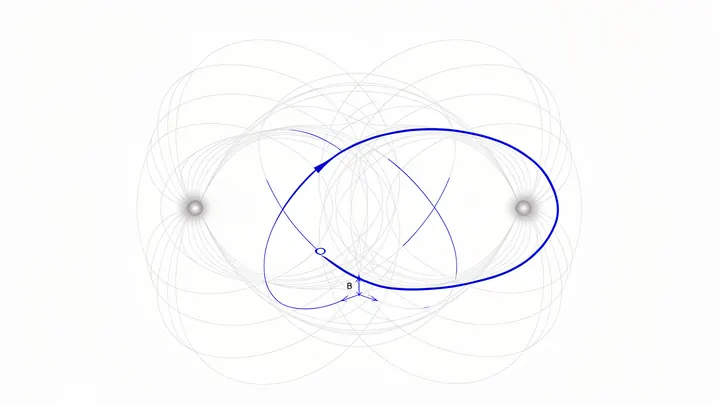
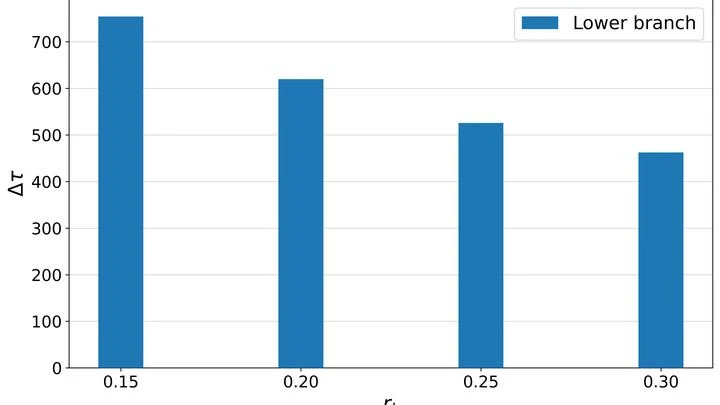
The three-body problem is the eternal stumbling block of celestial mechanics. Even Poincaré realized in the late 19th century that its chaos defies general analytical solutions. In this gravitational madness, islands of regularity appear only rarely — periodic orbits.
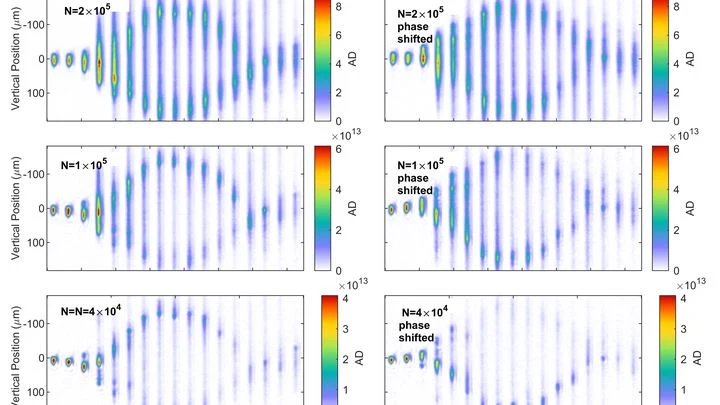
A quantum computer is like an orchestra where each musician, a qubit, must play their part accurately and on time. Usually, musicians are seated in fixed positions and connected by conductors' consoles. But what if we let them move freely across the stage and turn the movement itself into part of the music?
In the world of atoms and particles, everything tends toward rest: particles lose energy, just as a swing slows down due to energy loss (friction). But many devices — from hydrogen masers to atomic clocks — live by repetitive cycles.
A child on a swing: too strong a push and they fly off. Roughly this is how powerful light tears electrons out of an atom. It would seem that the stronger the push, the more certain the destruction. But in the quantum world it is different: when the field strength crosses a certain threshold, the atom suddenly freezes.
When hot soup cools, clumps form on the surface — similarly, as the early universe cooled, it gave birth to threadlike clumps of energy: cosmic strings. Some of them are like a stretched rubber band: as long as it's intact, it's stable. But if you nick the band, it snaps.
Imagine a soap bubble with electricity trapped inside and walls made of an invisible field: that's roughly what a black hole with 'resonant hair' looks like. This isn't real hair, but a cloud of scalar field held around the hole by its own interactions.
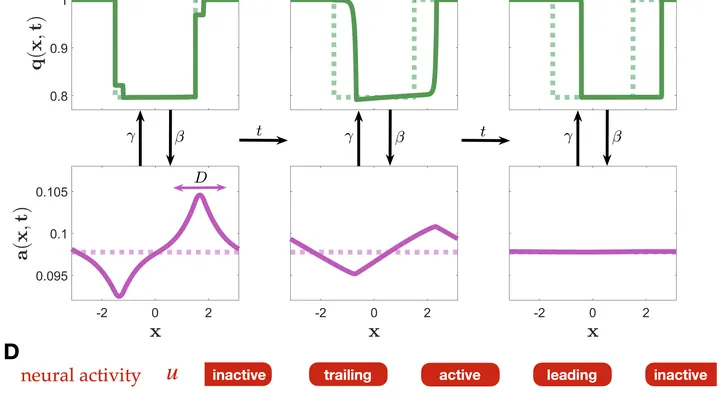
Holding a phone number in your head while you dial it: that's working memory. In the brain, a group of cells is responsible for this, sending signals to each other like people passing a bucket along a chain. But every transfer has a cost: it requires messenger substances that get used up.
A woven bamboo basket is not just a household item: it's an exact blueprint for how atoms are arranged in the crystal YMn₆Sn₆. Six manganese atoms form hexagons that assemble into a pattern reminiscent of the Japanese kagome. In such a lattice, electrons usually behave uniformly, like passengers in a crowded subway car.
A comet hurtling through space is a mountain of ice and dust that carries itself across the Solar System. If you mount small engines on such a mountain, it becomes a ship with its own fuel: gas from the interior can be vented through nozzles to change course.