Grain Boundaries: How Metal's Seams Alter Its Magnetic Character express
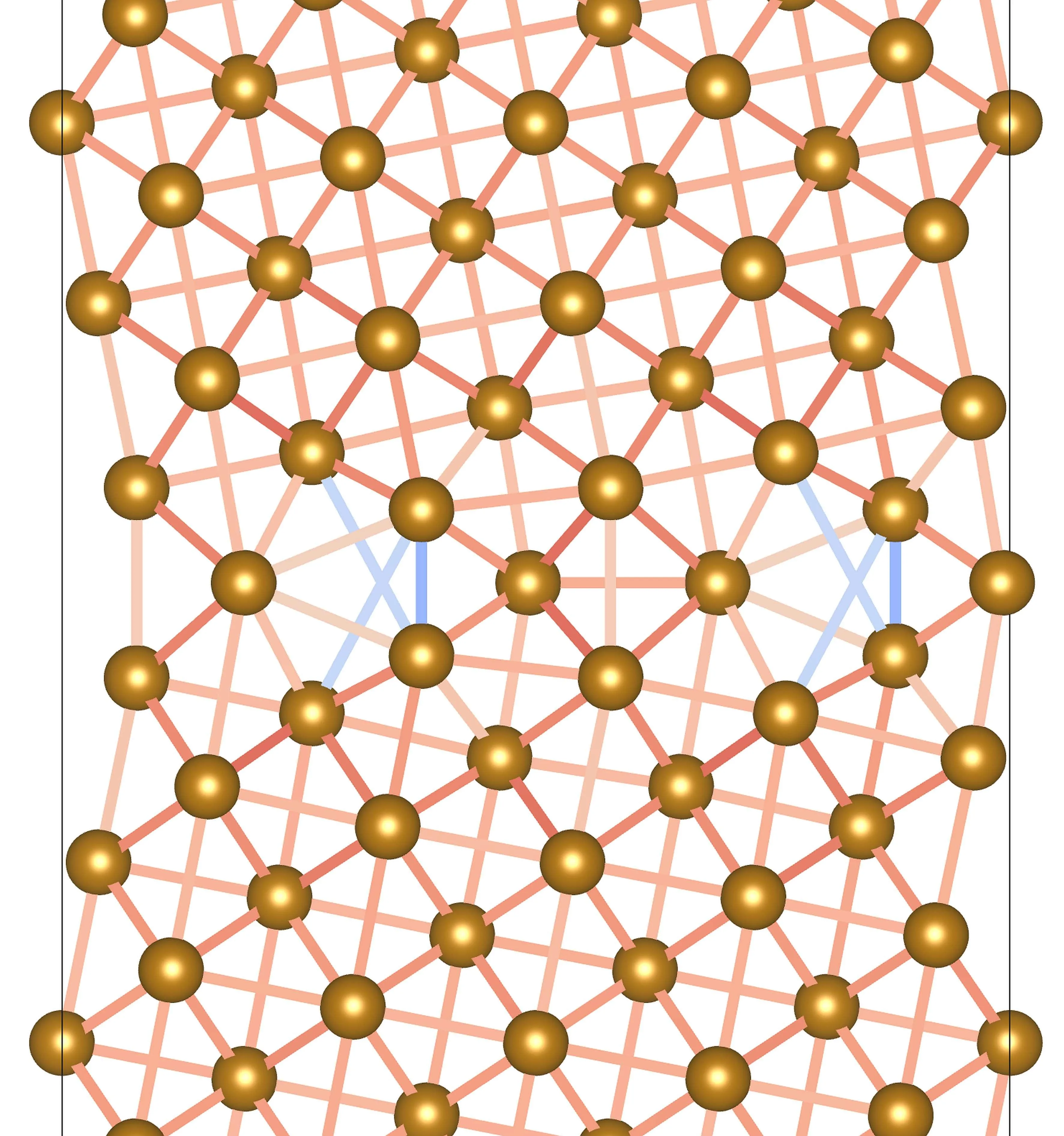
An iron crystal is like a mosaic of tightly packed grains. Where one grain meets another, a boundary forms — a narrow seam with disrupted order. It is in these seams that surprises for magnetism hide.
Scientists calculated how iron atoms interact with each other at three types of such boundaries. It turned out that at the seam itself, magnetic couplings can flip: instead of aligning in one direction, the spins of neighboring atoms start pointing opposite ways. This is like a crowd where people usually walk in one direction, but in a narrow passage someone turns around and disrupts the flow.
When phosphorus atoms get into such a seam, they alter the magnetic picture even more. Phosphorus acts like a pebble in a gear: it suppresses the flipped couplings and redistributes interactions around itself.
But how significant is this for the whole piece of iron? The researchers ran computer simulations and saw that even with a noticeable number of boundaries, the Curie temperature, the point where iron loses its magnetization, drops only slightly. The bulk of the metal remains untouched, and it is this bulk that dictates the overall magnetic character.
So the seams in the iron mosaic do affect magnetism, but only locally. To noticeably weaken a magnet, you would have to artificially create boundaries almost everywhere — something that doesn't happen in real materials.
Original abstract
as written by the authors arXiv:2604.10489
This work investigates how grain boundaries (GBs) modify magnetic exchange interactions in bcc iron, with particular focus on the effect of phosphorus segregation. Using density-functional theory combined with the Liechtenstein-Katsnelson-Antropov-Gubanov Green's-function approach, we calculate Heisenberg exchange parameters for three symmetric tilt GBs, $$\Sigma5(310)$$, $$\Sigma13(510)$$, and $$\Sigma13(320)$$, and use these parameters in Monte Carlo simulations to evaluate finite-temperature magnetic behavior. All clean GBs exhibit strong local deviations from bulk exchange interactions, including antiferromagnetic coupling across the boundary plane. These negative exchange interactions are not governed by interatomic distance alone, but arise primarily from the altered local coordination and symmetry breaking at the GB. Phosphorus segregation, modeled in both substitutional and interstitial configurations at the $$\Sigma5(310)$$ GB, suppresses the antiferromagnetic couplings and significantly redistributes the local exchange landscape through chemical and electronic effects. Monte Carlo results show that, despite pronounced local perturbations, realistic GB densities cause only a small reduction in the Curie temperature because bulk-like regions dominate the global magnetic transition. A substantial decrease in Curie temperature appears only when the GB volume fraction is artificially increased. The results demonstrate that GBs strongly influence local magnetic interactions while having a limited effect on global magnetic ordering, and they establish a general framework for linking atomistic interfacial structure and chemistry to mesoscale magnetic behavior in Fe-based materials.
The Curie temperature for pure iron is about 770 °C. That's hotter than any kitchen oven.