Quantum Judge: A Verdict Without Evidence express
A judge walks into the courtroom but doesn't look at the evidence: he immediately delivers the verdict. That's how the new quantum sensor works: it doesn't measure the signal but directly decides which class it belongs to.
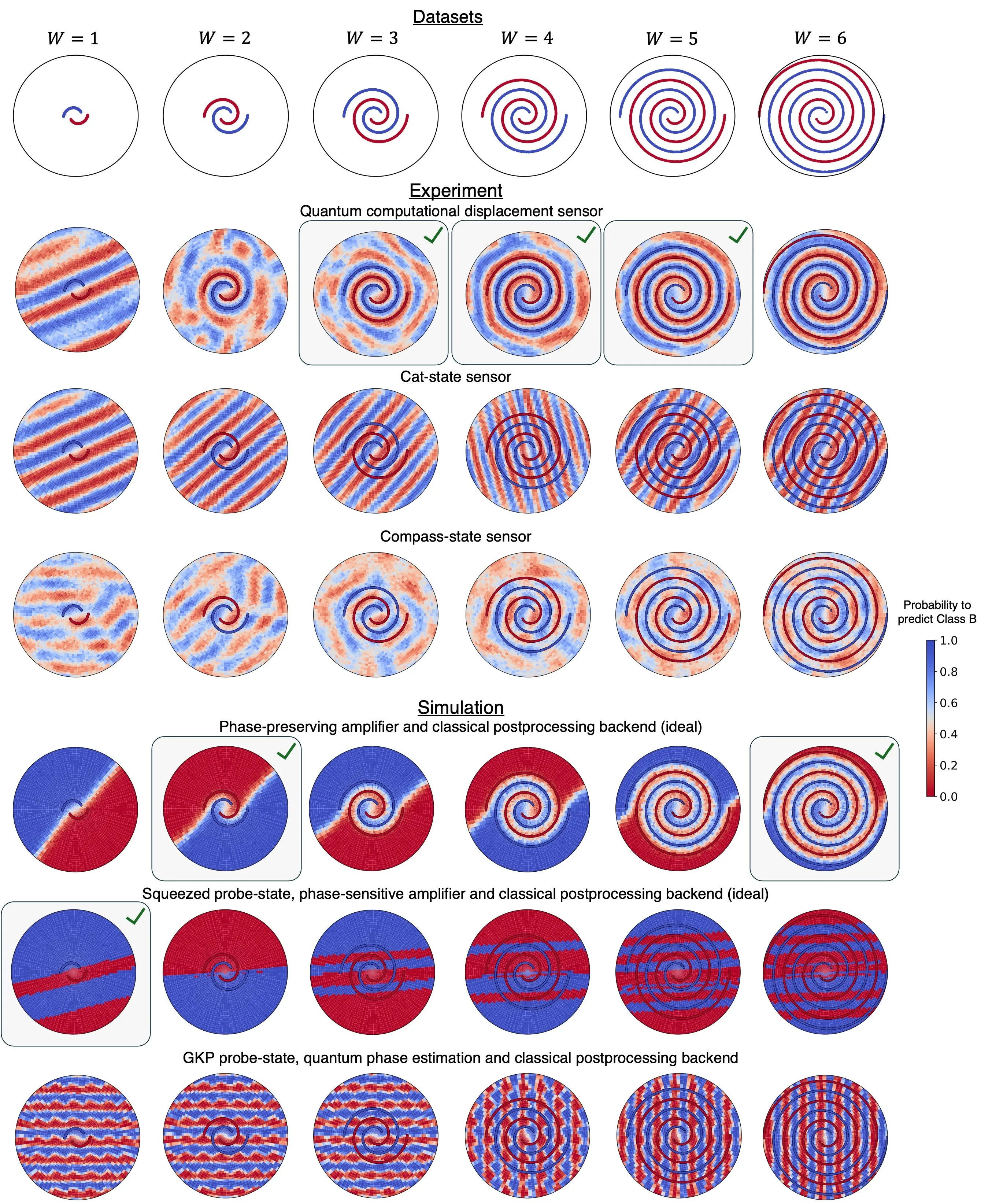
In conventional quantum sensing, it's all like a detective story: first you gather clues (measure the signal), then you analyze them. But the scientists proposed a different path — combining quantum measurement and quantum computation in a single circuit. The circuit, consisting of a superconducting qubit (quantum bit) and an oscillator (resonator), is tuned so that after a single measurement of the qubit, it immediately outputs an answer: "yes" or "no."
The experiment showed: the more layers in the circuit, the more accurate the classification. On certain tasks, the quantum approach outperformed the classical alternative by 15 percentage points. It's as if a judge, skipping the study of evidence, could guess the culprit more accurately than an investigator after a lengthy analysis.
The quantum judge still works on simple tasks with noisy equipment, but it's already clear: sometimes you don't need to know everything to make the right decision.
Original abstract
as written by the authors arXiv:2604.13177
Quantum computational sensing (QCS) combines quantum sensing with quantum computing to extract task-relevant information from the physical world. QCS can in principle achieve an accuracy advantage for specific tasks versus the alternative of raw-signal estimation using conventional quantum sensing followed by task-specific classical postprocessing. Here we report the experimental demonstration of quantum computational displacement sensing (QCDS) with a superconducting circuit comprising a qubit coupled to an oscillator. We consider binary classification sensing tasks, where the goal is to predict the class label of a single complex-valued displacement sensed once by the oscillator. Rather than estimating the displacement, our computational-sensing protocol -- using parameterized quantum circuits before and after sensing -- attempts to determine the binary class label using quantum processing and map it onto the ground or excited state of the qubit. A single measurement of the qubit directly outputs the prediction. We implemented circuits with up to 24 entangling gates and 38 free parameters, which were trained in silico. We show that increasing the circuit depth systematically improves expressivity and classification accuracy. We experimentally obtained an accuracy advantage over a suite of protocols that first use conventional quantum sensing to estimate the displacement before using classical postprocessing to perform prediction. For certain tasks, our protocol achieves a 15-percentage-points higher classification accuracy than the best conventional approach considered. Our results establish the feasibility of quantum computational sensing with noisy superconducting hardware and illustrate how integrating quantum computation with quantum sensing can enhance performance when the goal is to estimate a property or function of a signal rather than to estimate the signal.
The circuit was trained on a computer (in silico) and then transferred to a real superconducting device, like a pilot practicing maneuvers on a simulator before the flight.
In the series "The Expanse," detective Miller uses intuition to find a missing girl without direct evidence — similar to how the quantum sensor delivers a verdict without fully measuring the signal.