Platinum Creeps Through a Memristor express
A memristor is a resistor with a memory: after the current is turned off, it retains its resistance. Inside, a thin film of metal oxide is sandwiched between two metal electrodes. When a strong current is first passed through the device, conductive filaments of oxygen vacancies form in the oxide, and the resistance drops sharply. This process is called electroforming.
In the new study, researchers took a niobium oxide memristor with platinum electrodes and looked at what happens after forming. It turned out that not only oxygen filaments grew inside, but also platinum ones. Platinum atoms left the top electrode and penetrated through the entire oxide, like salt penetrating a cucumber during pickling. Meanwhile, oxygen, on the contrary, accumulated near the top electrode and diffused deep into the platinum.
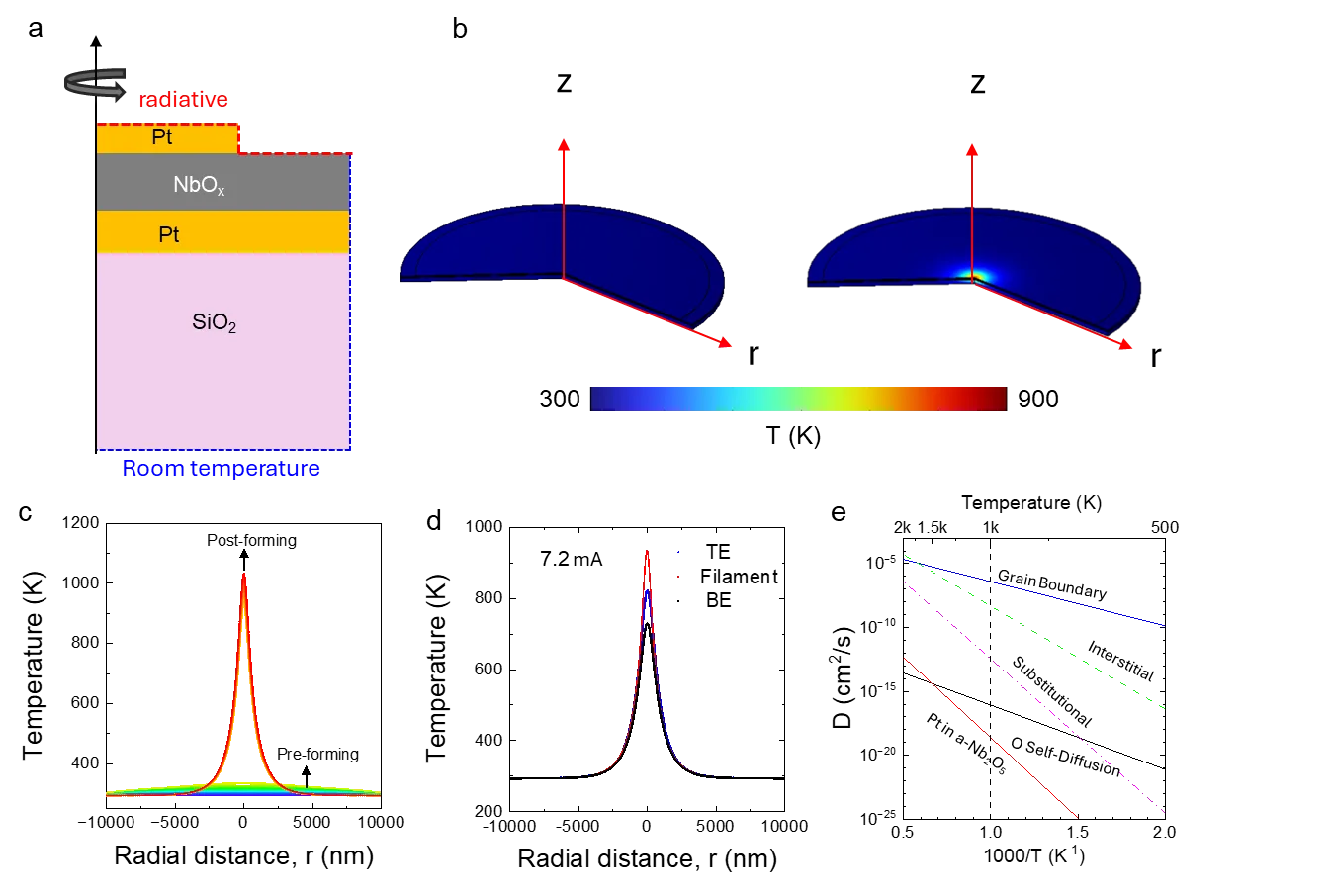
The reason lies in how the memristor works. After forming, it enters a mode with negative differential resistance: the higher the current, the lower the resistance, and vice versa. This creates rapid current oscillations that heat and cool the material thousands of times per second. Such thermal swings help oxygen leave the oxide, and platinum crawls through the remaining empty sites as if through tunnels.
This discovery changes our understanding of how memristors work. Previously, it was thought that the chemistry inside freezes after forming. Now it's clear that the material keeps changing with every switching event. So the lifespan and reliability of such devices depend not only on the initial forming but also on how they are operated. Understanding this will help create memristors that don't degrade over time and store information accurately.
Original abstract
as written by the authors arXiv:2604.14680
Electroforming of metal-oxide-metal memristors is generally attributed to the creation of oxygen-vacancy filaments within the oxide, with noble metal electrodes such as Pt and Au remaining chemically inert. Here, we demonstrate that electroforming and subsequent operation of Pt/NbOx/Nb2O5/Pt devices can induce an unexpected and highly correlated redistribution of both oxygen and platinum. Time-of-flight secondary ion mass spectrometry reveals a filamentary pathway characterized by micrometer-scale oxygen enrichment extending from the Nb2O5 layer through NbOx and deep into the Pt top electrode. Surprisingly, this is accompanied by the formation of a Pt-rich filament penetrating the oxide stack along the same filamentary path. Finite-element and lumped-element modelling show that current-controlled negative-differential-resistance operation produces localized Joule heating and high-frequency thermal cycling, which strongly enhances oxygen migration and enables thermally assisted Pt diffusion along vacancy-rich pathways. These findings reveal a previously unrecognized metal-ion transport mechanism in NbOx memristors and highlight the critical role of post-forming electrical dynamics in determining filament chemistry, stability, and device reliability.
Platinum is one of the most inert metals: it doesn't rust and doesn't dissolve in acids. But in a memristor, it crept along as if pushed by a hot iron.