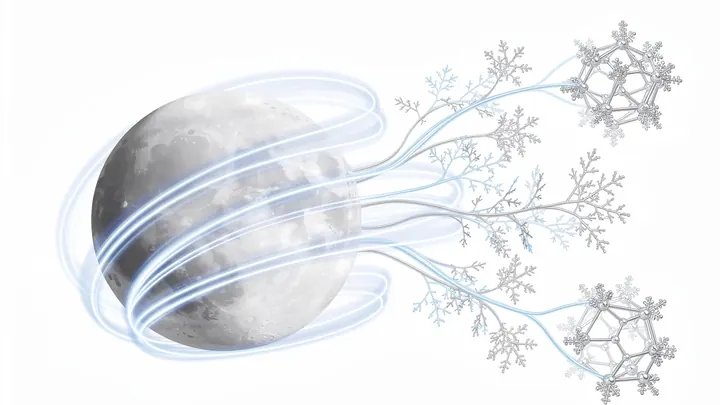
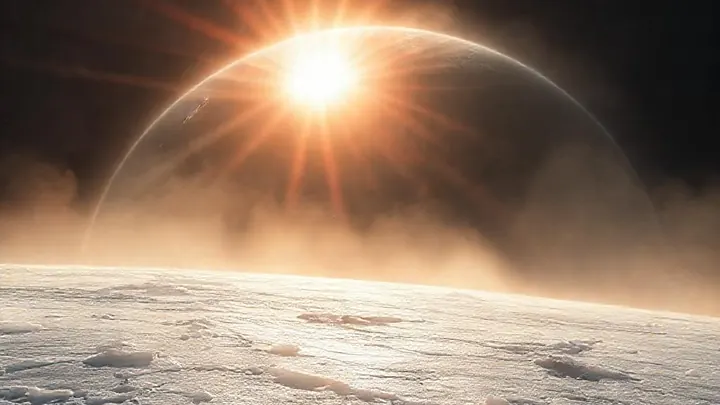
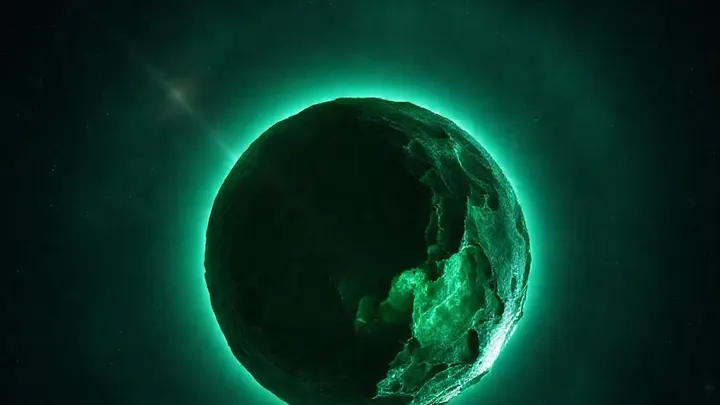
Titanium oxide (TiO) is a chemical compound made of one titanium atom and one oxygen atom. On Earth, it is a solid mineral often used as a white pigment, but in the atmospheres of hot exoplanets, it exists as a gas. Its presence is significant because TiO is a strong absorber of visible and ultraviolet light, acting like a blanket that can heat a planet's upper atmosphere to extreme temperatures, sometimes exceeding 2000°C.
History
Titanium oxide was first detected in the atmosphere of an exoplanet in 2017, in observations of the hot Jupiter WASP-19b, using the FORS2 instrument on the Very Large Telescope. The detection was reported by a team led by Elyar Sedaghati.
How it works
In a gas phase, TiO molecules absorb photons across a wide range of wavelengths, particularly in the blue and ultraviolet. This absorption converts light energy into heat, warming the atmospheric layers where the gas resides. Because TiO is heavy, it tends to sink, but in very hot atmospheres, convection and mixing can keep it aloft, creating a thermal inversion—a layer where temperature increases with altitude, opposite to what is typical on cooler planets.
In practice
Astronomers use TiO absorption features to probe the temperature structure and circulation patterns of exoplanet atmospheres, helping to classify these worlds and understand their weather.
Fun fact
On Earth, titanium dioxide (TiO2, a different compound) is the main ingredient in many sunscreens, but its cousin TiO in space acts as a powerful heat-trapping gas, not a shield.
A frozen orchestra where musicians swap seats when the conductor, magnetism, sets a new score. In a spinel crystal, iron and magnesium atoms sit in two types of seats: some surrounded by four neighbors, others by six. At room temperature, they barely stir, but cool the material to 5 K and a mass migration begins.
A transparent film of bismuth tungstate sits on a substrate and does not conduct electricity. Three minutes in a cloud of nitrogen plasma, and it turns black, with resistance dropping by a factor of a billion.
Forty light-years away lives a star that went unnoticed for a long time: TRAPPIST-1 emits two thousand times less light than the Sun. But it turned out to have seven Earth-sized planets, three of which orbit in the zone where water could remain liquid. Yet little was known about the star itself, about its chemical kitchen.
A translator who has memorized all the lines in advance responds instantly — no need to listen to the whole conversation again. That's how the new model works: instead of running atoms through a computer for hours, it immediately outputs the crystal's free energy at any temperature and pressure.
Turn off the stove, and water stops boiling almost instantly. In the world of catalysis, researchers expected a similar picture: stop the reaction, and all intermediate particles vanish right away. But fresh observations of platinum nanoparticles tell a different story.
Water comes in different varieties. Not just fresh or salty, but also "heavy"—when one of its hydrogen atoms is replaced by deuterium, its heavier cousin. Such water is called HDO, and it's a true cosmic passport: the amount of deuterium in water reveals where and when that water was born.
Ever since Voyager 2 raced past Uranus in 1986, the planet's icy moons have kept a mystery: where does the carbon dioxide on their surfaces come from? The spectrometers of that era only hinted at the presence of CO₂, but couldn't say anything about its origin.
Massive stars are cosmic titans, living under the sign of indomitable energy. When such a star enters the B[e] supergiant phase, its radiation is so powerful that it would seemingly pulverize any molecule into atoms. The spectral lines, once systematized by Johann Balmer, blaze here with particular fury.
Hundreds of light-years away, there's a planet that looks like a giant mirror. LTT9779b reflects most of the light that hits it — far more than you'd expect from a Neptune-sized body. Astronomers have long debated what makes it so shiny: a thick carbon-rich haze or a layer of clouds.
The James Webb Space Telescope has helped settle the debate.
Some 158 light-years away, around the dim star TOI-6894, a red dwarf, a planet moves leisurely. Its year lasts less than two Earth days, yet it is a cool world with an equilibrium temperature around 420 K, just a bit warmer than a sauna.
WASP-121 b is not just a hot ball. It's a world where iron vaporizes and the sky glows with its own heat. A fresh look at it has revealed what 'ingredients' went into making it.
The James Webb Space Telescope has for the first time clearly detected vaporized silicon monoxide in its atmosphere — a refractory substance usually locked inside dust grains.
The atmosphere of Titan, discovered by Christiaan Huygens, is opaque to ordinary telescopes. But spectral analysis finds 'windows' of transparency — narrow regions where the haze parts.
The James Webb Space Telescope peered into a disk of gas and dust around a young star where planets are born, and for the first time spotted ice made of heavy water. This water is not ordinary: in its molecules, regular hydrogen is replaced by deuterium, its heavier sibling.
The young super-Jupiter TWA5B, a scorching ball 25 times Jupiter's mass, floats just fifty light-years away. Its faint infrared glow long hid its chemical makeup. Now, high-resolution spectroscopy with CRIRES+ has registered the ghostly trace of SiO — silicon monoxide.
A kindergarten where some kids are busy making sandcastles while others are already assembling building blocks. That's roughly what the V1298 Tau system looks like: it's only 20 million years old — by cosmic standards, it just left the nursery. Several planets orbit it, and two of them, b and e, turned out to be surprisingly different.
Using the JWST space telescope, astronomers conducted a chemical analysis of the centaur Chiron, an icy body from the fringes of the Solar System. It turns out its gas activity resembles a layered cake. Carbon dioxide evaporates from the surface, forming a top crust.
Throw a ball almost parallel to a wall — it will slide along it before bouncing off. The same happens with a light beam: when reflected at a shallow angle, it shifts by microns. This Goos–Hänchen shift was long considered a mere amusing paradox.
Beyond Neptune, in the icy belt, astronomers watched as object (612533) 2002 XV93 momentarily occulted a distant star. Using метод прохождений (when a planet dims the star's light for a second, like a fly in front of a lamp), Уильям Боруки and Дэвид Шарбонно determined: the light not only dimmed but also shifted…
Light from a distant star seeps through a planet's gaseous envelope, and astronomers try to guess what that envelope is made of. That's how we study the atmospheres of worlds we can never touch. When a planet passes in front of its sun's disk, its gaseous veil briefly intercepts some of the rays.
A giant cloud of gas and dust, so cold that its warmth barely flickers, just a few degrees above absolute zero. This is TMC-1 in the constellation Taurus, one of the darkest and densest cradles of molecules in our Galaxy. In recent years, it has become a true treasure trove for astrochemists: the number of substances found there has more than doubled.
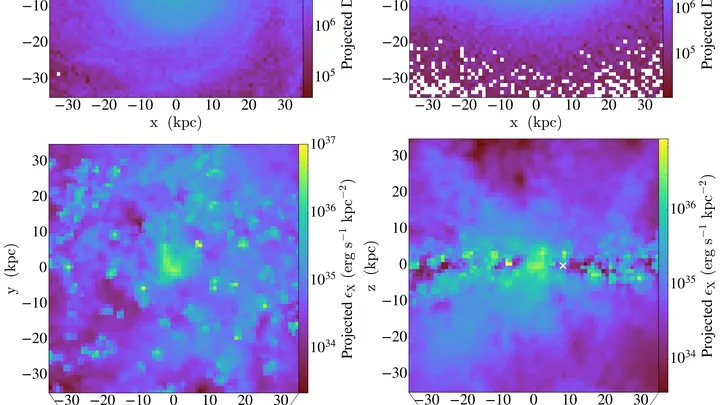
Around our Galaxy, like an invisible crown, stretches a tenuous cloud of gas heated to millions of degrees. It is called the galactic halo. Seeing this glow directly is difficult: it emits soft X-rays that are absorbed by Earth's atmosphere.
Titan is a cold world with methane lakes and a dense orange atmosphere. But beneath the icy crust, warm puddles may hide, formed after meteorite impacts. In such a puddle, like a chemical flask the size of Selk Crater, simple gases from the air, hydrogen cyanide and acetylene, mix.
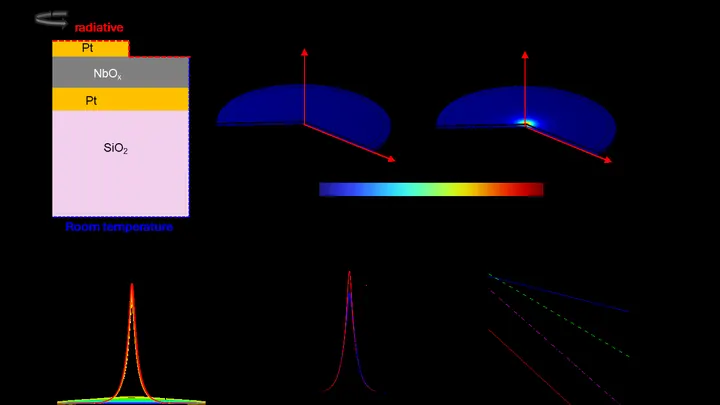
A memristor is a resistor with a memory: after the current is turned off, it retains its resistance. Inside, a thin film of metal oxide is sandwiched between two metal electrodes. When a strong current is first passed through the device, conductive filaments of oxygen vacancies form in the oxide, and the resistance drops sharply.
A world that for years refused to show its face. Planet GJ 1214 b is exactly such a case. It is larger than Earth but smaller than Neptune, and its dense envelope made the atmosphere invisible to telescopes: starlight passed through it without leaving clear traces. But astronomers' persistence and a new sensitive instrument provided the first clue.
An ordinary transistor in a phone is made in a vacuum chamber, where atoms are deposited layer by layer. Expensive and slow. But indium oxide can be printed like ink — from a drop of liquid metal that, in air, coats itself with a thin oxide film.
The authors took indium, melted it, and rolled it over a substrate at 250 degrees.
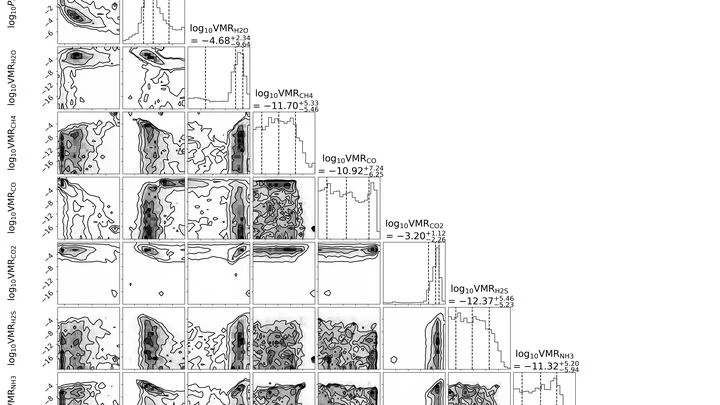
Light from a distant star, passing through the atmosphere of planet K2-18b, left unusual "fingerprints" in its spectrum. Astronomers spent 420 hours collecting this light with the James Webb Space Telescope and split it into colors, like a rainbow.
In its youth, our Sun radiated about 30% less energy than it does today: this faint young Sun paradox long troubled planetary scientists: with such a heat deficit, Earth's oceans should have frozen, yet geological evidence says otherwise.
Titan, Saturn's largest moon, is wrapped in a thick orange haze. It's made of hydrocarbons and other organic molecules that are born when sunlight breaks apart methane and nitrogen in the upper atmosphere.
The gas in a galaxy glows like a neon sign, and by the color of that glow, astronomers can tell how hot it is. The logic is simple: the more heavy elements (which astronomers call metals) in the gas, the better it cools. So galaxies rich in metals should have cooler gas. But new observations show the opposite.
In a blazing foundry, any ice cube would vanish instantly. But tucked inside a thick mitten, it survives. Nature pulled a similar trick in the planetary nebula NGC 6302.
When a chef prepares a dish, not only the proportions of ingredients matter but also their total amount. Two pies with the same sugar-to-flour ratio but made from different batch sizes will turn out differently. So it is with disks around young stars: carbon and oxygen are the key 'spices,' and their absolute amounts change the look of the cosmic 'kitchen' no less than their ratio.
In a cloud where massive stars are being born, there is a hot, dense core. Like a crowded kitchen where the heat of the stove makes smells evaporate, here the warmth from young stars evaporates molecules from the surface of cosmic dust grains.
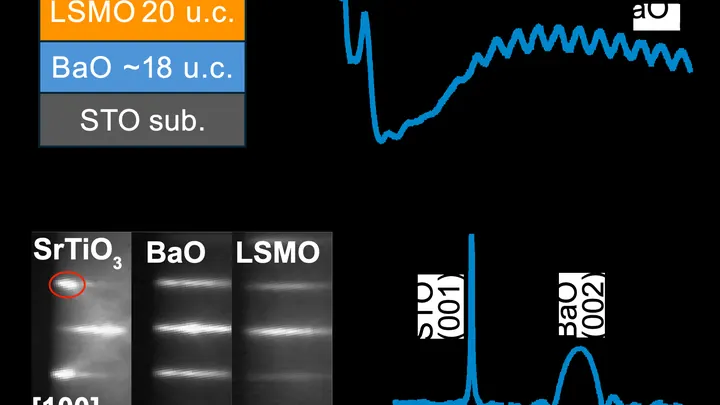
A thin film of a complex oxide is like a transfer tattoo: you need to carefully peel it off one surface and stick it onto another without tearing it. Previously, water-soluble layers were used for this, but they either dissolved too slowly or damaged the film itself. Now a new 'glue' has been proposed: barium oxide. It disappears in water within minutes, leaving the film intact.
In the dark, cold clouds where stars are born, dust grains are covered with an icy crust. Across this crust, like on a winter road, individual atoms wander slowly. Calculations show that it is precisely these wandering oxygen and nitrogen atoms that kick off the assembly of the HNSO molecule — a compound of hydrogen, nitrogen, sulfur, and oxygen.
In stellar nurseries, massive stars are not born alone but in pairs. Two stars orbit a common center, and the more massive one expands first and begins to shed its outer layers. Some of this material doesn't escape into space but flows onto the companion, like water from an overflowing cup into a cup held beneath.
A crystal one atom thick is like a sheet of paper you can write on with electricity. Such a material promises to become the foundation for tiny, fast microchips. But before putting it into production, you need to know exactly what it's made of. And that's where the usual formula falls apart.
Titan, discovered by Christiaan Huygens in 1655, resembles a canvas that is constantly being repainted. Impacts from cosmic dust and asteroids leave crater marks on it. But an invisible artist, the moon's own forces, time and again covers everything with a fresh layer, erasing old strokes.
An oven with three racks, each baking a different dish: that's the image that comes to mind when you look at the galaxy I Zw 18. The top rack is blazing at 21,200 kelvins, the middle one at 17,290, and the bottom at 16,170.
In a cold gas cloud right at the center of our Galaxy, designated G+0.693-0.027, hides a true chemical laboratory. There, far from stars, on the surfaces of tiny dust grains, about the size of smoke particles, atoms stick together into molecules, like dough on a kitchen counter.
In every leaf, in the light, a factory works that splits water into oxygen and hydrogen. The oxygen goes into the air we breathe, and the plant uses the hydrogen for food. The heart of this factory is a protein complex with four manganese atoms and one calcium atom.